Resources and the regroup phase in Star Wars: Unlimited
On this page
In Star Wars: Unlimited, there is no independent phase called the "resources phase." Resources are prepared at two points: when setting up the game, you place two cards from your hand face down, and during the rearrangement phase of each round, you may place an additional card from your hand face down as a resource. The normal choice during rearrangement is optional. Cards converted into resources are no longer available for regular play, unless a specific ability explicitly allows interaction with that zone. To avoid running out of playable cards, decide which card to convert after seeing the two cards you draw during rearrangement and before preparing the exhausted cards.
How the Resources Zone Begins
The official rulebook explains that after setting up base and Leader, each player draws an initial hand of six cards. A full mulligan is allowed: return your entire hand to the deck, shuffle, and draw six new cards that you must keep. Once your hand is finalized, each player selects two cards and places them face down as resources. This means you begin the action phase with fewer cards in hand, but with two resources available to pay costs. Cards are not chosen at random; you decide which cards from your hand will sacrifice their normal use.
The initial decision resembles an investment. A costly card that you won't be able to play soon might be a reasonable resource, but if your strategy depends on it later, you might prefer to keep it. A cheap card that fits your first action might be more valuable in hand than face down. Before placing the two cards, review the cost of your first plays, the type of unit you want to deploy, and the Leader ability you plan to activate. A hand full of expensive cards might require protecting the only cheap card, even if it's less noticeable.
The Correct Order of Rearrangement
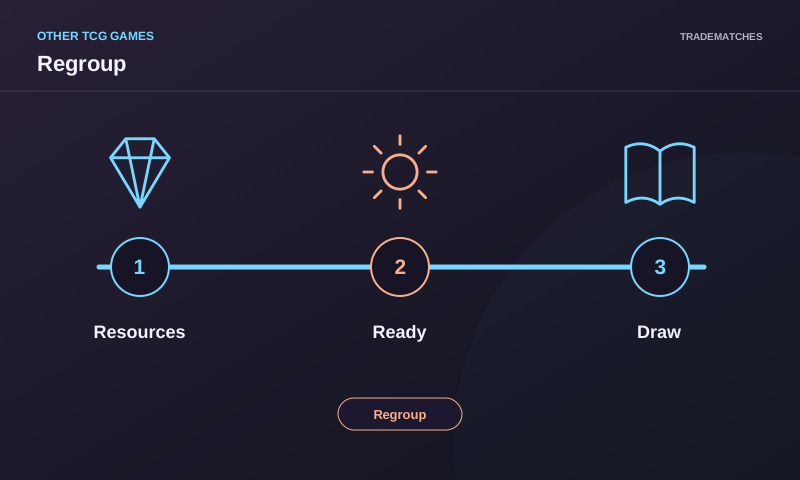
After the action phase, when both players have passed, comes the rearrangement phase. According to the official explanation, its standard steps are draw two cards, optionally place one card as a resource, and prepare exhausted cards. Following this order changes your decision: you first see what you drew, then decide whether to convert a card from your hand into a resource. Do not declare a card before drawing or prepare exhausted resources as if it were a step that occurs during every action. Both players follow the round sequence.
The option to place an additional resource can be rejected. There is no general obligation to convert a card each round. The guide recommends doing so during early rounds until you reach the costs you need, but this is a strategic suggestion, not a rule forcing you to lose your last useful card from hand. If you already have enough resources for your immediate plan, keeping a response or a unit might be better. If you only have two resources and several high-cost cards, skipping the option delays your most powerful plays.
After deciding on a resource, exhausted cards are prepared, including resources, units, and Leader when applicable. The next round begins with resources available again, unless a specific effect states otherwise. Do not confuse "exhausting a resource to pay" with discarding it: normally, it remains face down in its zone and is re-prepared. The total number of resources determines how many cards you can pay during a round, but how you alternate actions with your opponent also matters.
How to Pay a Card's Cost
When playing a card, you exhaust a number of available resources equal to the cost you must pay, taking into account any applicable modifiers. Once exhausted, those resources cannot be used again for another card until they are re-prepared or an effect allows it. The official rulebook illustrates costs in the top-left corner and shows the physical rotation of resource cards. Cards placed face down are not spent or discarded simply because a cost is paid—the payment temporarily uses their availability.
For example: you begin a round with four prepared resources and want to play two cards costing three and two. Even though the total number of cards in hand is small, the five resources needed exceed the four available. You'll have to choose a different sequence, obtain an additional resource, or wait. If instead you play two cards costing two each, you can pay both, provided the rest of the game conditions and opponent responses allow it. The printed number is not the only relevant factor: certain aspects outside of your base and Leader impose a cost penalty, and some abilities modify the cost.
Face-Down Resource Does Not Mean Identity-Less Card
Normally, a resource is a card placed face down whose normal text is not used. This means any card chosen can be used to pay, regardless of its original type, and hides from your opponent what you've reserved. However, the resources zone has special interactions with certain cards and sets. The keyword Smuggle, for example, allows playing certain cards from that zone while fulfilling their own conditions and cost. Do not convert the general rule "I can't play it" into an absolute prohibition when a card's text establishes an exception.
Conversely, do not assume that a card with a useful ability in the field continues to produce that ability while it is face down as a resource. A unit converted into a resource is not deployed on the battlefield; an event card placed there does not resolve simply because it was paid with. When an effect allows you to look at, reveal, or play resources, follow its exact text. The original card's name does not change the cost it pays when face down, unless a specific effect states otherwise.
When It Makes Sense to Place an Extra Resource
Plan ahead for your next round. What is the most expensive card you genuinely want to play? How many resources does the Leader's epic ability require? Do you want to make two medium plays instead of one major one? If the answer requires more resources than you currently have, placing one now could be decisive. Don't focus only on the most expensive card in your deck; a cost of seven you don't currently hold might be less urgent than the possibility of combining two cards costing three in the next round.
The other half of the decision is opportunity cost. Every card sent face down loses its status as a normal playable option. If your hand empties, an extra resource might give you payment capacity you can't otherwise use. If you have many cards in hand and several serve the same function, converting the least useful one usually causes less harm. Aggressive decks may value playable cards now more; control plans may require reaching high resource levels to respond in future rounds. None of these approaches eliminates the optional rule.
Resource acceleration cards add a third path. The official guide mentions effects like Resupply or Superlaser Technician that increase resources outside the normal rearrangement step, under specific conditions. Do not apply the rule "one per round" to an effect that explicitly places additional resources. At the same time, check whether that resource is exhausted or prepared: the difference determines whether you can use it immediately. Reading the specific card is essential for calculating the sequence.
Common Mistakes When Learning
The first is looking for an autonomous resources phase. The resources step is part of the rearrangement phase and also includes an initial choice. The second is placing a card before drawing two during rearrangement; new information can change your decision. The third is believing that placing a resource is mandatory every round. The fourth is discarding a resource when it is exhausted to pay; normally, it remains face down. The fifth is forgetting the final preparation and starting the next action phase with all resources turned face up.
Another mistake is treating cards converted into resources as an additional hand from which you can freely play. Unless explicitly enabled, they are intended only for paying costs. It is also common to overlook aspect penalties when calculating whether a card is playable. If the actual cost differs from the printed number due to an uncovered aspect, you might need more resources than expected. Before committing to a play, count prepared resources, applicable cost, and any modifying effects; do not base your decision on the total number of face-down cards if some are already exhausted.
A Method to Decide in Ten Seconds
When reaching the resources step, mentally group your hand into three categories: cards you want to play in the next round, responses you need to keep, and cards whose cost or function doesn't fit your upcoming actions. Then check whether adding a resource opens a specific play. If it doesn't open any and leaves you without a response, you can skip. If it does, choose the card that least harms your plan. You don't need to predict the entire game; it's enough to identify the next decision your resource economy allows or blocks.
When practicing with a new deck, note the rounds when you ended up with cards you couldn't pay and the rounds when you had excess resources but no useful card. The first pattern may indicate that you're skipping too many resource steps or holding too many expensive cards; the second may indicate that you're sending too many cards face down. This small record provides more useful insight than a rigid rule like "always place a resource" or "stop placing them on the fifth round."
Frequently Asked Questions
Can I choose not to place a resource during rearrangement?
Yes. The standard step allows placing one card from your hand face down as a resource, but it is optional. Consider the cost of losing that card against the payment capacity you gain.
Do I draw cards before or after choosing the resource for the round?
First, you draw two cards. Then you can choose one card from your hand to convert into a resource. Finally, exhausted cards are prepared, following the general sequence described in the official rulebook.
Is the card used as a resource discarded when paying?
No, under normal procedure. It is exhausted to pay and remains in the resources zone. It is later re-prepared. A specific effect may change its destination, so read its text if an exception appears.