Smuggle in Star Wars: Unlimited
On this page
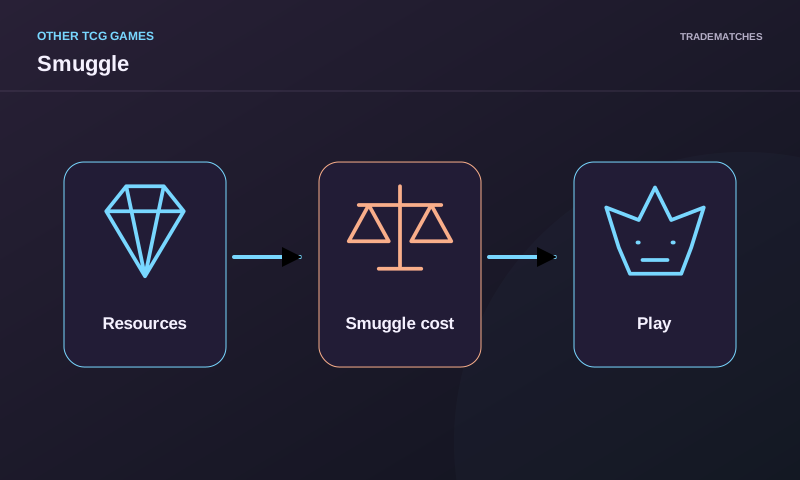
Smuggle in Star Wars: Unlimited allows you to play a card from your resource zone by paying the cost indicated next to the keyword, instead of its printed cost. When playing it, the resource leaves the zone and is replaced by the top card of your deck, placed face down and exhausted. This mechanic turns a hidden resource into an actual play, but still follows cost, timing, and card type rules. It does not equate to drawing the resource into your hand.
What a card in the resource zone represents
A resource is a card placed face down in the resource zone. Normally it is used to pay costs and its identity remains hidden from your opponent. A card with Smuggle retains that ability while functioning as a resource, even though its face with text is not visible to the opponent. If you decide to use it, you reveal the card as part of playing it according to the procedure. Your opponent then sees what you converted into a resource.
The resource zone is not a second hand available to all cards. You can only play from it when a rule or ability permits it; Smuggle grants that permission to the card that has it. Other face-down cards remain ordinary resources, even if revealing them would be useful. This restriction is the foundation of the mechanic: you can save a future option, but only cards designed for that purpose leave the zone in this way.
How to read "Smuggle [cost]"
The number or combination that follows Smuggle is the alternative cost to play that card from resources. It does not automatically add to the printed cost nor is it paid as a surcharge after playing: it is used in place of the printed cost. Normal cost rules continue to apply, including penalties for applicable aspects. The card may have multiple Smuggle abilities; each is treated independently.
Example: A unit has a printed cost of 3 and Smuggle [5]. If it is in your hand and you play it normally, you look at the cost 3 and applicable adjustments. If it is face down as a resource and you choose Smuggle, you look at the cost 5 and its adjustments. You cannot choose 3 to use Smuggle unless another rule allows it. Separating the two paths prevents paying the more favorable number without respecting the origin zone.
The procedure for playing it
Using Smuggle is a modified version of the "play a card" action: the essential difference is that the card starts in the resource zone, not in your hand. You must be able to perform the action at that moment, identify the card you are playing, and pay its Smuggle cost according to the rules. If it is a unit, it enters the corresponding arena; if it is an event, it resolves and then goes to the owner's discard pile; if it is an upgrade, it is played according to its requirements.
Smuggle does not turn a unit into an event or an event into a unit. It also does not grant Ambush or allow you to ignore targets or restrictions. If the card has a "When Played" ability, playing it via Smuggle counts as playing it and can trigger that ability. The procedure may include other effects that trigger upon entering play. For a specific card, review its text and the rules for its type, in addition to the keyword.
Can you pay part of your own cost?
A common oversight is that the card remains in the resource zone while paying the Smuggle cost. Therefore, it can be exhausted to help pay its own Smuggle cost, if it is prepared and other rules allow it. The card has not yet left the zone at that moment. This does not mean the cost is reduced: you still need sufficient resources; simply one of them can be the card you are about to play.
Example: You have several prepared resources, including the card with Smuggle. When paying, you can exhaust that same card as one of the resources if allowed, and complete the payment with the others. Afterward, it leaves the zone to become the played card. The exhausted state of the substituted resource does not make the new replacement card enter ready: the rules state that the new resource enters exhausted.
The replacement with the top card of the deck
When you play a card using Smuggle, you replace it in the resource zone with the top card of your deck. That new card is placed face down and exhausted. You do not choose a card from your hand and do not search for the one you prefer in the deck, unless a different effect changes the procedure. In practice, you normally maintain the same number of resources, but you change the identity of the resource used with an unknown card.
The rules treat the played card and the new resource as simultaneous entries into play during the relevant procedure. You do not delay the replacement to try to use the new resource in paying the Smuggle cost that created it: it enters exhausted and the cost was already being paid. The correct order also helps resolve "When Played" abilities and effects that observe entries into play. An informal sequence could result in extra resources or invalidate a valid trigger.
What happens if the deck is empty?
The rules allow playing a card via Smuggle even when the deck is empty. In that case, the card leaves the resource zone and is not replaced, because there is no top card. It is not considered that you attempted to steal a card from an empty deck through this procedure, so no damage is applied to your base associated with an impossible steal. This is an important exception to the simplified idea that Smuggle "always maintains" the number of resources.
Before announcing the play, calculate whether you will have enough resources for future turns. If the deck is empty, the resource used is permanently lost as a resource when the card is played. This may be a strategically sound decision, but it is not free. The rule describes legality and outcome; it does not guarantee it is the best decision. It also does not grant you an additional card to replenish the zone from another source.
Unit, event, or improvement
The type of card determines what happens after playing it. A unit played via Smuggle enters exhausted, like a regular unit without an applicable exception. An improvement is attached legally according to its text. An event is played and resolves, then goes to the owner's discard pile after resolution. "When Played" abilities function because the card was actually played; it was not simply "placed into play" by an external effect.
It also matters where the card would have been if a play failed before completion or if an effect modifies the cost. The official procedure for "playing a card" has steps and restrictions that remain valid, with the origin zone modified. Do not attempt to resolve a rare interaction using the analogy of "pulling it from resources" alone. Identify at which step the cost is determined, when it is paid, and when the card enters play to apply the correct effects.
Hidden information and planning
Your opponent does not know the identity of a face-down resource simply because it has Smuggle. This allows you to save a threat or response without revealing it immediately. However, you also cannot move any card from resources to your hand if you change your mind: the opportunity depends on the printed ability. If you eventually play that resource, the information is revealed at that moment. Decisions to hold and pay are based on the Smuggle cost, not on a hypothetical normal cost.
In a physical game, keep all resources face down clearly and indicate which one you are using when announcing the play. Revealing before confirming that a legal action exists may disclose unnecessary information. How errors are handled in a tournament event may depend on its tournament rules; to avoid disputes, announce the cost, show the card when playing it, and execute the replacement exactly as the rules indicate.
Common mistakes
The first is paying the printed cost instead of the Smuggle cost. The second is adding a card from your hand as a replacement instead of using the top card of the deck. The third is placing the new resource as prepared when it must enter exhausted. The fourth is believing you cannot exhaust the own resource to pay its Smuggle cost. The fifth is applying damage to your base due to an empty deck when Smuggle did not attempt to steal. Each mistake materially changes the game.
A five-step check avoids these errors: confirm the card has Smuggle; verify you can play its type now; calculate the alternative cost with its adjustments; pay with legal resources; play the card and place the top card of the deck face down and exhausted, if it exists. If the card has "When Played", resolve that ability at the appropriate time. This schema helps learn the keyword without confusing it with the general procedure of adding resources during the reorganization phase.
When to review the full rule
Interactions with aspects, cost reductions, cards that alter the resource zone, or abilities that trigger upon playing may require the detailed text of the Comprehensive Rules. The July 2026 edition of Star Wars: Unlimited Comprehensive Rules explains Smuggle within the keyword section. Use it as a reference to resolve a specific dispute. The printed card provides the cost and effect; the rules explain how they apply at each step.
As a summary, Smuggle transforms a hidden resource into a played card by paying an alternative cost, normally without permanently reducing the number of resources because the deck provides an exhausted replacement. If the deck is empty, that replacement does not occur and no failed steal is triggered. The keyword is an additional play option from resources, not a general permission to use any face-down card from that zone.
Frequently Asked Questions
Can I use a card with Smuggle to pay its own cost?
Yes, if that resource is prepared and can be exhausted to pay: it remains in the resource zone during the payment.
Does the resource that replaces the card enter ready?
No. The top card of the deck enters face down in resources and exhausted when it replaces a card played via Smuggle.
Does Smuggle cause damage to my base if the deck is empty?
No. You can play the card, but it is not replaced; the procedure does not count as an attempt to steal from an empty deck.
Official Source: Star Wars: Unlimited Comprehensive Rules v8.0, July 2026, Smuggle section.