Sentinel in Star Wars: Unlimited
On this page
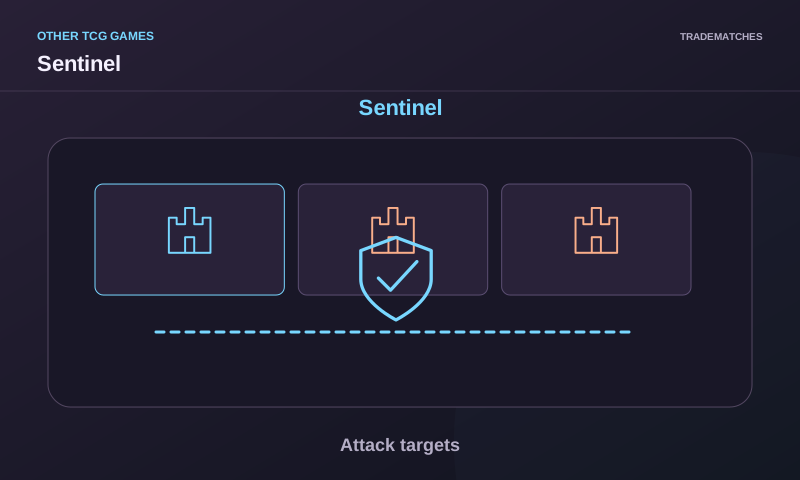
Sentinel in Star Wars: Unlimited forces attackers in the same arena to choose an enemy unit with Sentinel before attacking the base or an enemy unit without Sentinel. The key phrase protects objectives within the arena where the unit is located, not the entire board. If there are multiple units with Sentinel in that arena, the attacker may choose which one defends. Understanding arena scope and actual selection avoids illegal attacks.
What Does Sentinel Protect?
The regulation text states that units in that arena cannot attack your units without Sentinel or your base while an enemy unit with Sentinel forces them to pass through it. The protection applies to unit attacks; it is not a general shield that prevents events, abilities, or indirect damage from affecting those objectives. A unit with Sentinel may have other abilities, but the keyword itself modifies the choice of target for an attack.
Example: You control a unit with Sentinel in the land arena and another unit without Sentinel also in land. If a rival unit declares an attack and has no applicable exception, it must attack a ground unit with Sentinel. It cannot choose your normal unit or your base. In contrast, a rival unit in the space arena is not blocked by that land Sentinel; it checks the Sentinel units in the space arena for its attack.
The Arenas Matter
Star Wars: Unlimited separates land and space units. In a standard attack declaration, the attacker chooses an enemy unit from their own arena or the opponent's base. Sentinel is checked in the attacker's arena. A ground unit with Sentinel does not protect a space unit; a space unit with Sentinel does not force a land attacker to fight it. The base is shared as a target, but the restriction comes from the Sentinel in the arena from which the attack originates.
This is a common source of errors when looking at a large board. It may seem that the base has "a guard," but that guard only covers the path of its own arena. If both players have units in both arenas, each attack is decided from its specific arena. A special ability may allow arena interactions; in that case, read its text and check how it modifies the selection. The basic Sentinel rule does not automatically extend from one arena to another.
When Is It Checked?
When an attack is declared, the attacker exhausts and is checked to see if the defender has units with Sentinel in the attacker's arena. If such units exist, one of them must be the defending unit, unless the attacker can ignore Sentinel. The current state of abilities matters: a unit that gained Sentinel through an upgrade or an active effect counts; a unit that lost Sentinel before the check does not impose that restriction.
Suppose an upgrade grants Sentinel to a unit. As long as the upgrade remains attached and its effect is active, the attacker must consider it. If the upgrade is defeated before the attack and the unit loses Sentinel, it no longer blocks. Do not decide the target based on how the board looked during a previous action; review the state at the time of the choice. If the ability enters or leaves during the attack, consult the precise moment of the attack in the full rules.
Multiple Units with Sentinel
If you control two units with Sentinel in the same arena, the opponent is not required to attack the oldest, the strongest, or your preferred unit. They may choose any of those units with Sentinel as the defender, unless another restriction changes the choice. Your units without Sentinel and your base remain protected from that attacker by the keyword. Accumulating multiple Sentinel units increases obstacles, but it does not allow you to choose which one receives each attack.
Example: You have a Sentinel unit with high health and another with low health in land. A rival land attacker may choose the one with low health if it is a legal target. After defeating it, if the other Sentinel remains and the rival has another land attack, it must be considered. The obligation of Sentinel is not "used up" by one attack during the phase. The restriction is re-evaluated on each attack.
Sentinel Does Not Force an Attack
The keyword modifies what you can attack if you choose to attack with a unit from that arena. It does not force the opponent to declare an attack nor does it prevent them from playing a card, activating an ability, or passing. If it's not advantageous to fight the Sentinel, they may develop the board or find another legal way to deal with it. It also does not turn the Sentinel into an automatic attacker: its controller decides its own actions according to normal rules.
A player may attempt to defeat the Sentinel with an event or ability, or attack through the other arena if there is no Sentinel blocking it. These paths do not mean that Sentinel fails; they show its exact scope. Saying that "it protects the base" is a useful shorthand only if you remember "against attacks from units in its arena." In a beginner explanation, adding that phrase avoids false expectations.
Sentinel on a Deployed Leader
A deployed leader that functions as a unit in an arena may have or gain Sentinel. While it is in that arena with the keyword active, the same selection restriction applies to attackers from that arena. The presence of the leader does not turn the Sentinel into global protection for all of the player's units. The location where the leader was deployed determines which arena it covers.
Some cards grant Sentinel to other units or have conditions for retaining it. To resolve the situation, verify the current status of the leader as a unit, its upgrades, and any temporary effects. A leader that is still in its base zone and not functioning as a unit in an arena does not act as a Sentinel for that arena simply because one side of the card has that keyword. The condition of being in play as a unit is relevant.
The Saboteur Exception
An attacker unit with Saboteur can ignore enemy Sentinel units in its arena when choosing what to attack. It may select a legal unit in that arena or the base, even if there are Sentinel units present. Units with Sentinel do not lose the keyword for the entire game; the attacker with Saboteur ignores it during their choice. Other attackers without this permission remain subject to the restriction.
Example: Your opponent controls a Sentinel and a support unit in land. Your attacker with Saboteur can choose the support unit or the base. Another land attacker without Saboteur must select a Sentinel if attacking and one remains. The ability does not eliminate the guardian nor opens a permanent path for the rest of the turn. Cards may grant specific permissions; read their text before applying the Saboteur rule exactly.
"Cannot Be Attacked" vs. Sentinel
The rules address a less intuitive case: if a unit has Sentinel and also an ability stating "cannot be attacked," the Sentinel prevails in that interaction and the unit can still be attacked. The rule avoids creating an impossible block in which the attacker must choose it but cannot. Do not generalize this priority to any conceivable restriction; apply the official clarification to the specific case described.
The detail shows why reading two phrases in isolation is insufficient. A card's ability may seem to make the unit invulnerable as a guardian, but the rules establish the specific relationship. In a competitive game, consult the current version of the Comprehensive Rules when two restrictions appear incompatible. The Sentinel section provides this explicit answer and allows play to continue without relying on personal interpretation.
Sentinel and Effects That Do Not Attack
An event that selects a unit or deals damage according to its text is not a unit attack simply because it could defeat a Sentinel. The keyword does not automatically redirect events to its bearer. The same applies to abilities that affect the base without declaring an attack—you must follow the text of those abilities. Only an effect that explicitly states otherwise can extend protection beyond normal attacks.
To verify a play, first ask whether the action is "attacking with a unit." If the answer is no, Sentinel likely does not modify the choice. If the answer is yes, ask which arena the attacker is in and whether there is an active enemy Sentinel in that arena. If there is, choose one of them unless permitted to ignore it. This sequence is more reliable than the informal rule "there's a tank on the board."
Defending Without Confusing Initiative
Sentinel acts during the attack action that the active player has already chosen; it does not grant the defender an extra action. The attacker still decides whether to attack and, among legal Sentinel units, which one to target. Afterward, the attack proceeds normally: abilities that trigger on attacks, damage, and possible unit defeat. If the Sentinel survives, it can continue restricting future attacks.
Placing a Sentinel in an arena may force the opponent to spend resources or attacks before reaching the base, but the actual effectiveness depends on its health, upgrades, and effects. A unit with low health may be defeated by a single attack; another may withstand several. The rule defines the choice, not guarantees that the base remains undamaged throughout the round. To evaluate a game, examine the actual board and remaining actions.
Summary and Quick Check
Sentinel forces attackers in the same arena to choose an enemy unit with Sentinel instead of the base or an enemy unit without Sentinel. If there are multiple, the attacker chooses one. Saboteur allows that attacker to ignore the restriction when selecting a target. It does not affect the other arena or events that are not attacks. Before declaring a target, verify the arena, the current presence of Sentinel, and any special permissions of the attacker.
Frequently Asked Questions
Does a Land Sentinel protect against Space Attacks?
No. The restriction is checked in the attacker's arena. A space attacker checks enemy Sentinel units in the space arena.
Who Chooses Between Two Units with Sentinel?
The attacking player may choose any of the enemy units with Sentinel in that arena that is legally defendable.
Does Saboteur Destroy or Disable Sentinel?
No. It allows that attacker to ignore Sentinel when selecting a target; other attackers still must respect it.
Official Source: Star Wars: Unlimited Comprehensive Rules v8.0, Attack, Sentinel, and Saboteur sections.