Overwhelm vs Saboteur in Star Wars: Unlimited
On this page
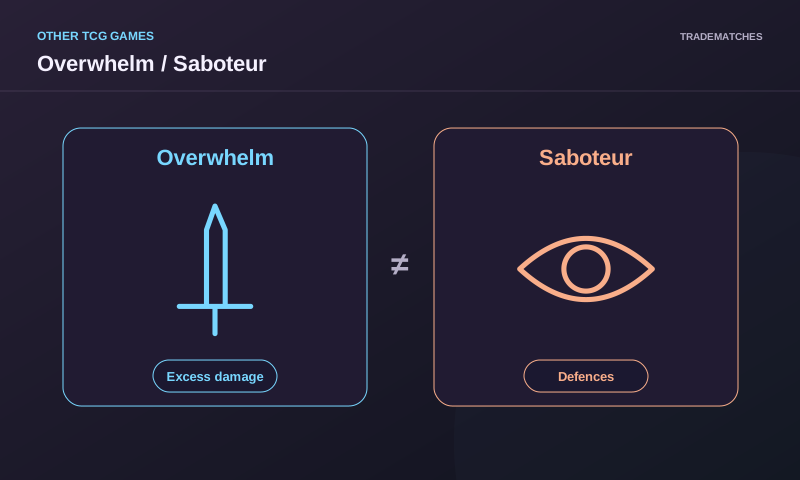
In Star Wars: Unlimited, Overwhelm and Saboteur help an offensive unit overcome defenses, but they solve different problems. Overwhelm can deal excess damage to the opponent's base after fighting a unit. Saboteur allows you to ignore Sentinel when choosing a target and defeats the defender's Shield tokens when attacking. Neither simply means "direct damage." To resolve a play, first determine who you can attack, then what happens with the Shields, then calculate the combat damage, and finally check if any excess applies to the base. Skipping this order often results in base damage that never actually belonged to the base.
Overwhelm: excess after the defender
Overwhelm applies when the attacking unit inflicts damage on an enemy unit and there is a surplus beyond what is needed to defeat it. This excess is dealt to the opponent's base according to combat rules. If a unit with five power attacks a defender with three health, with no prior damage or prevention, a simple resolution might result in three damage points needed to defeat the defender and two excess points going to the base. Actual values change with marked damage, stat modifiers, and other effects; the example illustrates that a defender exists first, and then the excess is calculated.
If the defender already has damage, do not automatically add its printed health as if it were unharmed. Calculate how much damage is needed to defeat it in its current state. If a unit with five health has two damage marks, it needs three more to reach the defeat threshold, unless health changes or prevention occurs. A higher power unit may leave more excess. Conversely, if an effect increases its health before damage is resolved, it may reduce or eliminate the excess. The key point is not a fixed amount of damage on its own; it depends on the state during combat.
Overwhelm does not allow you to choose a base while ignoring a unit with Sentinel. It also does not activate simply because you attack a base directly: in that case, the unit already deals normal damage to the base and there is no defender from which excess damage can arise. Its value lies in the fact that a defense with a unit does not necessarily absorb all of the attacker's power. If the opponent must deploy a Sentinel, Overwhelm can punish that defense, but the legal target choice remains governed by the attack.
The important exception: Defender's Shield
The combat rules state that if a defender's Shield prevents damage from an attacker using Overwhelm, no excess damage is dealt to the base from that attack. Do not calculate the excess as "power minus zero" and send it intact to the base. The Shield prevented the relevant damage; therefore, the interaction has a specific rule. The shield token normally defeats when fulfilling its function, so a subsequent attack may find the defender unprotected. The power of Overwhelm does not automatically convert a Shield into a partial shield.
There is a difference between "the defender survives because it had a lot of health" and "the defender did not take damage because its Shield prevented it." In the first case, you can calculate how much damage you dealt and whether excess remains; in the second, the damage was prevented and the rule blocks that excess. This distinction is useful when evaluating whether it's worth attacking first with a small unit to consume Shields and save the Overwhelm unit for later. The answer depends on available actions and whether the opponent can respond.
Saboteur: target selection and Shields
Saboteur has two parts in the rules. When attacking, the unit can ignore the restriction of enemy units with Sentinel when choosing what to attack in its arena. Additionally, when attacking a unit, Saboteur defeats all Shield tokens attached to the defender before combat damage is applied. You do not need to choose between these two parts as if they were exclusive modes; they apply as appropriate to the situation. If there is no Sentinel, the first part only changes the choice. If the defender has no Shields, the second part defeats no tokens.
"Ignoring Sentinel" does not mean ignoring all other conditions for declaring attacks. The unit must be in a position to attack, the target must be legal under general rules, and the arena must be respected unless text otherwise states. A land unit with Saboteur does not thereby gain general permission to attack space units. The key phrase removes that specific limitation of Sentinel during target selection; it does not rewrite the entire attack system.
The effect on Shields is easier to remember as a pre-combat action. If the defender has two Shield tokens, Saboteur defeats all of them, not just the first. Then combat damage is resolved with the updated power and health values. Experience, normal upgrades, and prior damage still count; Saboteur does not erase them unless another text states otherwise. If the attacker decides to go straight to the base, there is no defender unit whose Shield tokens are defeated by this part.
Example with Sentinel on the board
Imagine an enemy unit with Sentinel in your own arena and a second unit without Sentinel. A normal attacker might have to attack the Sentinel if it chooses a unit from that arena, according to the applicable restriction. An attacker with Saboteur can ignore the Sentinel and choose the other unit or a target allowed by general rules. If the chosen target has Shields, Saboteur defeats those Shields before damage is calculated. If the target does not have Shields, you have only taken advantage of the selection flexibility.
Switch the attacker to a unit with only Overwhelm. Now you cannot skip the Sentinel using that keyword. You attack the legal target, and if you deal more damage than necessary to defeat it, the excess can reach the base. If that Sentinel had a Shield that prevented the damage, no excess damage from Overwhelm will apply to the base. The comparison reveals the difference: Saboteur asks "Who can I choose and which Shields do I remove?" Overwhelm asks "What happens to the power that exceeds the defense?"
If a unit has both keywords
A unit can have both Overwhelm and Saboteur at the same time, by its own text or by effects. In that case, Saboteur helps choose the target and, if attacking a unit, defeats its Shields. Afterward, Overwhelm can apply excess damage if its conditions are met. It is a powerful combination precisely because Saboteur prevents the defender's Shield from blocking the attack, the interaction that normally would prevent excess. However, it does not guarantee base damage: if the defender has sufficient health, if the attacker fails to deal damage, or if a response changes the combat, no excess may remain.
The sequence must be resolved carefully if there are "On Attack" effects, upgrades, or responses. Declare a legal target, process attack effects and Shield removal according to game order, resolve any response windows, and reach combat damage with the updated state. Do not remove Shields from future damage while there is still a card in the stack capable of modifying the target or defeating a unit. If an interaction is not covered by the basic examples, consult the current rulebook and the specific card clarification.
How to choose which attacker to use first
When facing a large Sentinel with Shields, an attacker with Overwhelm may consume the protection but might not deal base damage in that first strike. A Saboteur can avoid that Sentinel or remove Shields from a chosen defender. If you have both units, consider which action opens better the next step: remove Shields, eliminate a threat, damage the base, or save power for later. Attacking with everything immediately may give the opponent the chance to use an efficient response; alternating actions per turn allows you to observe what happens before committing your best attacker.
In deck building, Overwhelm often rewards high power and situations where the opponent defends with small or damaged units. Saboteur rewards the ability to target specific threats despite Sentinel and dismantle protection via Shields. Do not conclude that one keyword is "better" in general: it depends on the resistance of the units you expect to face, the number of Shields, your other sources of damage, and whether your plan requires attacking the base or controlling the board.
Common mistakes
A common error is applying Overwhelm to a direct base attack as if it doubles the damage. Another is allowing Overwhelm to ignore Sentinel. Excess damage is also often calculated by going through a Shield that prevented damage, when the rules prohibit it. With Saboteur, a common mistake is thinking it defeats all enemy Shields in the field; it only affects the Shields of the defender of that attack, not those of other units. And although it ignores Sentinel, it does not change the arena or allow attacks from units that cannot attack.
To review a disputed play, write down five data points: attacker and keywords, arena, target chosen, defender's Shields, and existing health or damage on that unit. With this, you can first verify the legality of the attack, then determine the fate of the Shield tokens, and finally calculate any excess damage. The official rules of Star Wars: Unlimited and their updates must prevail over a summary of older card collection rules when a new exception arises.
Frequently Asked Questions
Does Overwhelm allow attacking the base if there is a Sentinel?
No on its own. Overwhelm resolves excess damage after combat; it does not remove restrictions on target selection. A keyword like Saboteur may modify how Sentinel affects the attack, but you must check the text and the arena.
Does Saboteur defeat all of the opponent's Shields?
No. When attacking a unit, Saboteur defeats the Shield tokens attached to the defender of that attack. It does not remove Shields from units not defending.
Can Overwhelm damage pass through a Shield?
If the defender's Shield prevents damage from the attacker, the combat rules state that no excess damage from Overwhelm is dealt to the base. Always check whether the prevention actually applied.
Checked sources
Saboteur also interacts with Sentinel; for other attacks, compare Ambush and Raid.