SWU Entrenched: stronger units that cannot attack bases
On this page
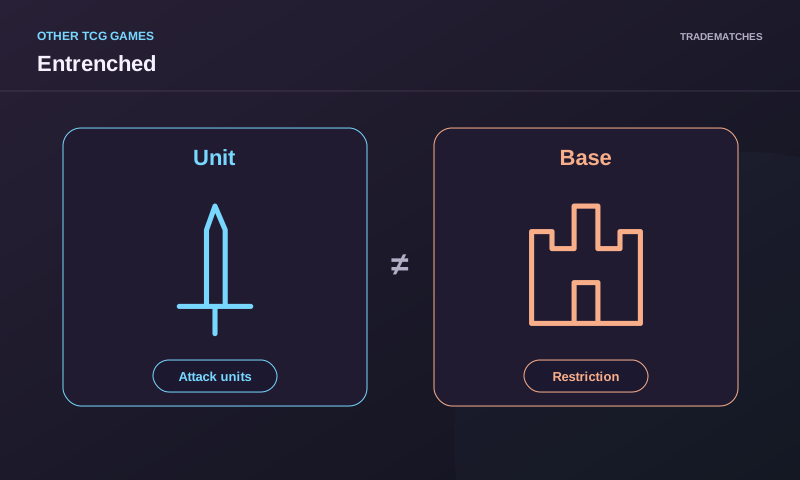
Entrenched is a Star Wars Unlimited upgrade that gives the attached unit +3 power and +3 HP while preventing it from attacking bases. It can be useful on an enemy as well as on a friendly unit. The restriction does not forbid attacking units, dealing every kind of damage, or taking other actions. Treat it as a specific card effect, not a universal status named entrenched.
Decide why you are attaching it
Fantasy Flight's official Emperor Palpatine deck article explains an intentional enemy use: attaching Entrenched prevents a threatening unit from attacking the base, while that unit must seek other legal combat targets. The bonus statistics are part of the same bargain. You make the enemy stronger in unit combat while constraining its direct base attacks.
On a friendly defensive unit, the same statistics can help it survive and win unit fights. That role does not erase the base-attack restriction when you later want to finish the game. Before playing the upgrade, decide which immediate problem you are solving and which future option you are giving up.
For example, an enemy space unit threatens your base and you have no units in its arena. Attaching Entrenched can leave it without an ordinary unit target there. If you later play a space unit, however, you have provided a legal combat target. The upgrade did not permanently disable the enemy; you changed the available target set.
Recalculate power and remaining HP separately
Use a hypothetical 2-power, 3-HP unit with one damage on it. With Entrenched and no other modifiers, its maximum HP becomes six and its power becomes five. The existing one damage is still recorded, leaving five HP before lethal damage. The upgrade did not perform an instruction to heal one damage.
Now suppose the same unit had already taken two damage. It becomes a five-power, six-HP unit with two damage, leaving four. Saying “the upgrade healed three” confuses a maximum increase with removing damage. That distinction becomes important if the upgrade later leaves and the lower maximum is restored.
| Hypothetical state | Maximum HP | Damage recorded | HP available before lethal damage |
|---|---|---|---|
| Base 3-HP unit, 1 damage | 3 | 1 | 2 |
| Same unit with Entrenched | 6 | 1 | 5 |
| Upgraded unit after 3 more damage | 6 | 4 | 2 |
| Upgrade removed while 4 damage remains | 3 | 4 | Lethal state must be checked |
These numbers are an original example. Apply real card effects and damage rules before deciding whether a unit is defeated.
“Cannot attack bases” is narrower than “cannot attack”
The attached unit can still make an otherwise legal attack against an opposing unit in its arena. Entrenched does not give it permission to attack across arenas or ignore Sentinel. It removes one class of target from its attack choices and leaves the rest of the attack rules in place.
Suppose a hypothetical ground unit with Entrenched has one enemy ground Sentinel and one enemy space unit available on the board. It cannot attack a base. Its ordinary arena and Sentinel checks still decide which unit target is legal. Do not interpret the remaining unit-attack permission as “attack any unit anywhere.”
The restriction also concerns attacking, not every possible damage instruction. A separate legal ability that deals damage to a base is not automatically an attack. Whether it works depends on its own wording and other applicable effects. Conversely, an ability instructing the attached unit to attack a base still has to respect the restriction; a fresh attack instruction is not an override merely because it comes from another card.
A powerful enemy can still be dangerous
Attaching the card to an enemy creates a tactical trade-off. A previously manageable attacker can become much better at defeating your units. If those units are providing Sentinel, resource generation or other useful effects, losing them can change the game even while your base avoids that unit's direct attack.
Work through a hypothetical board before playing it. Your base has eight HP remaining. The enemy unit has two power, and your important blocker has four HP remaining. Increasing the enemy to five power could stop base attacks but make it capable of defeating that blocker in a unit fight. The decision depends on other enemy attackers and the turns you expect to need.
In a different board with an isolated enemy space attacker and no legal opposing space-unit target, the same restriction may be much more valuable. These are situational examples, not a statistical claim about win rates or a recommendation to include a fixed number of copies in every deck.
Track the upgrade separately from its unit
An upgrade and the attached unit are separate objects with their own identity and control information. Placing your upgrade on an enemy does not mean you now control the unit. The unit's attack choices remain the opponent's decisions, constrained by the effect. The upgrade's owner is also relevant to its eventual card destination.
Read the printed ability carefully: a constant restriction on the upgrade is not automatically an ability granted with the words “attached unit gains.” An effect interacting with unit abilities, upgrade abilities or removing upgrades may therefore ask different questions. Use the current rules and card text for that interaction instead of grouping them under “silence.”
When practising, leave the upgrade visibly attached and announce the updated statistics and target restriction. A marker showing only +3/+3 can obscure the reason the unit cannot hit a base. Both the benefit and restriction should remain available for either player to verify throughout the game.
Removal changes both statistics and permissions
If Entrenched leaves the unit, re-evaluate its characteristics and attack restrictions. Losing the HP increase can leave existing damage lethal. If the unit survives and no other prohibition remains, it may again have base attacks available. Removing the upgrade is not merely a way to reduce power.
For a teaching scenario, remove the upgrade from the six-HP unit with four recorded damage in the table. The unit's maximum returns to three, so check defeat before assuming it can now attack a base. In another scenario with only one damage, it may survive and regain that attack option. The outcome depends on the current damage and remaining modifiers.
When buying a removal card to solve Entrenched, check whether it actually interacts with upgrades and whether the intended use is legal on that attachment. A card that defeats a unit and a card that removes only an upgrade can lead to different resulting boards and different opportunities for the opponent.
Frequently asked questions
Can I deliberately attach Entrenched to an enemy unit?
Yes, where the upgrade's attachment rules and any current restrictions permit. The official Palpatine deck article describes this use to restrict base attacks.
Does Entrenched heal damage already on the unit?
No. Its HP increase changes the maximum while existing damage stays recorded. Recalculate the lethal threshold if the upgrade leaves.
Can the attached unit still attack another unit?
Yes, if that attack is otherwise legal. Entrenched's restriction concerns bases; arena rules, Sentinel and other restrictions still apply.