Star Wars Unlimited Piloting: unit or upgrade?
On this page
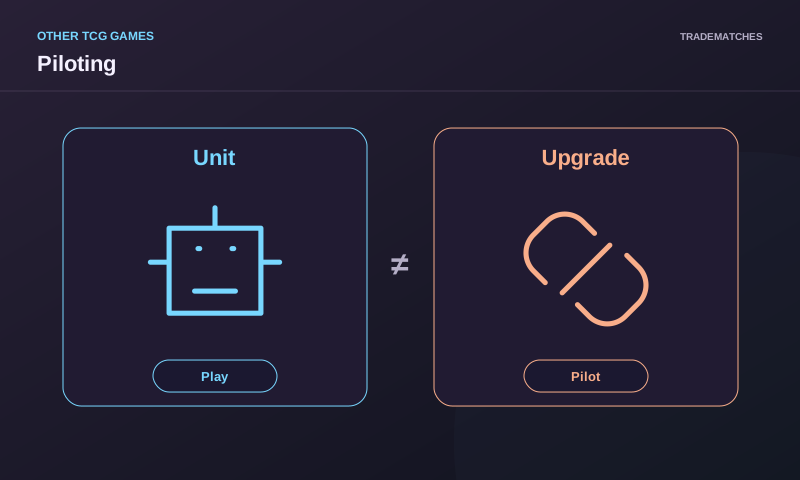
Piloting in Star Wars: Unlimited lets a qualifying unit card be played as an upgrade attached to a friendly Vehicle. You pay its Piloting cost rather than its ordinary printed unit cost, with the normal cost rules still applying. Alternatively, you can play the card as a unit through the ordinary legal procedure.
The important distinction is its current role. A pilot attached as an upgrade is not a separate attacking unit alongside the Vehicle, and its unit statistics are not automatically the bonuses it grants. This guide explains the two modes, the attachment requirements and the wording that determines which effects can play or find the card.
Two ways to use the same card
The current comprehensive rules, section 7.5.17, define Piloting. A card with the keyword offers an alternative way to play that unit as an upgrade on a friendly Vehicle that does not already have a Pilot upgrade.
When played as a unit, it functions as a unit in its appropriate arena. When played using Piloting, it functions as an attached upgrade. State the chosen mode before paying and placing the card; do not leave both players to infer it from a card positioned between zones.
The Pilot trait by itself does not invent a Piloting cost or an attachment permission. Read the actual keyword and card text. A character associated with flying in the story is also not automatically eligible to be played as a pilot upgrade.
The Piloting cost is its own payment
The number associated with Piloting supplies the alternative cost for that play. Normal cost rules still matter, including applicable aspect penalties. Do not assume that paying a smaller printed Piloting number removes every other part of the cost calculation.
Imagine a hypothetical pilot with a unit cost of four and a Piloting cost of two. If you choose the upgrade mode, begin with the relevant Piloting cost, then apply the actual cost rules and modifiers. You do not pay four plus two merely because both numbers appear on the card.
Now imagine your deck does not supply a required aspect. Check the penalty before declaring that the upgrade costs only two. A plan can fail because the final payment differs from the most visible number. Establish the whole cost before exhausting resources.
The receiving Vehicle must be eligible
The normal Piloting permission requires a friendly Vehicle without a Pilot upgrade already attached. Identify the Vehicle trait, its controller and its existing attached cards. A unit's artwork resembling a machine is not a substitute for its printed traits.
The receiving Vehicle can be in the ground or space arena if the actual card and rules permit it. The pilot's ordinary unit arena does not force every Vehicle receiving that upgrade into the same arena. Attaching is not the same action as playing the pilot as a unit.
| Question before using Piloting | Detail to inspect |
|---|---|
| Does this card have the permission? | Actual Piloting keyword or specific effect |
| Is the receiving unit a Vehicle? | Current traits and applicable effects |
| Is the receiving Vehicle friendly? | Current controller |
| Does it already have a Pilot upgrade? | Existing attachments |
| Can I pay the full cost? | Piloting cost, aspect penalties and modifiers |
| Which text applies afterward? | Upgrade-mode text and modifiers |
Use upgrade modifiers, not ordinary unit stats
Pilot cards can display both ordinary unit statistics and upgrade modifiers. Those figures serve different roles. Do not automatically add the pilot's full unit power and HP to the Vehicle because the card is now attached.
Fantasy Flight's design explanation for Jump to Lightspeed explains why the two roles have different costs and modifiers. The visual treatment helps distinguish the relevant upgrade text from the card's unit role.
For an illustrative card with unit statistics of 3 power and 4 HP but upgrade modifiers of +1 power and +2 HP, use the stated upgrade modifiers when it is attached. Those example numbers describe a hypothetical layout, not a particular published card.
Likewise, determine which abilities the attached card grants from its actual text. Attaching a pilot does not automatically transfer every unit ability, every trait or every imagined character capability to the Vehicle. Read the relevant text panel and any “while attached” wording.
An upgrade pilot does not attack separately
Once played as an upgrade, the card is not also a unit that can take a separate Attack With a Unit action. The receiving Vehicle is the unit using its own status, modified values and applicable abilities.
This matters when assessing board presence. One Vehicle with a pilot is not automatically two independently attacking units. Compare the benefit of strengthening an existing Vehicle with the benefit of playing the pilot as another unit instead.
Do not move the attached card into an arena as a separate unit merely because you now prefer that mode. Piloting supplies the choice when playing the card; later transformations or movements require an actual rule or effect granting them.
“Play an upgrade” and “find an upgrade” differ
The current rules provide a specific permission for effects instructing a player to play an upgrade or a non-unit card: a card with Piloting can be played in its upgrade mode through that instruction. An instruction to play a card can also allow either appropriate mode.
An instruction specifically to play a unit does not allow you to choose the Piloting upgrade mode through that instruction. You can play the card as a unit if the other requirements are satisfied. The desired final role must match the permission provided.
Outside play, however, a Piloting unit is still a unit card. An ordinary effect searching the deck for an upgrade does not find it merely because it could later be played as one. The rules' special permission for playing an upgrade is not a universal reclassification in every zone.
This distinction prevents a common deck-building mistake: counting every Piloting card as an upgrade target for every search effect. Read the verb, zone and specified card type before deciding that a synergy works.
The one-pilot requirement has specific exceptions
The normal restriction applies while playing or deploying a Pilot onto a Vehicle. The design article explains that specific abilities attaching or moving pilots can create situations with more than one Pilot upgrade on a Vehicle.
That does not mean you can simply use Piloting again on any already-piloted Vehicle. Identify the actual card effect supplying the exception. “An exception exists somewhere” is not permission for an ordinary play that fails the keyword's requirement.
If a movement effect permits the arrangement, still check its wording, legal choices and other restrictions. An ability may have its own cost or limited destination. Describe the source of the permission clearly when the resulting board looks unusual.
Uniqueness still follows the card identity
Changing a unique pilot's mode does not erase its identity. If you control one copy as an upgrade and play another with the same unique name and subtitle as a unit, the uniqueness rule still applies to the in-play copies.
This is separate from the receiving Vehicle's existing-Pilot restriction. One question concerns whether the attachment play is allowed; the other concerns duplicates under a player's control. Check both when a plan uses several copies of a unique pilot.
Keep the pilot's name visible under the Vehicle. That layout helps both players notice duplicate identities and inspect relevant text. It also prevents upgrade bonuses from being mistaken for unrecorded temporary effects.
Compare the final boards before choosing a mode
Lay out two possible boards with the same hypothetical pilot card. In one, it is a separate unit with its unit statistics. In the other, it is an upgrade beneath an eligible Vehicle, contributing the printed upgrade modifiers and applicable text.
Count the units able to take future unit actions in each arrangement and calculate the receiving Vehicle's relevant values. Then consider which cards would interact with a unit and which with an upgrade. The comparison highlights the real trade-off: concentrating benefits on a Vehicle versus creating another independent unit. Neither arrangement is universally superior, and the card's flexibility is useful only when you apply the rules of the chosen mode correctly.
Frequently asked questions
Can a ground-unit pilot attach to a space Vehicle?
The ordinary Piloting permission concerns a friendly Vehicle, not a requirement to match the pilot's unit arena. Check the actual card and any additional restrictions. Its upgrade mode is different from playing it as a ground unit.
Can an upgrade search find every Piloting card?
No. In out-of-play zones, these cards are still unit cards. The specific permission for effects that play upgrades does not automatically extend to effects that search for upgrade cards in the deck.
Can I attach a second pilot using the keyword normally?
The normal Piloting permission requires a Vehicle without a Pilot upgrade. A specific effect that attaches or moves a pilot may provide a different route, but you must identify and satisfy that effect rather than assuming an unrestricted second play.