Star Wars Unlimited Restore: healing your base on attack
On this page
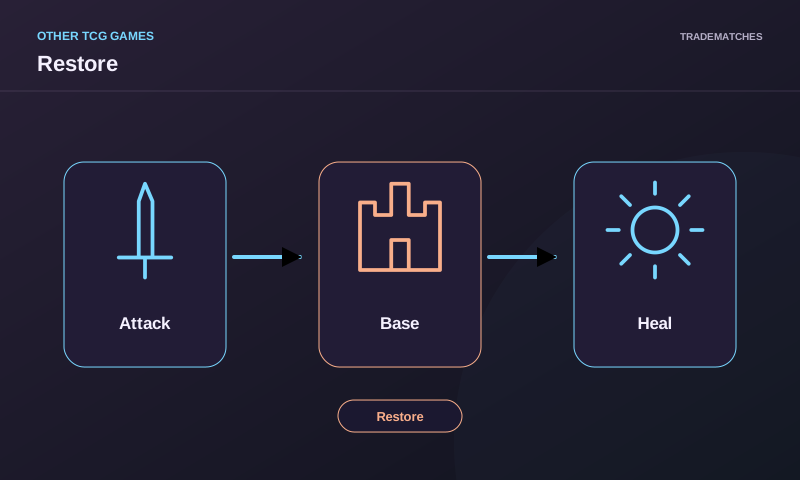
Restore in Star Wars Unlimited heals damage from your base when the unit attacks. It resolves as an On Attack ability, before ordinary combat damage, and does not require the attacker to damage the enemy base. Multiple Restore values add together. Healing removes existing damage; it does not raise the base's HP or create stored healing for later.
The key distinctions are trigger timing, healing amount and destination. Restore concerns your base even when the attack is directed at an enemy unit.
Starting an attack creates the trigger
Restore is defined as a keyword that resolves like an On Attack triggered ability. It is tied to the attack event, not to whether the attack eventually hits or defeats its target. Follow the normal attack procedure and resolve the relevant attack abilities in their proper window.
Merely readying a unit or declaring an intention to use it later does not perform an attack. The actual game action and its legal target must occur. A unit that cannot legally attack does not receive a free Restore activation because you would like to heal.
An instruction allowing a unit to attack can make Restore relevant when the attack is actually performed. Check that instruction's restrictions and the resulting legal attack. The keyword does not itself grant Ambush, extra attacks or permission to ignore arena rules.
Healing occurs before ordinary combat damage
On Attack abilities resolve in the appropriate window before the normal combat damage exchange. In a straightforward attack, Restore therefore removes damage from your base before the attacking and defending units deal their ordinary combat damage.
This timing differs from an On Hit or When Defeated instruction. Do not wait to see whether the attacker survives before applying a Restore trigger that already resolved. Its ordinary healing is not contingent on winning the battle.
If other attack abilities produce unusual events, use the full timing rules. A simplified sequence does not determine every combination of simultaneous triggers and removal. The important point is to identify Restore as an attack trigger rather than inventing a hit requirement.
Attacking a unit can still heal your base
A legal attack against an enemy unit can trigger Restore just as a legal attack against the enemy base can. The keyword's instruction says to heal your base; it does not say that the attack must be directed at the opposing base.
For example, a unit with Restore 2 attacks an eligible enemy unit. If your base has 5 damage, the ordinary Restore resolution removes 2, leaving 3. The later combat outcome does not change the fact that the healing already happened.
You still need to obey Sentinel and other target restrictions when choosing the attack. Restore does not let a unit select a prohibited target simply because the controller plans to gain a defensive benefit from the attack.
The healed object is your base
Restore does not ordinarily heal the attacking unit, a different friendly unit or the opposing base. The specified destination is your base. Do not move damage counters from a damaged attacker when the keyword instructs base healing.
Other cards can have abilities that heal units, and a full card might combine several effects. Resolve each instruction according to its own wording. The presence of a separate unit-healing effect does not redefine what Restore means.
Keep the base's damage visible and distinct from unit damage. A clear counter arrangement makes the amount easy to verify and avoids accidentally removing a counter from the wrong object during a busy attack sequence.
| Situation | Ordinary Restore outcome |
|---|---|
| Restore 2, base has five damage | Remove two; three remain |
| Restore 3, base has one damage | Remove the existing one; no excess is stored |
| Restore 1 and Restore 2 on the same unit | Add values to Restore 3 |
| Attack targets an enemy unit | Restore can still heal your base |
| Attacker is damaged | Restore does not itself heal that attacker |
Multiple values add together
The current rules say that multiple instances of Restore stack by adding their numbers. A unit with Restore 1 that gains Restore 2 is treated as having Restore 3 for its attack healing.
This is a specific keyword rule. Do not assume repeated instances of every keyword work the same way. Some keywords are redundant or produce separate triggers, while Restore uses the additive procedure stated in its definition.
Check that every contributing instance is currently applying. A temporary grant that ended earlier is not still part of the total. If another effect changes the unit's abilities during a complicated sequence, use the actual rules and timing for that change instead of freezing the value from a previous turn.
Healing is limited by damage already present
If your base has less damage than the Restore amount, you remove only the damage that exists. Restore 3 on a base with 1 damage does not give it negative damage, additional printed HP or a reserve that absorbs the next 2 damage.
That means a high Restore value can partly go unused in a given attack. You do not save the excess for another unit or the next turn unless a separate effect expressly establishes such a mechanic.
Use the difference between HP and damage carefully. The base's HP remains its current rules value; healing changes how much damage is marked on it. Describing the result as “raising maximum health” would suggest a different game modification.
A later defeated attacker does not undo healing
In the straightforward case, Restore resolves before combat damage, and then the attacker may be defeated during the combat exchange. That defeat does not rewind the earlier base healing. The game history contains both a healed base and a defeated attacker.
This can make a seemingly unfavourable attack tactically relevant, but it does not guarantee that sacrificing the attacker is a good choice. Compare the amount healed with the board position, future attacks and the unit's other value.
If the attacker leaves play during an earlier ability-resolution window, evaluate the pending trigger and attack under the specific timing rules. Do not use the ordinary combat-defeat example as a blanket ruling for every removal sequence.
Additional attacks can create additional opportunities
If a unit legally attacks again, Restore can be relevant to that new attack. The keyword does not contain a general once-per-turn restriction by itself. Any restrictions on the effect granting another attack still apply.
You cannot manufacture another trigger by physically straightening the card or repeating an already completed declaration. A legal additional attack requires the proper readying, permission and action procedure. Each attack must be evaluated as an actual game event.
For planning, count the attacks your current effects genuinely allow rather than multiplying Restore by an imagined number. A theoretical healing total is only meaningful if the unit can make those attacks and your base has damage to remove at the relevant times.
Sequence other attack abilities deliberately
A unit can have Restore alongside other On Attack abilities. The game's triggered-ability rules determine their resolution order and any choices available. Read the complete card and applicable rules before resolving several effects as a single combined instruction.
If another ability changes the board or damage, keep a record of what happened before Restore and what happened afterward. The state at each resolution can matter. Do not remove healing from the final damage total without accounting for the actual sequence.
In practice, announce the attack target and each relevant ability before moving counters. That gives the opponent an opportunity to confirm the process and helps both players distinguish an attack trigger from ordinary combat damage.
Evaluate Restore as time gained, not invulnerability
Healing can give your base more room to withstand future damage. It does not prevent the opponent from producing a larger amount afterward, and it does not protect the attacking unit from the fight it starts.
Compare Restore's immediate benefit with the opponent's likely next action. An attack that heals a small amount while losing an important defensive unit can leave a worse board even though the base's damage count improves.
Conversely, an attack that removes a threat while healing the base can support both board control and survival. These are context-dependent decisions. The keyword provides a measurable effect; it does not identify an automatic strategy independent of the actual game state.
Practise a complete attack record
Start with a damaged base, a legal Restore attacker and an eligible enemy target. Announce the target, resolve Restore in the On Attack window, record the new base damage, then apply ordinary combat damage and the resulting defeats.
Repeat with a base that has less damage than the Restore value and with two additive Restore instances. These simple exercises make the timing, destination and cap visible without introducing unrelated abilities that obscure the keyword.
For a tournament question, identify the current card text, attack event, contributing Restore values and any intervening abilities. Use the current comprehensive rules from the official resources rather than assuming an older starter explanation covers every later interaction.
Frequently asked questions
Must the attack hit the opposing base to use Restore?
No. Restore is an On Attack ability and can apply when the legal attack targets an enemy unit.
Does Restore heal the unit carrying it?
Not by the ordinary keyword definition. It heals damage from that unit controller's base.
Can excess healing increase maximum HP?
No. Healing removes existing damage; unused excess is not stored and does not increase the base's HP.