How to check Yu-Gi-Oh! Forbidden and Limited cards in Spain
On this page
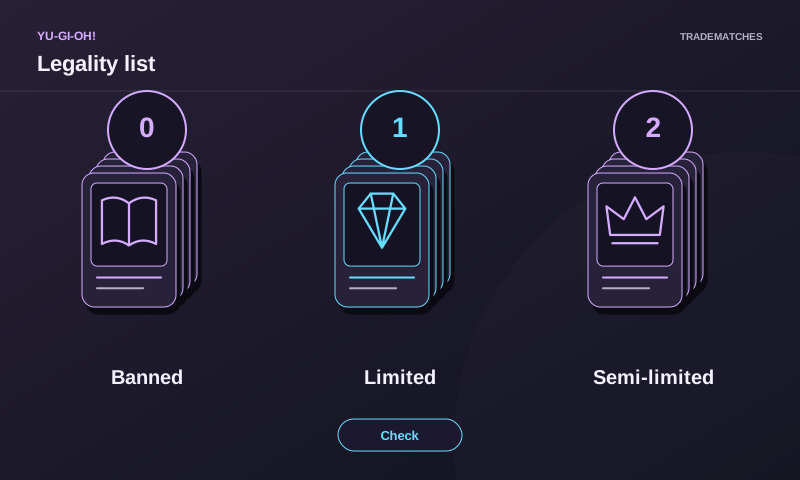
For an official Yu-Gi-Oh! TCG tournament in Spain, check the Konami Europe Forbidden and Limited list effective on event day. Forbidden means zero copies, Limited one and Semi-Limited two, counted across your Main, Extra and Side Decks together.
Choose the correct list
The European site shows the current list and previous versions. Check the effective date, not merely when someone posted a screenshot. The Japanese OCG list and a special event list do not automatically replace the European TCG list. A venue may announce extra conditions; read its event notice before assembling the deck.
Count copies across all three deck sections
If a card is Limited and you have one in your Main Deck, you cannot add another to your Side Deck. For a Semi-Limited card, one in Main and one in Side reach the two-copy maximum. The ordinary three-copy rule applies when a card is legal and has no lower restriction.
For a practical check, put your deck list in three columns and total each card name. Alternate art or rarity does not make a new card for this purpose. Revisit the official page before events: the list may change while you own the deck.
Two further checks
A card’s absence from the Forbidden list alone does not prove your printing is legal. Konami also has rules on language, release territory and some promos. If you are playing Speed Duel or another format, read its separate rules; the general Advanced TCG list does not cover every variant.
Start with the format and region
If you play Yu-Gi-Oh! TCG in Spain, you need the Prohibited and Limited list applicable to the TCG format of the event, not a Japanese OCG capture or a list from a simulator with its own settings. Konami Europa publishes the restrictions and the official card base allows you to consult them by name. Before building the deck, read the call-up: an advanced format regular tournament may follow a different document than a special event. The question "Is this card prohibited?" lacks a complete answer without format, region, and date.
A restrictions list can be updated several times a year. Look at the effective date, not just the date a creator posted a video. A recipe that won two months ago may include quantities that are no longer allowed. Save the official link and reopen it before sending your list is more reliable than memorizing popular card names. Competitive legality is a temporary condition.
What do the three categories mean
"Prohibited" means you cannot include copies in Main Deck, Extra Deck, or Side Deck. "Limited" allows a maximum of one copy between the three. "Semilimited" allows two in total. A card without specific restrictions follows the general maximum of copies per name and other construction rules. The categories do not describe rarity, price, or absolute power of the card. They indicate how many copies you can register for the format of the list.
Example: A Limited card appears once in your Main. You cannot add a second one to the Side "just in case." Although you would only play one in each duel, your registered set would include two. A Semilimited card could appear once in the Main and once in the Side, if the other rules allow it, but not two in the Main and one in the Side. Counting by zones separately is the error that is most easily overlooked.
The total spans Main, Extra, and Side
The limit applies to the total number of copies of a name between the three piles. When you review a digital list, group each card by name and sum the quantities. Do not check Main, Extra, and Side as independent inventories. A prohibited card in the Side remains prohibited; a Limited card in the Extra occupies the only available spot even if it does not appear in your initial hand. Reprints and distinct finishes of the same name are counted together for this verification.
Suppose a Semilimited card appears in two editions. You have one old print in the Main and two new ones in the Side. The appearance of the copies does not change the total: three. You must reduce one. If a card has an errata, use its current text to play, but the errata does not create a new name that automatically resets the limit. Confirm the identity of the card in the official base.
Search for the exact name in the official base
The Yu-Gi-Oh! Neuron base allows you to search for cards and consult the list. If the name changes between languages, verify the corresponding official entry. A shortened translation from a store may lead you to a different card or no results. Note the full name, type, and, if necessary, the code of your print. The list is organized by card, not by the illustration you remember. A card with alternative art and the same name still occupies the same spot.
When someone says "that card is one," ask for the source and the date. It may refer to another region, a list of an alternative format, or an old version. Consulting the official card page takes less time than discussing from memory. If the European website and another page seem to show different states, check which one applies to the event and if one of them shows an older file. The call-up and the current policy of the organizer are the final reference for registration.
New list, old deck
When a change is published, do not review only the cards that were previously Prohibited. A card may move from unlimited to Semilimited, from Semilimited to Limited, or in the opposite direction. Review the complete change table and then your list. If a card is removed from the list, it still applies the general limit and the format conditions; it does not mean infinite copies. If a card enters a more restrictive category, adjust Main and Side before playing.
An efficient review uses a sheet with name, quantity in Main, Extra, Side, and current limit. Sort by the cards that appear in Konami's list. Mark the ones that exceed the limit and decide which to keep. Then, recount the sizes of each pile, because removing a card may leave the Main below the minimum. A change in legality can cause a second construction problem if you do not replace the spot appropriately.
The tournament date matters
An announced update today may have an effective date later. If your tournament is before that date, consult which list the organizer indicates. If it is after, apply the new one. Do not assume that a social media post takes effect immediately. The Konami website shows previous files and dates to help reconstruct what was allowed at a particular time. This precision is important when evaluating tournament videos: a legal play in May may not describe the September list.
For a multi-day event, follow the organizer's instructions on which list to use throughout the tournament. Do not change the Side halfway through the event just because of a new announcement without confirming the tournament's rules. If you have doubts, ask before submitting the deck. It is easier to resolve it during registration than after starting a round.
Prohibition, release, and text are separate controls
A card not on the Prohibited list may still be illegal because the product has not officially launched for that region or because the event restricts formats. Additionally, playing an old print requires applying its updated text, if there is an errata. The restrictions list only responds to how many copies you can carry. It does not replace the date of the product or the reading of the current text. When buying a card for a tournament, verify the three data points separately.
Example: You see a new card not listed in any category. This does not prove you can carry it to a tournament held before its official release. Similarly, an old Limited card may have updated text even if your copy still has the old text. Each consultation has its specific official source. Avoid turning a page of limits into a universal answer about all legality.
A check before buying cards
Before buying three copies of a costly card, consult if it is free, Semilimited, Limited, or Prohibited for the format you want to play. If it is one, you may only need one copy for that deck. If a change announcement is approaching, consider the risk that legality may change; there is no guarantee of maintaining the same limit. A prohibited card may interest you for collection or for another format, but state that intention and do not present it as a necessary purchase for the Spanish tournament.
When sharing a list with a friend, include the date and format in the header. "Deck 2026" is too broad if restrictions changed within the year. A dated list allows you to know if it needs to be updated before copying it. Links to the Konami base and the European page reduce language doubts.
Common errors
One: Using the Japanese OCG list for a Spanish TCG tournament. Two: Adding copies by zone instead of in total. Three: Treating parallels as different cards. Four: Ignoring the effective date of an update. Five: Believing that "not prohibited" means "legal in any event." The solution is to follow a sequence: identify format and region, open the official list with date, search for the exact name, add Main, Extra, and Side, and check separately release and current text. This method still works even if the specific names in the list change.
Frequently asked questions
Can a Limited card be in both Main and Side?
No. The one-copy maximum counts Main, Extra and Side Deck together.
Should I use the OCG list for a Japanese card?
Not for a Spanish TCG event. Check the European list and the separate OCG card-legality rule.