Normal Summon, Set and Flip Summon in Yu-Gi-Oh!
On this page
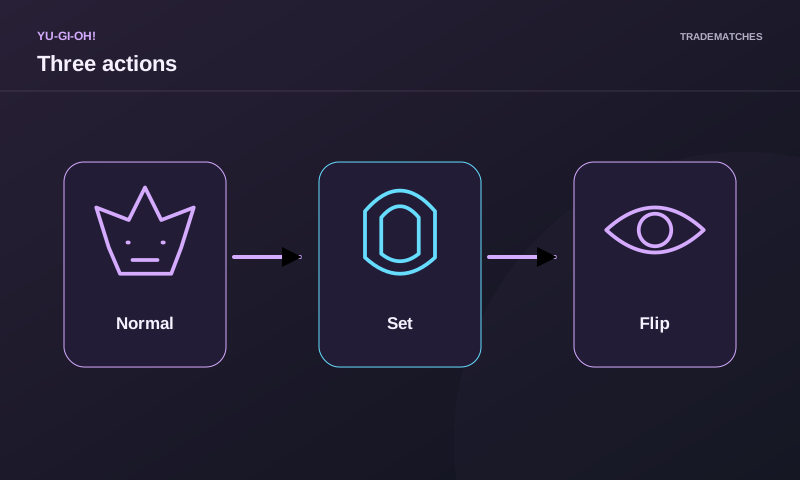
In Yu-Gi-Oh!, Normal Summon normally places a monster from your hand face-up in Attack Position; Set places it face-down in Defense Position; and Flip Summon changes a monster already in your field face-down in Defense to face-up in Attack. Normal Summon and Set share the standard limit of one per turn. Flip Summon does not consume that same summoning slot, but it cannot be performed on the turn you Set a monster.
These are three distinct actions with different starting points
Normal Summon and Set begin with a monster in your hand that you want to place in your Monster Zone. The first leaves it face-up in Attack; the second leaves it face-down in Defense. Flip Summon starts with a monster already in your field face-down in Defense and turns it face-up in Attack. If you confuse the starting point, you might announce a Flip Summon of a monster still in your hand or believe that revealing a Set card consumes a Normal Summon slot.
Example: You have a Level 4 monster in your hand and another already face-down from a previous turn. During your Main Phase, you can perform a Normal Summon of the first and a Flip Summon of the second, as long as there is no additional restriction. These are two separate actions. What you normally cannot do is Normal Summon a monster from your hand and then Set another from your hand using the same standard Normal Summon/Set opportunity of that turn.
Normal Summon: monster visible in Attack
In the basic procedure, you announce a Normal Summon of a monster from your hand and place it face-up in Attack Position on an available zone. Your opponent knows which card you played. Many effects specifically refer to "when this card is Normal Summoned"; reading that verb helps determine whether the event occurred. Do not assume that a Special Summon or a Set fulfills the same condition simply because it placed a monster on the field.
If the monster is Level 5 or higher, standard Normal Summon usually requires sacrifices: one for Level 5 or 6, two for Level 7 or higher, unless specifically stated. This is called Sacrifice Summon and still counts as a Normal Summon for standard summoning limits. The cost of sacrificing monsters from your field must be evaluated before announcing it. A card that allows an additional Normal Summon may change the number of actions available, but there is no default exception.
Set: monster hidden in Defense
Normally setting a monster from your hand places it face-down in Defense Position. Your opponent sees that there is a monster, but not its identity, ATK, DEF, or effect. The rules state that a monster Set in this way is not yet considered Summoned. Therefore, an effect that triggers when a monster is Normal Summoned does not activate simply because it was Set, unless a card rule states otherwise.
The standard limit is one Normal Summon or one Set per turn. If you have already Set a monster, you cannot perform an additional Normal Summon during that same turn. If you have already Normal Summoned, you also cannot Set another monster using this procedure. Special Summons and Flip Summons are analyzed separately, although they may have their own limitations. Mentally noting "I already used my Normal/Set" helps avoid illegal sequences when combining cards.
Flip Summon: showing a monster that was already there
A Flip Summon consists of voluntarily changing a monster from face-down in Defense to face-up in Attack, without using a card effect to perform the change. It does not move from hand to field— it was already there. The rules allow multiple Flip Summons in a turn if you have eligible monsters, because they do not use the Normal Summon or Set slot. Still, each monster must meet its own conditions for position change.
The easiest restriction to forget is that a monster cannot be Flip Summoned on the same turn it was Set. If you place it face-down during your Main Phase, you cannot voluntarily turn it face-up a minute later to immediately gain its Flip effect. You will have to wait for a later opportunity or for an attack or effect to turn it face-up through another means. Those other means are not necessarily "Flip Summon" even if they reveal the card.
Turning face-up is not always Flip Summon
If your opponent attacks a face-down monster, it may turn face-up during the battle procedure. A card effect may also turn it face-up. In both cases, a monster is revealed, but you did not voluntarily perform the Flip Summon action described earlier. Some Flip effects may activate when a monster turns face-up due to different causes, while other cards may specifically ask whether a Flip Summon occurred. The exact wording determines the result.
Example: You Set a monster face-down and end your turn. Your opponent attacks it during their next turn. The monster turns face-up during battle and may trigger a Flip effect if its conditions are met. Do not say "you used a Flip Summon on your opponent's turn"—you did not choose that action during Main Phase. On your next turn, if the monster remains face-down due to another sequence, you could consider a legal Flip Summon. Distinguishing between the event of revealing a card and the name of the action avoids misfiring effects.
Battle positions matter
Basic Normal Summon leaves the monster face-up in Attack. Set leaves it face-down in Defense. Flip Summon shows it face-up in Attack, not face-up in Defense. These positions affect which battle value is used and which effects can be selected by the card. A face-down monster maintains its identity hidden from your opponent until legally revealed.
Some cards allow Summons or position changes that deviate from the basic procedure, so this comparison does not replace reading special card text. The error lies in attributing these exceptions to all plays. If no card authorizes it, do not play a monster directly face-up in Defense from your hand as if it were a Set, nor announce a Flip Summon that leaves the card face-up in Defense. Use the physical position that corresponds to the action announced.
Sacrifices also affect Set
Setting a Level 5 or higher monster via the normal procedure may require sacrifices, just like a Level 5 or higher monster's Normal Summon. The requirement is not avoided by hiding the card face-down. The rules state one sacrifice for Level 5 or 6 and two for Level 7 or higher under normal rules. Your opponent does not see the identity of the Set card, but the player placing it must legally fulfill the required sacrifices.
Example: You want to Set a Level 7 monster from your hand and have only one monster available to sacrifice. Without a card effect changing the requirement, you cannot complete the normal Set. If instead the monster were Level 4, it would not require sacrifices and you could Set it using your standard turn opportunity. The decision to hide the card is tactical, but the regulatory cost still exists. In an event, you fulfill the procedure without revealing the card unnecessarily if the rule does not require it.
Special Summons do not replace this count
A Special Summon occurs via the method or effect that allows it. It is not the same action as a Normal Summon, a Set, or a Flip Summon. You can perform Special Summons on the turn you already used your normal summoning slot, provided the conditions are legal. However, some cards limit how many times you can Summon in a certain way or what you can do afterward; you must read them. The TradeMatches guide on Fusion, Synchro, Xyz, and Link explains specific methods from the Extra Deck.
In a long sequence, keep a separate count: "I used a Normal Summon or Set," "I performed these Special Summons," and "I Flip Summoned these monsters." This record prevents confusion between the number of cards entering the field and the Normal Summon limit. A turn can contain multiple entries via effects without granting a second standard Normal Summon. The event that triggers an effect must match the actual method used, not an informal description of "I summoned the monster."
A complete sequence to practice
You have a monster face-down from the previous turn and two Level 4 monsters in hand. During your Main Phase, you perform a Flip Summon of the old monster. Then you Normal Summon one of the hand monsters face-up in Attack. The Flip Summon did not use your standard summoning slot, but the Normal Summon did. You can no longer Set the second hand monster via the standard procedure that turn. You could use a card that allows another Summon if it exists and its conditions are met; do not assume it.
Now change the order: You Set one of the hand monsters face-down in Defense. You cannot Flip Summon it immediately because it was Set on that turn. You also cannot Normal Summon the other using your standard slot, which was already consumed by the Set. The monster that was already face-down from before might have a Flip Summon available if its conditions are met. Two identical hands generate very different boards depending on which action you choose to use your shared summoning slot.
Common mistakes and quick check
Common mistakes include Set and then Normal Summoning in the same turn without additional permission, turning a recently Set monster face-up by action, calling a Flip Summon when a monster is revealed by attack, omitting sacrifices when setting a high-level monster, or believing that all Special Summons consume the normal summoning slot. The common cause is using "summon" informally to describe actions with different rules.
Before moving the card, ask: Did it come from your hand or was it already in the field? Will it remain face-up in Attack or face-down in Defense? Have I already used my Normal Summon/Set slot? If it turned face-up by action, was it Set on a previous turn? If it is Level 5 or higher, are there sufficient sacrifices? Then announce the correct name of the action. This short sequence allows you to correctly apply effects that ask how the monster entered the field.
Frequently Asked Questions
Can I Set and Normal Summon in the same turn?
No under normal rules: they share a one-per-turn limit. A specific effect may grant an additional action.
Does Flip Summon consume a Normal Summon?
No. It is a separate action, as long as the face-down monster meets the conditions for being Flip Summoned that way.
Was a monster attacked face-down Flip Summoned?
Not necessarily. It may turn face-up during battle without the controller having voluntarily performed a Flip Summon action.