Targeting vs choosing on resolution in Yu-Gi-Oh!
On this page
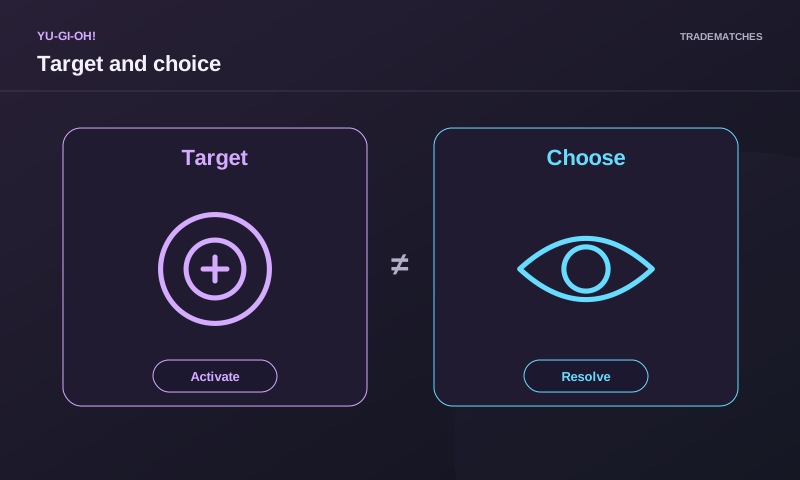
In Yu-Gi-Oh!, an effect that makes a target selects the card or player specified when the effect activates. An effect that does not make a target may choose which card is affected when the effect resolves, according to its text. The difference matters because the opponent knows the target before responding in Chain, and because protection against "being selected as a target" only works against effects that actually make a target. The exact wording of the current card text is the best clue.
Selection can occur at two moments
When you activate a card or effect, you first check its conditions, pay costs, and make selections required by the text during activation. Then the opponent may chain a response. Later, when resolving the Chain in reverse order, the corresponding effect is executed. An effect that makes a target fixes that target at activation; an effect that says "choose" during resolution without making a target may wait until that moment to determine which card will be affected.
Example: a card says "select 1 face-up monster on the field; destroy that target," with the selection before the semicolon in the official equivalent text. You announce the monster when activating it, and the opponent knows which one to protect. Another card says "destroy 1 monster your opponent controls" as an instruction during resolution and does not use the term "make target." In this case, you cannot assume a secret target was fixed at activation. Both cards can destroy, but they open different responses.
How to read the two points and the semicolon
Konami uses the PSCT card text system to separate conditions, activation actions, and effect. The condition usually appears before two points. If there is a semicolon, what comes before corresponds to what you do during activation—for example, paying a cost and, when the text specifies, selecting a target. What comes after describes resolution. This structure helps avoid paying a cost too late or selecting a target after seeing how the opponent responded.
A practical rule for modern cards is to look for the word "target" or "target" in the official text and observe where it appears. Don't rely solely on a visual indication that a card "points" to another or that the effect ends by affecting a single card. An effect can affect a single card without making a target. And an older card may have a print impression whose terminology has been updated: consult the official current text in the database before resolving a competitive interaction.
What the opponent knows when chaining
If the effect makes a target, the target is announced during activation. The opponent can decide their response with that information. They might chain a card that removes the monster from the field, protects it, changes its status, or affects the chain, as long as that response is legal. They cannot force you to choose a different target simply because the first one became inconvenient after the chain progressed.
If the effect does not make a target and will choose a card during resolution, the opponent does not know in advance which card you will select for that specific instruction. They can respond by modifying the field, but they do not necessarily have to defend against a pre-established target. That does not mean the controller of the effect can choose anything at resolution—there are still limits set by the text, such as card type, position, controller, or zone. The difference lies in when the selection occurs, not in the absence of rules.
Protection against being a target
A card that says it cannot be selected as a target by effects prevents, within its scope, a legal selection by an effect that makes a target. But that protection does not automatically save it from an effect that does not make a target and affects it in another way. It also does not make it immune to destruction by battle, sacrifice, or any zone movement. Read what operation the opponent's card is attempting and whether its text actually includes a target selection during activation.
Example: you control a monster that cannot be a target of your opponent's effects. Your opponent wants to activate an effect that says "make target of 1 monster your opponent controls; destroy it." They cannot choose that protected monster as a target under the applicable rule. If they have another effect that simply destroys all monsters, the protection against being a target is not sufficient to prevent it. If the second effect chooses a monster during resolution without making a target, you must read its text and any other protections on your card.
Choosing a card does not always mean "making a target"
In common language, any action directed at a card seems to "point." In Yu-Gi-Oh!, making a target is a technical property of the text. If a card says "choose 1 card" during resolution and does not use the target procedure, do not convert that choice into a target simply because it sounds similar. The PSCT texts were specifically written to avoid this confusion. The effect must still choose a legal card according to its instructions when it resolves.
The distinction also applies to cards that protect themselves. A card might resist effects that make it a target, but not effects that choose it in another way during resolution. Another might be indestructible against effects and thus resist destruction not directed at it, even if it lacks protection against being a target. Do not mix these two defenses: "cannot be a target" responds to selection; "cannot be destroyed" responds to a removal action. The guide on destroying versus sending to the GY develops the second difference.
What happens if the target changes or disappears
After announcing a target, the Chain may modify the field. If the target leaves the zone it was expected to be in before the effect resolves, you cannot physically apply destruction that requires it to remain there. However, the exact consequence for the rest of the effect depends on the wording. Konami explains that phrases like "that target," "both," or a different pronoun may require different checks when a condition changes between activation and resolution.
That is why it is dangerous to use a simplified rule like "if a target disappears, the entire card is nullified." Some cards have multiple targets and may still affect the remaining ones; others require all targets to remain valid; others have independent additional effects. Read the phrase after the semicolon and the conjunctions that connect it. If the case is complex, consult the official PSCT explanation or a specific card resolution. The fact that the effect made a target at activation is only the beginning of the analysis.
Target at activation versus activation condition
A condition before the two points determines whether you can activate the effect at that moment. A target announced in the activation section is a specific choice. If the condition changes during the Chain, it is not always rechecked at resolution, unless the card itself requires it to remain true. The target, in turn, may become illegal or leave the zone where the effect expected to find it. These are distinct issues that are often confused because both occur "before the card does something."
Generic example: a card can only activate if you control a monster of a certain type and also makes a target of an opponent's card. You meet the condition and announce the target. The opponent chains an effect that changes your field. When resolving, you should not automatically assume either that the entire card fails or that everything works: check whether the effect requires preserving the condition and whether the target still meets the requirements. PSCT separates these steps so the response is in the text, not in an intuitive guess about the Chain order.
Do not confuse attack targets with effect targets
The rules also use the language of "attack target" when a monster declares a battle. A text that prohibits selecting a card as a target of effects may have a different scope than one that prohibits attacks. Read the full phrase of the protection. Do not simply say "it cannot be targeted" without specifying whether it refers to cards, effects, attacks, or a combination. The type of action the card chose determines which restriction applies.
Example: a monster cannot be a target of effects from the opponent. That does not necessarily mean a rival monster cannot attack it. If another card says it cannot be chosen as an attack target, then the restriction applies during battle declaration. This separation prevents table errors when a card has multiple defensive lines. In case of doubt, point to the exact printed phrase and the type of action being announced.
A routine for resolving the Chain
When activating, identify the conditions and costs. Then check whether the text requires making a target and announce it before opening the response window. Place the card or ability as a Chain link. The opponent may chain anything that is legal. When resolving in reverse order, verify whether the targets still remain where the effect requires them and read the exact consequence of each part. If the effect chooses during resolution, make that choice then—never before by habit.
This routine is especially useful with older cards. If an impression uses text prior to the modern system and the target interaction is unclear, consult the official updated text of the card rather than interpreting an old word like "select" without context. TradeMatches already has a guide on old text and errors; it's advisable to use it when a collection card is played in an event. The purpose of this page is to teach you what question to ask the text, not to memorize an endless list of cards.
Common mistakes
The most common errors are declaring a target when the effect is already resolving, changing it after seeing the opponent's response, assuming that any effect affecting a single card makes a target, or believing that protection against being a target equals total immunity. It is also sometimes applied a false universal rule when one of several targets disappears. Each error is corrected by separating activation from resolution and reading the words that connect the instructions.
In casual play, announce "this card makes a target of that" when the text requires it. If it does not make a target, say "the choice will be made during resolution" if that is the sequence. Keep the Chain order clear and do not move the affected card before resolving what is on top. Precise communication makes it easier to check protections and avoids making a legal decision appear to be a secret choice made after seeing the opponent's result.
Frequently Asked Questions
Does an effect that affects a single card always make a target?
No. It depends on the official text and when the card is chosen. A single card can be selected during resolution without making a target.
When is a target announced?
During activation of an effect that makes a target, before the opponent decides how to respond in Chain.
Does a card that cannot be a target resist global destruction?
No, solely by that protection, if the destruction does not make a target. Check whether it has additional protection against destruction or another relevant rule.