Pendulum Summoning in Yu-Gi-Oh!
On this page
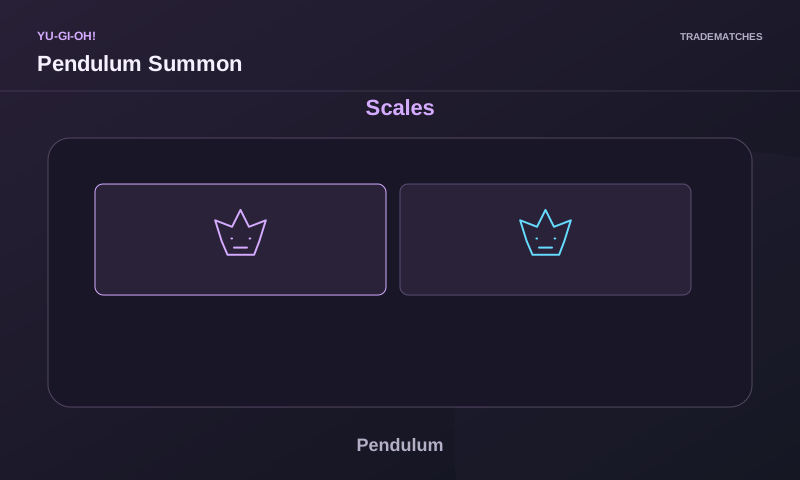
To perform a Pendulum Summon in Yu-Gi-Oh! TCG, place two Pendulum Monsters as Magic & Trap Cards—one in the leftmost Magic & Trap zone and one in the rightmost Magic & Trap zone. Their Pendulum Scales determine which Levels you can summon: the Levels must be strictly between both scale values. During your Main Phase, you may declare one standard Pendulum Summon per turn, bringing appropriate monsters from your hand and Pendulum Monsters face-up from your Extra Deck, while respecting available zones. Monsters from your hand can go to valid Main Monster zones; Pendulum Monsters from the Extra Deck must go to an Extra Monster zone or a Main Monster zone that points to a Link Monster. The origin difference is just as important as the scale.
What is a Pendulum Monster?
A Pendulum Monster combines Monster attributes with a Pendulum effect and a Scale. You can play it as a Monster according to its rules or activate it as a Magic & Trap Card in a Pendulum zone. When in that zone, its Pendulum effect applies; when in a Monster zone, its Monster effect applies, unless otherwise specified. It is not a card occupying both zones simultaneously. Check where it is physically located before applying the text. The current field layout uses the outermost Magic & Trap zones as Pendulum zones as long as those cards are present.
This corrects the image of some older rules or mats that show separate Pendulum zones. A more recent official guide explains that you activate Pendulum Monsters as Magic & Trap Cards in the leftmost and rightmost Magic & Trap zones, and those zones then function as Pendulum zones. Each zone is occupied by the corresponding card, reducing your available space for Magic & Trap cards. When building your deck, a pair of scales not only enables summons but also uses two of your five Magic & Trap spaces while the card is in place.
How to read the two scales
You need a low scale and a high scale. The allowed Levels are the numbers between both, excluding the endpoints. With scales one and eight, you can summon Monsters of Levels two, three, four, five, six, or seven. You cannot summon a Level one or Level eight Monster using that pair. If the scales are three and seven, the normal range includes Levels four, five, and six. If they are equal or consecutive, there may be no integer Level between them, and you will not be able to summon a standard Monster within that range.
The Scale is not the Level of the Pendulum Monster placed in it. A Level-four card can have a Scale of one; a Level-two card can have a Scale of eight. To determine what you can summon, read the Scale numbers on the sides of the cards in the Pendulum zones, not the Levels shown when played as Monsters. If an effect changes a Scale, use its current value at the time of declaring the Summon. If an effect prevents one of the cards from staying in its Pendulum zone, verify that you still have two scales before attempting the procedure.
Steps of a Pendulum Summon
During your Main Phase, with a card in each Pendulum zone, announce that you are performing a Pendulum Summon. Check the Level range, select which eligible Monsters from your hand and which eligible face-up Pendulum Monsters from your Extra Deck you will summon, and verify that all fit in legal zones. A standard Pendulum Summon occurs once per turn, though it may include multiple Monsters simultaneously. You do not need to announce a new Summon for each Monster entering during that same event. Then resolve the effects of entry and restrictions according to the rules and the involved cards.
Example: you have scales one and eight, two Level-four Monsters in your hand, and one face-up Level-six Pendulum Monster in your Extra Deck. All three Levels fall within the range. You could summon the two from your hand to free Main Monster zones; the one from the Extra Deck requires an additional valid Extra Monster zone or a Main Monster zone pointed to by a Link Monster. If there is no valid zone for this last one, you cannot add it simply because the scale is correct. The scale answers "which Levels"; the origin and arrows answer "where they can enter."
From hand and from Extra Deck are not the same
The 2021 official update explicitly retains the zone restriction for Pendulum Monsters summoned from the Extra Deck. From your hand, a Monster enters a suitable Main Monster zone if there is space and no other effect prevents it. From the Extra Deck face-up, it must go to an Extra Monster zone or a Main Monster zone pointed to by a Link Monster. You cannot apply the freedom granted to Fusion, Synchro, and Xyz to Pendulum Monsters from the Extra Deck. The card type matches, but the origin changes the outcome.
This difference affects how many Monsters you can bring in at once. With several eligible cards in your hand, you could occupy multiple Main Monster zones, but with several face-up Pendulum Monsters in the Extra Deck, you need sufficient valid zones for each. A Link Monster with arrows pointing to your Main Monster zones can open additional spaces; an arrow pointing to an occupied or unusable zone does not create imaginary capacity. Before announcing a large Summon, mentally place each Monster in its destination. If you cannot assign a legal zone to all the ones you want to include, adjust your selection.
Why do Pendulum Monsters appear face-up in the Extra Deck?
When a Pendulum Monster in the field would go to the Graveyard, the general rule places it face-up in the Extra Deck instead. This can happen whether the card was functioning as a Monster or in a Pendulum zone, as long as the movement conditions are met. Later, you may summon it via Pendulum if its Level falls within the scales and you have the allowed Monster zone. This does not mean that any Pendulum Monster discarded from your hand goes to the Extra Deck—the rule applies only to Pendulum Monsters that were in the field and would have gone to the Graveyard.
The phrasing "would go to the Graveyard" also matters. If a card is sent to the Graveyard, returned to your hand, or moved to another zone by an effect that takes precedence, do not automatically place it face-up in the Extra Deck. If a Pendulum Monster is used as a Material for Xyz and ends up beneath the Xyz, it is no longer a standalone Monster in the field; subsequent movement rules may require special checks. Read each movement's origin and destination. A simplified rule like "Pendulum Monsters never go to the Graveyard" is false and can break a gameplay sequence.
Simultaneous Summoning and one-time limit
A Pendulum Summon can bring in multiple Monsters during a single event. This allows for rapid field development if you have suitable scales and cards, but requires planning of zones and resources beforehand. The standard procedure can only be declared once per turn; do not perform a Summon of two Monsters and then, later after drawing another eligible one, declare a second Summon as if the first had not occurred. If a specific effect allows an additional Summon, analyze its conditions. The text of a card that specially summons a Pendulum via another method does not automatically count as a standard Pendulum Summon.
Since all Monsters enter at the same time during that Summon, you cannot use a card that just arrived from the same Summon as if it had already opened a Link arrow before deciding where another card from that same event enters, unless a rule or effect specifically changes the sequence. For a plan relying on Link arrows, prepare the zone through a prior action. If your field has limits on the number of Special Summons, types of Monsters, or zones, verify them before declaring the mass Summon. A single action can result in multiple Monster entries and trigger different cards.
Pendulum Scales as Magic & Trap Cards and their effects
Pendulum Monsters in their zones are not just numbers. Many have a Pendulum effect that can support your strategy or limit which Monsters you can summon. Read the top of their text and its condition. A wide scale range may seem ideal, but its restrictions might make summoning a specific attribute, archetype, or Monster type impossible. Conversely, a narrow scale range may better support a specific sequence. When choosing which cards to place, evaluate both the numerical range, the Pendulum effect, the space they occupy, and what happens if your opponent removes one of them.
Activating a Pendulum Monster in a Pendulum zone is a distinct action from performing a Pendulum Summon. The first places the scale and its effects; the second uses the two existing scales to summon Monsters. If you play a Pendulum Monster as a Monster, you have not filled a Pendulum zone for that action. If you lose a scale during your turn, you may need to place another legal card before declaring the Summon. Do not confuse the physical card with a permanent "Pendulum" permission that remains available when the card is no longer in the correct zone.
Relationship with Link Monsters and other Extra Deck Monsters
Link Monsters are especially relevant to a Pendulum deck because their arrows can open Main Monster zones where you can summon face-up Pendulum Monsters from the Extra Deck. The direction of the arrows and the zone occupied by the Link Monster matter. A Link Monster does not change the Level range—it only helps placement from the Extra Deck and may provide additional printed effects. Separately, Fusion, Synchro, and Xyz follow their own summoning methods, and since the official update, they can go directly to Main Monster zones. Do not use "all are Extra Deck" as a sole explanation for a card's destination.
A deck can combine Pendulum with other methods. For example, a Monster summoned via Pendulum from your hand could later serve as material for a Link Monster if it meets its requirements. When leaving the field, its destination depends on whether it is a Pendulum Monster, the procedure that moves it, and any possible effects. If the goal is to return it face-up to the Extra Deck for reuse, verify that it actually goes to the Graveyard from the field; not all materials and exits produce the same result. Planning recycling routes requires reading each step, not just the names of the two mechanics.
Common Mistakes
The first is including the endpoints of the scales in the range: with scales one and eight, Levels one and eight are not included. The second is looking at the Level of the card used as a scale instead of its Scale number. The third is summoning a face-up Pendulum Monster from the Extra Deck to any Main Monster zone without a valid arrow. The fourth is sending a Pendulum card discarded from your hand to the Extra Deck as if it had been in the field. The fifth is declaring two standard Pendulum Summons in the same turn. And the sixth is following an old mat with separate Pendulum zones, ignoring the current placement in the outermost Magic & Trap zones.
The quickest check is: do I have two scales in the correct zones? What Levels are strictly between them? Which cards are eligible in my hand and which are face-up in the Extra Deck? What actual zones do I have for each origin? Have I already used my Pendulum Summon this turn? If all answers are clear, announce the selection and resolve the Summon. If a card's text changes the method, re-read that text before applying the standard procedure. This sequence avoids most corrections without turning every turn into an exhaustive rule check.
Frequently Asked Questions
Can I summon a Level seven Monster with scales two and seven?
No. The valid Levels are strictly intermediate: three, four, five, and six.
Can I summon a face-up Pendulum Monster from the Extra Deck to any Main Monster zone?
No. It needs a valid Extra Monster zone or a Main Monster zone pointed to by a Link Monster.
Does a Pendulum Monster discarded from my hand go face-up to the Extra Deck?
No, by the general Pendulum rule. That rule applies only when a Pendulum Monster in the field would go to the Graveyard.