When vs If: missing timing in Yu-Gi-Oh!
On this page
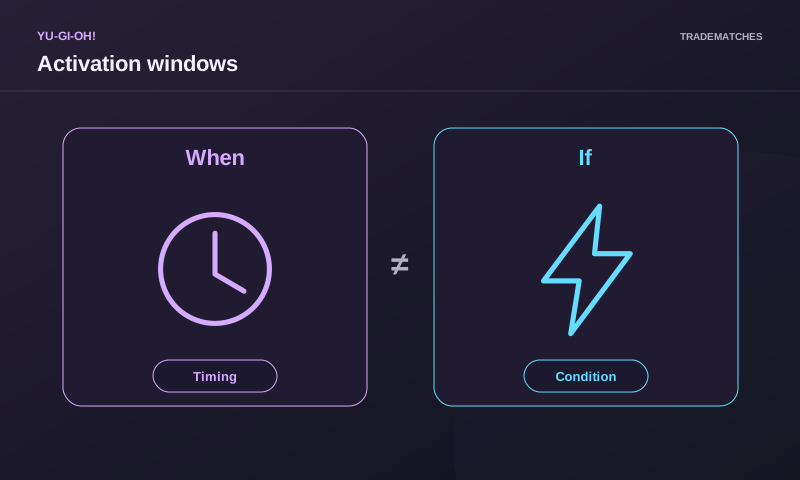
In Yu-Gi-Oh! TCG, optional effects written «When… you can» can only activate if the event that triggered them was the most recent relevant occurrence before their activation window opens. If another action happens after within the same resolution or Chain, the effect may lose timing. Optional effects written «If… you can» generally retain the possibility of activating after a resolution is complete, as long as they meet all other requirements. This comparison is a reading tool, not a license to ignore the card's text: there are mandatory effects, conjunctions such as «after» or «and if you do», zone changes, and card-specific restrictions that also determine the outcome.
What does "losing timing" really mean?
The phrase does not mean you forgot to press a button or reacted too slowly at the table. It means, according to the rules, the activation window for a strict activation optional effect no longer corresponds to the most recent event that occurred. This is common with an effect written «When this card is sent to the Graveyard: you can…». The card arrives in the Graveyard, but the effect that sent it still performs another action afterward. When the resolution ends and new effects can be activated, the last thing that happened was that subsequent action, not the initial send. Thus, the text «When… you can» may lose its legal activation window.
Konami explains that the conjunctions in the text affect «what was the last thing that occurred». Their card text guide uses the example of summoning a monster and then ending the Battle Phase: when the effect ends, the last thing that happened was ending the phase, so cards that can only activate «when» a monster is summoned no longer find their moment. You don’t need to memorize all historical examples; identify the actual sequence of your card and the conjunction linking its instructions. If the summon and another action occur simultaneously, the outcome may change.
«When… you can» versus «If… you can»
The formula «When [event]: you can [effect]» usually requires that this event be the last thing that occurred when the activation window opens. «If [event]: you can [effect]» is less strict in this regard: the event may have occurred earlier within a resolution or Chain, and the effect could activate in the next appropriate window. But «can» is important. The card might have a turn limit, require a legal target, need to be in a specific zone, or be affected by a rule update. Don’t resolve an entire interaction just by looking at the first two words.
Abstract example: a card says «If this card is sent to the Graveyard: you can draw a card». An effect sends the card to the Graveyard and then destroys another. When the resolution ends, the condition «if it was sent» may still be available for the appropriate activation window, subject to other requirements. If the card had said «When this card is sent to the Graveyard: you can draw», the subsequent action could make the send no longer the last event and cause timing to be lost. This example illustrates the difference in wording; for a real card, consult its official text and the specific resolution of its interaction.
The Chain does not pause to activate a trigger
During the resolution of a Chain, links are resolved in reverse order and no new link is opened in the middle of another. If an event that triggers a card ability occurs while another effect is resolving, you wait until the Chain ends and the next opportunity to form a new link arises. This interval can change what was the last relevant event. That’s why a card with «When… you can» might lose its opportunity even if the event clearly occurred and everyone saw it. It’s not that the player rejected activation; the activation might not be legal when the next legal window finally appears.
Suppose Link 2 of a Chain summons a monster, and Link 1 still needs to resolve another action. When everything finishes, the summon might no longer be the last event; a conditional optional effect written «When this card is summoned: you can…» might not be able to activate. If the summon was the last event during the resolution and no other action occurred afterward, the result could be different. The key is not simply «it happened in Link 2» or «it happened within the Chain»: examine the last relevant event when the next legal activation window arrives.
«After» and simultaneous actions
The words linking instructions are decisive. «Do A, then do B» indicates that B occurs after A; when both actions are completed, B is the last event. «Do A and B» or other conjunctions may indicate simultaneity according to official text rules. If A is sending a card to the Graveyard and B is summoning a monster, the difference determines whether a «When this card is sent to the Graveyard… you can» effect still sees its event as the last. Don’t translate all conjunctions into the colloquial «I do both things» and then guess the timing.
Konami’s official guide on conjunction functions explains that «after» is sequential, while «and» and «and if you do» may treat their actions as simultaneous for timing purposes, even though they differ in execution requirements. There is also «also», with its own behavior. This page focuses on the question «what was the last thing»; if you need to know whether B occurs when A is impossible, consult the same conjunction guide because the causality criterion is different. A card may perform part of its instructions and still close an activation window due to how it is written.
The cost before the semicolon
Modern card text uses two points and a semicolon to separate moment, conditions, costs, and the effect that resolves. What appears before the semicolon can occur when activating the card, while what follows occurs during the resolution. This helps identify when a card is sent to the Graveyard. If it is sent as a cost when activating, the event occurs before the Chain resolution; if it is sent as part of the effect, it occurs when that link resolves. The result of a «When… you can» effect from the sent card can vary due to this difference.
It’s not enough to say «the card was sent to the Graveyard by this Magic». Ask whether it was a cost, part of the resolution, a simultaneous consequence with another action, or a subsequent move. The official Problem-Solving Card Text guide clarifies that costs are paid when activating, and the text after the semicolon describes the resolution. At a physical table, point to the two parts of the card before moving Materials. This way, you can reconstruct what action was last when the activation window finally appears.
An official example of simultaneity
Konami uses Quickdraw Synchron to show that the phrase «send a monster from your hand to the Graveyard and summon this card specially» treats those events as simultaneous for timing purposes. This prevents certain optional effects written «When… you can» from losing their opportunity simply because of the summon. If the text used «after», the result could change because the summon would occur after the send. The example teaches you to focus on the printed conjunction, not to memorize a universal permission for Quickdraw.
A careful reading also avoids the opposite error: believing that any «and» makes the entire sequence simultaneous even if the card includes a separate verb followed by «after». Break the effect into its actual instructions and observe where each conjunction appears. If a final part occurs after, it may become the last event. In cases of older editions, use the updated official card base text; an old print may use language predating the standardization of PSCT and no longer accurately reflects the current reading.
«When» does not always mean it is lost
The problematic combination is usually an optional effect with «When… you can». A mandatory effect written differently may activate under different rules. A fast effect that activates in response to a specific event also requires studying its own activation window, not being automatically labeled as «timing lost» just because it contains the word «when». The practical rule is not an absolute grammatical filter. Before applying it, identify whether the text is an optional effect, where the card was, what event fulfills its condition, and when the activation window appears.
Example: if an optional effect «When this card is destroyed: you can…» is destroyed as the last thing that occurred, it does not lose timing simply because it begins with «When». The event may still be the last. Similarly, a card stating «If» does not guarantee that its effect resolves: it might lack a legal target or have reached its usage limit. The purpose of comparing these phrases is to avoid a specific type of error, not to replace a full reading of each card.
Zone change before activation is possible
The 2021 official rule update adds precision that prevents oversimplifying «If… you can». If an effect triggered by a condition is met, but hasn’t yet had a chance to activate because the Chain or another effect is still resolving, and the card’s zone changes before that activation window opens, the effect does not activate. The update mentions changes between field, Graveyard, hand, banish, and Deck. Therefore, a card with «If» may not lose timing due to the last action, but be blocked by a zone change before its activation window opens.
Imagine a card is sent to the Graveyard and, within the same resolution, is returned to the hand before having a chance to activate its triggered effect. Don’t respond with «it says If, so it works safely». Check the official update and the zone sequence. This rule differs from the classic case of «When… you can» and deserves a separate question. When reviewing a complex play, draw a timeline showing the card’s movements: initial zone, moment the trigger condition is met, subsequent movements, and zone when the activation window opens.
How to resolve a doubt at the table
Read the updated official card text; identify whether the effect is optional and whether it starts with «When» or «If»; mark what event triggers it; separate costs and resolution using two points and a semicolon; break down «after», «and», and other conjunctions; resolve the entire Chain; determine what was the last relevant event and whether the card changed zone before the activation window opened. If there’s still a special interaction, consult the official Neuron base or call a judge. This sequence is more reliable than repeating «timing was lost» as an explanation without identifying the event that closed it.
To a deck relying on an optional ability, test the exact sequence with the cards you actually use. A motor may work if the send and summon are simultaneous, but fail if another card changes «and» to «after». Two lists with similar names can produce different results. Before swapping for several pieces of a combination, verify the current text and save the official resolution reference if it’s a delicate case. Knowing when an ability can activate provides more value than memorizing an incomplete lemma about «When» and «If».
Frequently Asked Questions
Does every effect that says «When» lose timing?
No. The main concern is optional effects written «When… you can» when their triggering event is no longer the most recent relevant occurrence when the activation window opens.
Does «If… you can» always work even if a long Chain resolves?
No. There may be other requirements, usage limits, or zone changes before the activation window, as required by the 2021 official rule update.
Why does «after» matter compared to «and»?
Because it determines whether two actions are sequential or simultaneous, and therefore what event was the last when the «When… you can» activation window opens.