Digimon Barrier and Evade against deletion
On this page
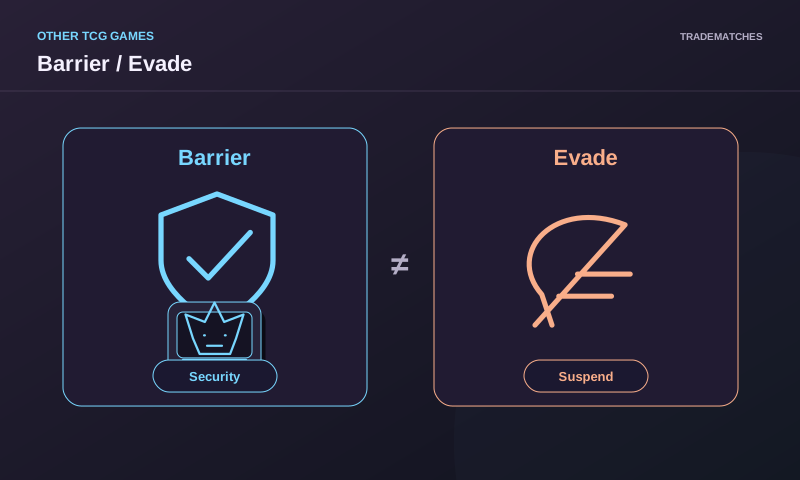
Barrier prevents deletion in battle by trashing the top card of your security stack. Evade prevents a deletion by suspending the Digimon itself. Evade therefore needs an unsuspended Digimon, while Barrier needs a security card and a deletion caused by battle.
Neither keyword is general immunity to every way of leaving the battle area. Returning a Digimon to the hand is not deletion, and Evade does not permanently save a Digimon that remains at 0 DP. The current comprehensive rules and official keyword Q&A distinguish those cases.
Compare the trigger and the payment
Read the cause of the impending deletion before deciding which keyword applies. A battle can delete a Digimon, but an effect can also delete one. Barrier covers the former. Evade has the broader deletion trigger, subject to being able to suspend that Digimon.
The payment is also different. Barrier uses your top security card. Evade changes the state of the Digimon carrying the keyword. You cannot suspend another Digimon to satisfy Evade, nor choose a convenient card elsewhere in your security stack for Barrier.
| Question | Barrier | Evade |
|---|---|---|
| What deletion can it address? | Deletion in battle | Deletion, including by battle or an effect |
| What must you do? | Trash the top security card | Suspend this Digimon |
| Can an already suspended Digimon pay? | Its suspension is not the payment | No |
| Can you pay with no security cards? | No | Security is not its payment |
| Does it stop a return-to-hand effect? | No | No |
Both are optional protective choices. If the required condition cannot be carried out, announcing the keyword is insufficient. If you choose not to use an available option, the game continues with the impending deletion and its normal consequences.
Barrier only covers battle deletion
Suppose your Digimon would lose a battle against an opposing Digimon. If it has Barrier and you can trash the top security card, you may use that keyword to prevent its deletion. The security card is the cost of preserving the Digimon in that situation.
Barrier can also apply in a battle against a security Digimon, as the official Q&A confirms. The important distinction is that the impending deletion is from the battle. A security card's separate effect deleting a Digimon is not the same cause.
The protection does not turn the security payment into a security check. You are trashing the top card for Barrier. Do not resolve that card's security effect just because a card left the security stack; the procedure instructing its removal matters.
Retaliation is not battle deletion
Retaliation can occur as a consequence of battle, but its deletion is caused by an effect. The official Barrier Q&A explicitly says Barrier cannot prevent that deletion. “It happened after a battle” is broader than “deleted in battle.”
This distinction can produce two different decisions in one sequence. Preventing the initial battle deletion does not necessarily answer every later effect. Identify each impending deletion and its cause rather than treating an entire combat sequence as one protected event.
Evade needs this Digimon to be unsuspended
Evade lets you suspend the Digimon that would be deleted to prevent that deletion. If it is already suspended, you cannot suspend it again for the payment. A Digimon attacking will normally already be suspended, making its current state especially important.
An unsuspended Digimon threatened by an effect that deletes it can potentially use Evade. An unsuspended Digimon attacked through a permission to attack unsuspended Digimon can also potentially use it against battle deletion. The trigger is not restricted to your own turn.
If a later effect unsuspends the surviving Digimon and another qualifying deletion occurs, Evade may be available again. The official Q&A confirms this interaction. Evade itself does not say once per turn, though other effects and the full game state can impose separate restrictions.
Why 0 DP defeats ongoing prevention
The official Evade answer Q264 addresses a Digimon whose DP reaches 0. Evade can technically be activated, but if the Digimon still has 0 DP afterwards, the rules delete it again. Suspending it has not fixed the condition that causes the rule deletion.
Do not describe this as Evade increasing DP or granting a temporary exception to the minimum. Its instruction changes the suspension state and prevents the particular deletion; it does not remove the DP reduction or create positive DP.
Barrier does not address the 0 DP deletion in the first place, because that deletion is a rule check rather than battle deletion. For either keyword, distinguish a battle comparison from a persistent state that the rules continue checking.
This is a useful contrast with effects that do something else when a Digimon leaves, such as Partition. Preventing deletion and playing cards from digivolution cards are different mechanics. A ruling about one should not be copied to the other without reading its trigger and result.
Prevented deletion does not trigger On Deletion
When the keyword successfully prevents the deletion, the Digimon has not been deleted by that event. Its On Deletion effect does not trigger just because deletion was about to happen. The official Q&A confirms this for both Barrier and Evade.
You cannot resolve a useful On Deletion ability first and then decide to prevent the same deletion afterwards. These protective effects intervene before the deletion they prevent. The desired benefit from leaving play does not happen if you successfully stop that departure.
Other consequences can still exist. Trashing a security card for Barrier can matter to effects watching security removal. Suspending a Digimon through Evade can matter to effects watching an effect suspend a Digimon. Resolve those actual events rather than inventing a deletion that never occurred.
Protection does not cover every removal route
A return-to-hand effect, movement to another zone or another instruction that does not delete the Digimon requires its own analysis. Neither keyword's deletion prevention automatically stops those effects. Read the verb used by the removal instruction.
De-Digivolve is also not simply another name for deletion. Removing top cards from a stack can change which Digimon and abilities remain. Barrier or Evade on a card that is no longer providing the ability cannot be assumed to protect the resulting Digimon from every subsequent event.
If an effect contains several instructions, finish each using the game's timing rules. Explain the actual sequence to a judge when unsure. A broad question such as “does Evade protect against this card?” can hide two different instructions with different outcomes.
Choose the cost with the board in mind
Consider a Digimon with Barrier when your security stack is empty. The battle trigger can be relevant, but you have no top security card to trash. You cannot substitute a hand card or promise to pay after another effect adds security. Now compare an unsuspended Digimon with Evade in the same empty-security situation: its payment uses its own suspension state, so the absence of security is not the obstacle. These two boards expose why checking only the threatening attack misses the actual payment requirement.
Finally, compare the Evade example after that Digimon has already suspended to attack. It now lacks the normal payment even though its security total has not changed. The board state, rather than the keyword's name alone, determines which option is available at each moment.
Barrier trades a security card for survival. Whether that is useful depends on the Digimon's role, the remaining security and the threats still available. It is not automatically correct to pay merely because the option exists.
Evade preserves security but suspends the Digimon. Consider what that state means for later attacks and other interactions. A saved Digimon may face another deletion while suspended, when it can no longer pay Evade's normal condition.
If a Digimon has both keywords and battle deletion is impending, identify the available choices without assuming you must pay both. Before choosing, confirm security availability and suspension state. The relevant cost can matter more than the fact that both texts mention avoiding deletion.
For a teaching game, demonstrate one battle-deletion case, one effect-deletion case and one 0 DP case. The comparison shows the keywords' boundaries directly. Using only successful battle examples can leave new players thinking both abilities offer universal immunity.
Frequently asked questions
Can Barrier stop deletion from Retaliation?
No. The official Q&A identifies that as effect deletion rather than deletion in battle.
Can an already suspended Digimon use Evade?
No. It cannot pay the required suspension of itself. An applicable later unsuspend effect may make Evade available for another qualifying deletion.
Does Evade permanently save a Digimon at 0 DP?
No. If it remains at 0 DP, rule deletion occurs again. Evade does not repair the DP value.