Arsenal in Flesh and Blood: storing a card
On this page
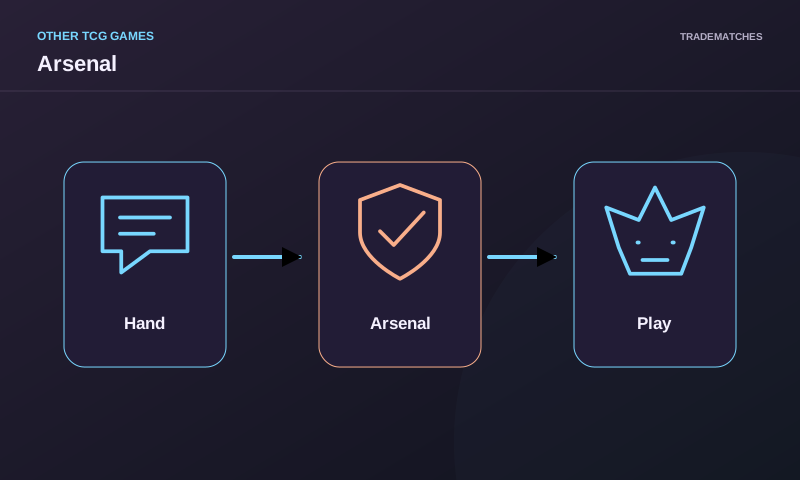
The Arsenal in Flesh and Blood is a private zone where you can place a card face down at the end of your turn to play it later. It is not a full second hand: the capacity is limited, and placing a card in the Arsenal does not allow you to use it directly as a pitch from there. The decision matters because the card remains across turns, can open a future play, and may block the option to store another card if the space remains occupied.
When to store a card
During the end-of-turn procedure, the player whose turn it is may place a card from their hand face down into an empty Arsenal zone they own. This is an option, not a requirement. It occurs before returning pitch cards to the bottom of the deck and before filling their hand to the hero's intellect. Because of this, storing a card reduces the visible hand size at that moment and makes room for drawing at the end according to the rules.
Example: you end your turn with two cards in hand and an empty Arsenal. You may store one of those cards face down; then continue the end-of-turn procedure, including the corresponding draw. If you prefer to keep both cards in hand, you may choose not to store any. Do not wait to look at the newly drawn cards to decide which one to store in the Arsenal during the normal end-of-turn procedure: the card is stored before the draw.
How much space does it have?
An Arsenal zone can only hold one card from the player's deck. In regular play, you typically work with one zone, although certain cards or effects may create situations involving multiple zones; the rules refer to "Arsenal zones" in plural. If the available zone is already occupied, you cannot place a second card there through the normal procedure. You would first have to empty a zone legally or apply an effect that allows something else.
Example: you stored a card on the previous turn and did not play it or move it. When it comes to your next end-of-turn, the Arsenal remains occupied. You cannot stack another card underneath, replace the old one with the new one, or choose to discard the old one for convenience, unless a rule or card grants such an action. The occupation turns the decision to store today into a limitation for the next cycle.
Face down and privacy
The card placed in the Arsenal via the end-of-turn rule is placed face down in a private zone. Only the owner knows which card it is; the opponent does not learn this information simply because the card was stored. When you play it later, it is revealed as part of the normal procedure. If a card or effect allows showing, flipping, or viewing the card, that specific text applies. Do not reveal the card when placing it unless a specific rule requires it.
It is important to keep the card physically separate from hand, pitch, and deck. The opponent may know there is a card in the Arsenal, but should not confuse its identity with another card or lose track of occupied zones. At events, respect the rules on hidden information and clearly communicate when you play a card from the Arsenal. The privacy of the zone does not allow you to secretly replace the card with a more favorable one.
Playing from Arsenal
General rules allow playing cards from your hand or from Arsenal, unless a restriction or card text specifies otherwise. When playing a card from Arsenal, you still need a legal moment, objectives, and costs. An attack action from Arsenal may require an action point and resource points; a defense reaction from Arsenal is used during its corresponding window. The origin zone may be relevant for effects that specifically state "if played from Arsenal".
Example: You have an attack card stored and begin your next turn. If you have an action point and can pay its costs, you can play it from Arsenal when the card type allows it. You do not need to bring it first to your hand. If your opponent attacks and you have a defense reaction stored, check its window and conditions before playing it from there. The fact that it is stored does not change the printed type of the card.
Arsenal is not a standard source of pitch
The rules define making pitch as moving a card from your hand to the pitch zone to gain the corresponding resources. A card in Arsenal is not in your hand. Therefore, you cannot make pitch of it using that basic rule to pay another card. This explains why storing a card with a high pitch value can be inconvenient if you later need exactly those resources.
Example: Your only card capable of providing three resources is face down in Arsenal, and you want to play a card from your hand that costs three. You cannot use the stored card as a standard pitch. If that card in Arsenal is playable on its own, you can evaluate that play; if a special ability moves it to your hand, check its text. But do not directly jump from Arsenal to pitch just because it has a high printed pitch value.
Arsenal also does not defend like a card from hand
Defending with a card from your hand and playing a defense reaction from Arsenal are separate procedures. The presence of a printed defense value on a stored card does not authorize you to declare that card as a standard defense from Arsenal. Some cards do have text or type that allows them to be played from there during a defensive window; in those cases, you are using that specific permission. To avoid errors, ask yourself whether you are "defending with a card" or "playing a reaction".
Example: You store an attack card with a 3 defense value and your opponent attacks. You cannot pull it from Arsenal as if it were a card from your hand to block 3. If instead you have stored a defense reaction that can be played during the reaction window, you could play that card, paying its cost if required. The same origin zone allows legal play of one but not the other as a standard defense.
What happens when the stored card is played
When played, the card leaves Arsenal and enters the played pile as a played card. After resolving, its fate is determined according to its type and the state of the game. The Arsenal zone becomes empty, which may allow storing another card at the end of a subsequent turn. If an effect returns the card to Arsenal or creates a replacement, consult the exact text and the zone's ability.
Opponents may respond in windows that indicate rules. Hiding a card during a turn does not make it impossible to respond when it is played. Likewise, playing from Arsenal does not waive costs, class restrictions, or objective requirements. The main advantage is preserving access to an additional option between turns and leveraging effects that reward this zone—not gaining universal rule exemptions.
The order of end-of-turn matters
According to the official procedure, you first save a card, then the pitch cards return to the deck, permanents are set up according to the rule, and action and resource points are lost; finally, you draw up to the hero's intellect when applicable. This sequence can influence which card you keep and how many cards you draw. The Arsenal is not part of your hand when counting hand size during that draw.
Example: your hero has 4 intellect. You end the turn with two cards in hand and save one in the Arsenal. When it comes time to draw, you will have one card in hand and draw up to four, subject to applicable rules. The card in the Arsenal remains there, in addition to those four, because it does not count as a hand card. If the Arsenal was full, you would keep the two cards in hand and your draw would be smaller.
Cards with bonuses from the Arsenal
Some cards have text that activates or enhances when played from the Arsenal. That condition is checked based on the actual zone of origin. A card that was in the Arsenal but returned to hand before being played does not automatically satisfy "played from Arsenal." Conversely, a card placed there by a non-end-of-turn effect may satisfy that condition when played, provided the text and rules do not add another requirement.
Not all cards gain a bonus for being stored in the Arsenal. The value of the Arsenal can also be strategic: hiding your next action, protecting a hand option from certain effects, or enabling a future combination. However, the limited space comes with a cost. A card you cannot play due to lack of resources or window may block the zone and leave you without the option to save another.
Cases with multiple zones or special effects
Current rules state that each Arsenal zone can hold one card. Some effects may create or grant additional zones and other ways to move cards toward them. When this occurs, apply the capacity to each zone and read the special effect. If an instruction attempts to place a card into the Arsenal without an available empty zone, the rules indicate that part fails, unless another rule modifies the case.
A beginner's guide often summarizes "Arsenal holds one card," which describes normal gameplay. For interactions involving multiple zones, that phrase falls short. Count the actual zones you control and the cards in each. The core idea remains: one card per zone, privacy while face down, and the ability to play from the Arsenal under its own rules.
Common mistakes and summary
The most common mistakes are saving after drawing, placing a second card in an occupied zone, pitching from the Arsenal, defending normally with a card saved, and playing it without paying its cost. A useful check is: am I at the end of my turn and is there an empty zone? If yes, I can save a card from my hand. Later, can I play that card from the Arsenal now and pay its cost? If yes, I play it under normal rules.
The Arsenal lets you reserve a card face down between turns and play it later. Its limited capacity and inability to function as a normal pitch make the choice carry consequences. The moment of saving comes before the final draw; the card saved does not count toward your hand size during that draw. Read effects that mention the Arsenal, as they may expand or restrict these general rules.
Frequently Asked Questions
Can I save a card I just stole at the end of my turn?
No, using the standard end-of-turn procedure: the opportunity to save occurs before the steal action takes place.
Can I make a pitch with an Arsenal card?
No, using the normal pitch rule, which moves cards from your hand. You need special permission if a card attempts something different.
Does my opponent see which card I saved?
No, due to the normal face-down placement. They know there is a card in the zone, but its identity remains private until a rule or effect reveals it.
Official sources: Flesh and Blood Comprehensive Rules, Arsenal; End of Turn Procedure; Playing Cards from Hand or Arsenal.