Pitch zone order at end of turn in Flesh and Blood
On this page
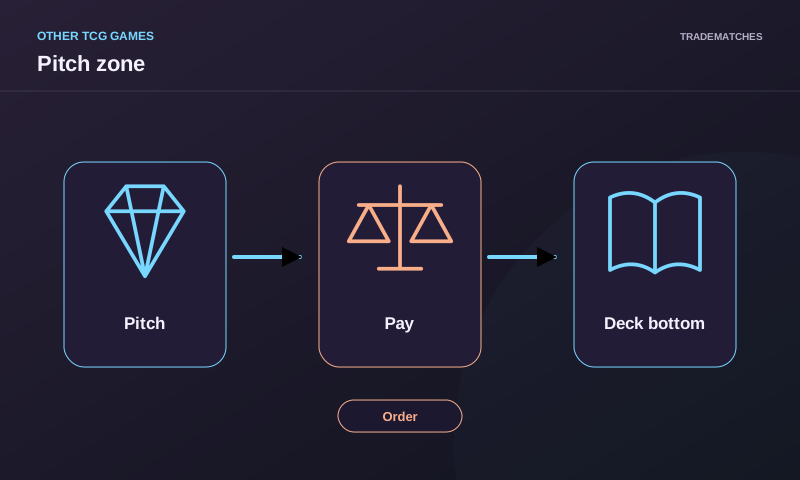
In Flesh and Blood, the cards you make pitch to generate resources remain in your pitch zone during your turn. At the end of the turn, each player places the cards in their pitch zone to the bottom of their own deck in the order they choose. That order is hidden information. The cards do not return to hand, are not shuffled with the deck, and do not need to maintain the order in which they were sent to pitch. This simple rule influences long games: when your first deck cycle is exhausted, the block of cards returned to the bottom may appear in an order you deliberately prepared.
What does "pitch" mean?
Pitch is moving a card from your hand to the pitch zone to generate resource points to pay a cost, following the applicable procedure. The resource value of the card determines how much it produces. On most cards, red, yellow, or blue is associated respectively with one, two, or three resources, but check the printed value and any exceptions. It is not discarding: the card goes to a different zone and returns to the bottom of your deck at the end of the turn unless another effect changes its destination. It also does not mean playing the card using its normal ability.
Typically, you pitch cards while paying a cost that requires resources. You cannot move a card from your hand to the pitch zone at any time just to prepare for the next deck cycle. Some cards or effects explicitly state "pitch" and generate resources or move cards, but this exception depends on the text. If you pay a cost of two using a card that generates three resources, the excess point remains available during the turn according to resource rules; the card you pitched does not return because it produced more than necessary.
The pitch zone during the turn
Each player has their own pitch zone. It is a public zone: cards there are visible by default while they remain in it. Therefore, both players can observe which cards were used to pay, although the final order in the deck is not revealed. Keep the zone physically separate from the graveyard and the deck; accidentally mixing the cards alters resources, effects that check the pitch zone, and the end-of-turn order. In a game with multiple actions, leave the zone as a clear small pile that you can review before the end-of-turn procedure.
The visibility of cards during the turn does not authorize using their text from the pitch zone without permission. An attack card sent to pitch is not a pending attack; a Defense Reaction sent to pitch cannot be played later from there by the general rule. Some abilities check the number, color, or type of cards in pitch, while others allow moving them, so do not place them prematurely into the bottom of the deck. Until the appropriate step occurs or an effect acts, their location matters.
The order at end of turn
The full rules place the return of pitch within the end-of-turn procedure. Before this, effects at the start of the final phase and other established steps are resolved. Within the procedure, the current player may place a card from hand face down into an empty arsenal zone; afterward, each player places all cards from their pitch zone to the bottom of their deck in the order they prefer. Then, the remaining steps occur, including permanent preparation, action and resource loss, and hero intelligence steal as applicable. Do not reorder these steps to change which cards are available in hand.
The mention of each player matters in multiplayer or when an effect causes a non-turn player to have cards in their pitch zone. It is not a privilege exclusive to the player who completed the action phase. Each person orders their own cards and places them beneath their own deck. The choice can be made privately so the opponent does not know the exact sequence, even though they have seen the cards in pitch. Follow the event's rules on physical deck manipulation to maintain hidden information.
You can choose any legal order
If you pitched first a blue card A and then a red card B, you are not required to place A under B or B under A by chronological order. At the end, you choose how they are ordered within the block placed at the bottom. If A is a resource you'd like to steal earlier during the next deck cycle, you can organize the block so it appears before B when the deck reaches those cards, keeping in mind how you physically define "first" within the block. The essential point is that you do not shuffle and do not publicly reveal which card is on top of which.
This does not allow you to reorder the rest of the deck or look at cards already hidden within it. You only choose the order of the cards from your pitch zone that are now placed at the bottom. If there were other cards already beneath the deck due to prior effects, the new block goes to the bottom according to the rule placing it there; you cannot insert cards into intermediate positions unless specifically instructed to do so. You also cannot leave a card in pitch for convenience when the step states that all cards are returned.
Why order matters when the deck is exhausted
In a short game, you may never draw a card you pitched. In a long game, the deck may be fully cycled and begin revealing cards placed at the bottom in previous turns. If you ordered resources to match future costs, you could prepare a more stable sequence. This strategic planning is commonly called "pitch stacking." It is not a special rule allowing card searching; it is a consequence of placing cards in order at the bottom without shuffling.
The real utility depends on other actions. If an effect shuffles the deck, the prepared sequence may be lost. If you draw additional cards, search, or place other cards at the bottom, it changes when the block appears. And if the game ends before you cycle through the deck, the optimization had no effect. That's why it's reasonable to start with a simple choice: group blue resources for future payment sequences or separate cards you don't want to draw at once, but don't sacrifice immediate decisions just for an unlikely second cycle.
Example of a round
During your turn, you pay two cards. First, you pitch a blue card and generate resources; later, to pay a new cost, you pitch a yellow card. Both cards are visible in your pitch zone. At the end, you decide that the blue card should be closer to the top of the returned block so it appears earlier if the deck reaches that point, and that the yellow card should come after. You place both cards at the bottom of your deck in the chosen order. You do not announce the order to your opponent; that sequence is hidden information. Then you continue with the rest of the end-of-turn procedure.
If you already had a card in your arsenal during that final phase, you cannot place another card there by the normal procedure, as the zone is occupied. The pitch return still occurs; the arsenal and pitch zone are separate operations. If an effect removed the blue card from pitch before the end, it will no longer be there to return or to be ordered with the yellow card. Always reconstruct the actual content of the zone at that moment, not what you remember pitching at the start of the turn.
Pitch is not discard, graveyard, or arsenal
A discarded card goes to the graveyard according to the discard procedure; a card pitched goes to its zone and generates resources. A card placed in the arsenal is placed face down in that zone to be played later under its own rules; it does not generate resources simply by being there. These differences in destination explain why some cards say "if you pitched a blue card" while others reference the graveyard or the arsenal. A physical error in placing a card in the wrong zone can alter the game even if no one intended to exploit it.
The return of pitch is also not a draw. Placing cards at the bottom does not immediately increase your hand. The draw at the end of the turn occurs afterward, up to hero intelligence when applicable, and normally takes cards from the top of the deck. Cards pitched are at the bottom; they will appear only when the deck is exhausted or when an effect changes the order. Do not say "I recover my resource cards at the end" if it implies they return directly to hand.
Common mistakes
The first is sending pitched cards to the graveyard at the end of the turn. The second is shuffling the deck after placing them at the bottom. The third is maintaining the chronological order of pitch. The fourth is revealing the chosen order to the opponent as if it were public information. The fifth is returning only the cards of the active player, forgetting a pitch zone belonging to another player that also contains cards. The sixth is choosing the order while looking at the rest of the deck, even though that information is not available.
A simple routine avoids these errors: at the end of actions, indicate each player's pitch zone; resolve the turn's arsenal; each player takes their pitched cards and places them at the bottom of their deck in the chosen order; then continue with preparation, resource loss, and draw. Keep the graveyard separate throughout the process. If a specific card alters its destination or requires a particular order, follow its text and consult the current full rules.
Frequently Asked Questions
Do I need to keep the order in which I pitched?
No. The rules allow you to place all cards from your pitch zone to the bottom of your deck in any order at the end of the turn. The sequence you choose is hidden information.
Are pitched cards shuffled with the deck?
No, by the normal end-of-turn rule. They are placed at the bottom in the order chosen. An independent effect that orders a shuffle may modify that situation afterward.
Does only the active player return pitched cards?
No. The procedure states that each player returns the cards in their own pitch zone. This also covers situations where a non-active player pitched a card due to an effect.
Checked sources
Alongside pitch, distinguish go again and action points, arsenal and arcane defenses.