Gundam Card Game: Breach and Support with examples
On this page
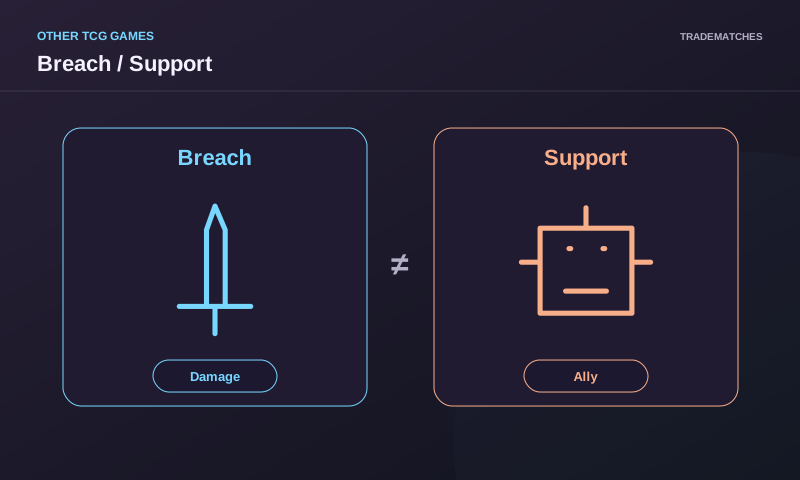
Breach N deals N damage to the first card in an opponent's shield area when your Unit destroys an enemy Unit through battle damage during your turn. A Base receives it if present; otherwise the topmost Shield does. It is not excess attack damage and cannot become a direct winning hit when the area is empty.
Support N works differently: during your Main Phase, rest that Unit to give another friendly Unit AP+N for the turn. It does not increase HP, cannot choose its own provider and does not automatically perform an attack.
Breach's trigger condition
The keyword needs an enemy Unit destroyed through battle damage during your turn. Attacking with Breach is insufficient if that enemy survives. Destroying it through a separate non-battle effect does not independently satisfy the same requirement.
The number specifies Breach damage rather than unused AP. A Unit with AP 5 and Breach 1 destroying an enemy with HP 2 generates one Breach damage, not three calculated by subtracting HP from AP. These are separate quantities.
Increasing AP may help achieve the destruction enabling Breach, but it does not automatically raise Breach's value. If the keyword remains Breach 1, its additional damage remains one unless another effect modifies the relevant keyword or damage.
Check whose turn it is too. The rule specifies your turn. Do not assume every enemy destruction during the opponent's turn generates Breach merely because the Unit participated in a battle.
Base first, then a Shield if no Base exists
The official Breach FAQ establishes the destination. With a Base in the shield area, damage goes to it. Only without a Base does it go to the first Shield. You cannot freely choose between them to bypass an existing Base.
Imagine a Base with three HP remaining and a Unit with Breach 2 meeting its condition. Those two damage apply to the Base. They are not split between Base and Shield, and cannot be redirected to a Shield merely because triggering its destruction would suit your plan.
Without a Base but with Shields remaining, damage goes to the topmost Shield. Breach 2 does not mean destroying two Shields: it means two damage to the first card. Do not convert its number into a quantity of affected cards or invent a distribution option.
If the Base receives more damage than required to destroy it, Breach does not itself authorise moving the excess onto the next Shield. Resolve damage to the stated recipient and the corresponding consequences. Another effect would need to supply any additional permission.
| Opposing shield-area state | Breach destination | Mistake to avoid |
|---|---|---|
| Base and Shields present | Base | Skipping it to damage a Shield |
| No Base, Shields present | Topmost Shield | Splitting damage across several |
| Neither Base nor Shields | Breach does not activate | Turning it into a direct winning hit |
| Both battling Units destroyed | Can activate when requirements are met | Requiring the Breach Unit to survive |
When both Units are destroyed
The FAQ confirms that Breach can activate when both Units are destroyed in battle. Losing your Unit does not erase the fact that it destroyed the enemy through the relevant damage during your turn.
This matters when evaluating a trade. You can accept losing a Unit and still obtain Breach damage if the sequence meets its requirements. Account for the loss nevertheless: Breach does not protect the Unit or make the exchange automatically favourable.
For an opposing Destroyed effect occurring alongside Breach, the FAQ describes the relevant simultaneous-resolution priority: resolve the active player's Breach first in that case. Do not choose an order by personal preference. Follow comprehensive procedures where additional effects complicate the sequence.
With neither Base nor Shields, Breach does not activate. Other battle consequences still occur, but the keyword cannot serve as a shortcut to victory. The attack needed to win and Breach's shield-area damage are not interchangeable procedures.
Activating Support
Support is an Activate—Main effect. Rest its Unit, choose another friendly Unit and give that recipient the specified AP increase for the turn. “Another” excludes the provider itself; it cannot support itself through the ordinary procedure.
The action does not cause the recipient to attack. It can improve a later attacker, but the attack follows its normal rules as a separate action. Support also does not ready the recipient or remove any attack restriction it may have.
For example, an AP 3 Unit receiving Support 2 has AP 5 for the turn before other modifiers. Its HP does not rise through that effect. Existing damage is not healed, and its ability to withstand damage does not increase merely because its AP increased.
Resting the provider is part of the procedure. A Unit already rested cannot pay that resting requirement again simply by being indicated. An effect readying it can change later options, but Support does not contain its own free readying action.
Newly deployed Support Units
The Activate—Main FAQ confirms these effects can activate during the turn a Unit was deployed. Do not impose an automatic one-turn wait on Support by analogy with attacking restrictions.
You must still pay costs and have a valid recipient. Deployment this turn does not independently block the effect, but it does not waive other requirements. If another instruction leaves the Unit rested, check whether the resting cost can actually be paid.
That difference between attacking and activating lets a Unit contribute without attacking. Plan the contribution explicitly: the provider becomes rested, and its resulting position can matter for opposing attacks and responses.
The answer is not universal permission for every ability. It concerns Activate—Main in the permitted state. A card with particular conditions still needs individual reading, even when you know this general timing rule.
Combining keyword values
Official FAQs explain that values add when a Unit gains another copy of the same keyword. Breach 2 plus Breach 1 is treated as Breach 3. Support 2 plus Support 1 is treated as Support 3.
That is not the same as two separate activations selected independently. Resolve the combined value through the keyword's procedure. Ordinary Support still affects one other friendly Unit, not two recipients because the total came from two sources.
Separate Units can also provide Support to one recipient through valid activations. Track provider, recipient, amount and duration for each increase. The printed number on one card does not describe every current modifier affecting the recipient.
Team battle defines “friendly” to include your teammate's cards as well as your own. That matters for the recipient. Do not mechanically apply a two-player interpretation to team mode, or confuse “friendly” with “your” when text uses the narrower word.
Combining Support and Breach
Imagine a Breach 1 Unit lacking enough AP to destroy its intended enemy. Another Unit can provide Support 2 before the attack. If that increase enables destruction through battle during your turn, Breach applies its own value of one.
Support does not guarantee the sequence. Responses, attack conditions or other modifications can change the battle. Recheck AP, HP, damage and states after each effect instead of calculating everything from the position before activating Support.
Evaluate the successful destruction and Breach benefit against the cost of resting the provider. That Unit might attack or serve another function if left available. The concrete comparison is more useful than assuming Support must always be activated whenever possible.
Use markers that distinguish AP changes from damage. A die displaying two beside a Unit could otherwise be interpreted as two damage or AP+2. Announce its meaning and remove temporary AP reminders at the appropriate point rather than carrying the increase into later turns.
Before committing to the sequence, identify the Support provider, the intended attacker and the opposing Unit you expect to destroy. Then identify the first card in the opposing shield area. That short check makes the plan explicit and reveals whether the benefit you expected comes from the AP increase, the battle itself or the subsequent Breach damage.
Frequently asked questions
Can Breach win when no Base or Shields remain?
It does not activate in that state according to the FAQ. Its number cannot become a direct winning attack or replace the normal victory procedure. Resolve the battle, then check remaining legal actions separately.
Does Support increase both AP and HP?
Ordinary Support increases AP for the turn, not HP or healing. It also chooses another friendly Unit. An additional HP change needs separate text authorising that effect rather than an assumption about the word support.
Is Breach lost if my Unit also dies?
The FAQ confirms it can activate when both are destroyed in the battle. Enemy destruction through battle during your turn must have occurred, with an appropriate recipient in the shield area under the rules.