Items in Lorcana: playing, exerting and using
On this page
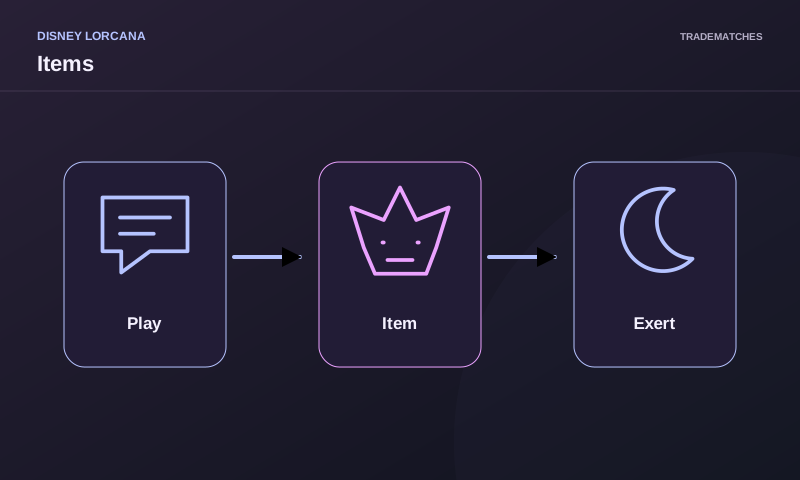
A Item card in Lorcana is played by paying its ink cost and remains in your play zone. Its ability can be used during the same turn you play it, if you meet its text and pay any activation cost. It can even be exhausted on that same turn: Items do not "dry" like newly played characters. This difference allows for immediate effects, but does not make all Items free or unlimited in use.
How to Identify an Item
The card's classification line includes "Item" in English or "Objeto" in the corresponding edition. It may have additional classifications, but its card type is Item. When in play, it is considered an Item in play; in hand, deck, or discard pile, it is an Item card. This precision matters because many effects refer to Items "you control" or to Item cards in a specific zone. The name or illustration alone is not sufficient to change its type.
Before playing it, identify three parts of the card: ink cost, the inkable symbol if present, and ability text. The top corner cost does not necessarily describe how much ink is required to use each ability later. A card might cost two inks to enter and request a third ink to exhaust for an ability. Another might provide a continuous effect without any additional activation cost. Reading these three elements separately avoids paying the same resource twice or activating something for free that requires a resource.
Playing It During the Main Phase
Items are generally played during your main phase. You announce the card, determine the total applicable cost, exhaust the required ink from your inkwell, and place the Item into play. The rule requires paying the full cost: you cannot place half an Item into play and finish paying it later. A specific effect might modify how it's played, but you must follow its text; the general rule does not allow playing Items from any zone or moment by intuition.
Example: You have three ink cards ready and an Item with a cost of two in your hand. Without modifications, you exhaust two ink cards and place the Item into play. One ink card remains. If the Item's ability requires exhausting an additional ink, you can pay it later if the timing and text allow. If the ability costs three inks, simply having paid two is not enough to play the Item—those were separate costs. Each cost is analyzed at the step it applies.
The Item Remains After Being Played
An Item does not automatically go to the discard pile when its effect ends. Rules place it in the play zone, where it stays until an effect or rule banishes or otherwise removes it. This permanence differentiates it from a regular Action card, which is played, resolves its effect, and then goes to the discard pile. If an Item has a continuous ability, it can continue affecting the game while in play and its conditions are met.
This permanence does not mean unlimited use. An Item that requires exhaustion for its ability can only pay that cost when it is ready, unless another card prepares it or changes the permission. An Item with text like "once per turn" or with a specific condition remains subject to that limitation. To determine how many times it provides value, ask two questions: "Is it still in play?" and "Can this specific ability be used now?" The answer to the first does not automatically determine the second.
Can It Be Used on the Same Turn It Enters?
The rules explicitly state that, if an Item has an ability, it can be used during the turn it is played. The glossary adds that it can be exhausted on that same turn. It does not have the drying period of characters. If the text requires exhausting the Item and it is ready, you can pay that cost at a legal moment after playing it, as long as all other requirements are met. This is one reason to use Items when you need an immediate effect.
Example: You play a hypothetical Item with the ability "Exhaust this Item: gain an effect." Once it is in play, you can activate it on the same turn if the phase, objectives, and costs allow. You do not have to wait until your next turn just because you placed the card on the table. Instead, if the Item enters exhausted by a specific effect, you cannot pay a cost that requires exhausting it again until it is ready, unless another effect changes the situation.
Exhausting Is a Cost, Not a Universal Effect
Some abilities show the exhaustion symbol before the effect text. In those cases, you rotate the Item as part of the payment. Other abilities do not require exhaustion and may have an ink cost, a temporary condition, or no activation at all. You should not automatically rotate all Items when using them, nor assume that an ability without a symbol can be used without limit. Read where the cost is and whether the card specifies a usage frequency.
During the Ready step at the start of your turn, cards exhausted in your play zone and inkwell are prepared. An Item exhausted by an ability can return to being ready for future use on a subsequent turn, as long as it remains in play. That does not make the effect "once per turn" by definition: its availability depends on the cost, the Item's state, and the rest of the text. If another effect prepares it before your next turn, you must check what additional limits it retains.
Activated, Triggered, and Static Abilities
An activated ability requires the player to pay a cost to gain an effect. A triggered ability waits for an event described in its text. A static ability applies a continuous effect while the Item remains in play. A single Item can contain more than one ability. The phrase "can be used on the turn it is played" does not require activating an ability that hasn't met its event or paying a cost you don't have.
Imagine an Item with a continuous bonus for your characters. When it enters play, the bonus can begin applying if its conditions are met; you do not have to exhaust it if the text does not require it. Another Item says "when you play a character, ..." and will wait for that event. A third has "pay one ink and exhaust this Item: ..." and requires a decision and a payment. Classifying the ability avoids treating a continuous effect as if it were a repeatable action or missing a trigger by failing to announce it.
Item vs. Character, Action, and Location
Characters can make quests and challenge, but dry when they enter. Regular Actions resolve their effect and go to the discard pile. Locations remain in play and can gain lore at the start of the turn if they have lore value, in addition to other rules. An Item also remains in play, but is not considered a Character or a Location. It cannot make quests or challenge because of an illustration of a character or a name that sounds like a place.
This comparison helps build a play curve. An Item used immediately can solve a current turn problem. A Character might provide lore starting from the next turn. An Action can resolve a specific effect without occupying the table afterward. A Location can produce value across multiple turn starts, but is exposed to challenges and damage according to its rules. No type is "better" by definition: look at what your plan needs and what type of card each search or synergy requires.
Entinting an Item Is Not Playing It
If an Item card has the inkable symbol, you can place it face down in your inkwell through the legal action of entinting. There, it represents ink; it is not an Item in your play zone, and you cannot use its printed ability simply because it now serves as a resource. Deciding between entinting and playing it is one of the most important choices in an initial hand with flexible Items.
Suppose you have an inkable Item that costs three and only two inks available. Entinting it may help you pay other cards, but you give up using that copy as an Item while it remains in the inkwell. Keeping it in hand may allow you to play it later, even if you lack the third ink this turn. The existing guide on inkable cards explains the symbol and action; here the distinction is functional: an Item face down in the inkwell does not offer its Item-in-play text.
What Happens If the Item Leaves Play?
An effect can banish an Item. When it leaves the play zone, it stops providing abilities that were active due to its presence, unless a specific instruction states otherwise. The card goes to the zone indicated by the effect and rules. It does not remain "active" just because it was used before. The consequences of a resolved effect may have its own duration, so it is important to distinguish between the Item's continuous text and an effect that has already been created and has a defined end date.
Example: An Item provides a continuous bonus while in play. If the opponent banishes it, that bonus stops applying. Another Item activated an ability that granted a modification "until the end of the turn" and was then banished; the duration of the already-resolved effect must be analyzed according to its text and rules, not assuming it disappears or continues in all cases. Before responding to an Item banishment, identify which abilities remain pending and which depended on its presence.
Common Mistakes and Quick Check
Common mistakes include expecting to exhaust an Item played on the same turn, sending it to discard as if it were an Action, counting the cost to play it as payment for its ability, using the ability of a copy that is face down in the inkwell, or treating it as a Character that can make quests. Each of these is avoided by checking type, zone, and cost in that order. The fact that two cards are played by paying ink does not mean they have the same lifecycle.
Before activating an ability, check that the card is an Item in play, that the timing of the text allows using it, that you can pay the full cost, and that its objectives or conditions are legal. If it requires exhausting it, verify that it is ready. If it does not require exhaustion, do not rotate it by habit. After resolving the effect, leave the card where the rules indicate—usually it remains in play. This method works whether there is one Item on the board or multiple effects linked together.
Frequently Asked Questions
Can I exhaust an Item on the turn I play it?
Yes, Items can be used and exhausted on the same turn if their ability and costs allow it. The drying rule for characters does not apply to them.
Does an Item go to discard after using it?
No by general rule. It remains in play until a rule or effect removes it. Check the specific card's text.
Can I use the text of an Item I placed in the inkwell?
No as an Item in play. A card entinted is face down in the inkwell and serves as a resource, not as an active Item.