Support in Lorcana: adding Strength after questing
On this page
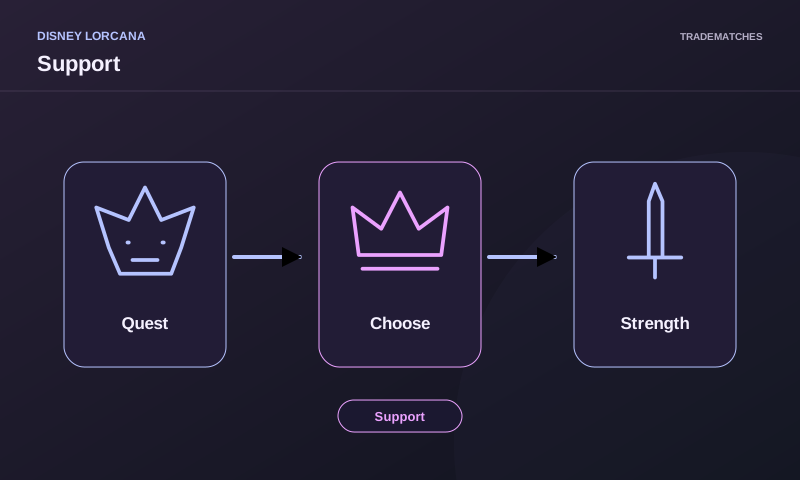
Support in Disney Lorcana triggers when the character that has it performs a quest. You can add that character's strength to the strength of another character chosen during the rest of the turn. It does not increase the amount of lore the character gains from the quest, and it does not apply to itself because the text specifies "another." The recipient can be either your own character or an opponent's character, as long as the choice is legal; an official Ravensburger guide even describes using Support on an opponent to combine with cards that look at their strength. The key decision is when to perform a quest with Support and which character will benefit—or be modified—before your next actions.
What triggers and when
Support is a triggered ability: its condition is "when this character performs a quest." First, you perform a legal quest with a character and gain the corresponding lore. The Support ability is then added to the list of pending abilities and resolved according to the game rules. When resolving, you can choose to add its strength to another character for the remainder of the turn. You cannot activate Support arbitrarily from a character that is ready without first performing a quest, nor can you use it as a response during the opponent's turn simply because it would be beneficial to increase strength.
The character with Support must be able to perform a quest: normally, it must be ready, have been in play since the start of your turn, and not be blocked by Reckless or another effect. Performing a quest exhausts the character. The strength boost to the recipient does not restore the Support character or allow it to challenge in that same state. If the character was already exhausted by another action, it generally cannot perform a quest again to trigger Support. The number of times you see the ability in a turn depends on how many legal quests actually occur, not on how many times the ability appears on the card.
Strength is not lore or will
The strength symbol determines, among other things, how much damage a character deals in a challenge. The lore value indicates how much lore a player gains when performing a quest with that character. Will determines how much damage a character can accumulate before being banished. Support adds strength, not lore or will. If a Support has strength three and lore one, performing a quest normally grants one lore point and allows a +3 strength boost to another character. It does not turn the quest into four lore points. It also does not heal existing damage or increase the damage threshold of the recipient.
This distinction matters when planning your turn. If your goal is to reach twenty lore, Support can contribute through its own quest, but its bonus usually prepares a challenge or activates another card that depends on strength. If you need a character to survive a blow, increasing strength might change the damage it inflicts in a future challenge, but it does not remove existing damage counters or automatically modify the recipient's will. Read every statistic on the card and do not use "stronger" as a description that blends three distinct values.
Why it has to be another character
The official rule states "another character chosen." The character that performed the quest and generated Support cannot be selected for its own strength boost. If no other eligible character is in play and the ability is optional, you may choose not to apply the effect. If there is another character, consider whether you want to strengthen one of your own or whether a specific combination justifies choosing an opponent. A card that says "one of your characters" imposes a different restriction, but Support itself does not add that "yours" to the official text.
Example: You control a character A with Support and strength two, and a character B ready with strength three. You perform a quest with A. When resolving Support, you choose B: B gains strength five for the turn, unless other modifiers change the calculation. Now, if B can legally challenge a target that is exhausted, its damage is calculated using the increased strength. A remains exhausted from the quest and does not receive the +2. If B was already exhausted, it could still receive the boost if it's a legal choice, but it might not be able to use it to initiate a challenge that turn; hence, the target and order matter.
Choosing an opponent character can make sense
Increasing an opponent's strength seems counter to winning challenges, but some cards depend on a character's strength to select, banish, or produce a different result. An official Ravensburger guide explicitly mentions using Support to increase an opponent's strength and turn certain elimination cards into consistent responses. It does not mean that it always makes sense to do so: if your subsequent action fails or the opponent benefits from the increase during your turn, you may have strengthened a threat. Before choosing an opponent, clearly define the full combination and when the effect expires.
Abstract example: You have an action that affects a character with strength equal to or greater than a certain threshold. The opponent controls a threat just below that threshold. You perform a quest with your Support and add its strength to the opponent's character, raising it above the threshold. Then you play the action if it remains legal. The Support boost is real and applies to all interactions during the turn until it ends. If the action says "one of your characters," this plan won't work; if it requires a choice that another protection like Ward prevents, it may also fail. Always read both full texts before investing your quest in the combination.
Duration: "this turn"
The strength boost generated by Support lasts only during the turn in which it is resolved. You do not place a permanent strength counter on the recipient, and the effect does not carry over normally into the next turn. If you choose a character that will challenge later, the benefit is available during that challenge on your turn. If the character does not challenge or use its strength for another effect, the benefit may expire without having any effect. That's why Support rewards a planned sequence, not just having the ability on the table.
If multiple characters with Support perform quests during the same turn and choose the same recipient, the applicable boosts are applied, provided each ability was legally triggered and resolved. Do not treat two Supports as a single effect that activates once for the entire board. Keep track of the amounts and their durations. You can use temporary markers or a note, but remove them at the end of the turn when effects expire to avoid miscalculating damage in the next turn.
How to prepare a challenge with Support
The typical sequence is: identify an opponent character that is exhausted and that you want to challenge; calculate how much strength your potential challenger needs; perform a quest with the character that has Support; resolve the ability by selecting the challenger; and then declare the challenge if that character is ready, not being exhausted, and meets all other restrictions. Support does not make a target legal if Evasive, Bodyguard, or another effect prevents selection. It also does not turn an exhausted character into a ready one. It only modifies the strength of the selected character during the turn.
Suppose your challenger has strength two and the opponent's threat has will five with two damage counters. If it receives +2 from Support, it will have strength four and could deal enough additional damage to banish the target, provided the challenge is legal and other reductions or effects do not change the damage. The opponent will also damage your challenger simultaneously during the resolution of the challenge. Don't just look at whether your new number meets the damage requirement; evaluate whether your piece will survive, whether it has Resist, and whether the Support effect is already active before declaring. The added strength increases potential damage, not guarantees a result.
Support and Reckless
Reckless prevents a character from performing a quest. If the character with Support is also under Reckless, it generally cannot perform the action that triggers its Support while the restriction is active. This does not mean that a recipient with Reckless cannot receive strength from another Support: the ability chooses "another character," and increasing its strength can help it challenge. Distinguish between the character that generates the ability and the one that receives it. The Reckless rule about ending the turn and challenging is analyzed separately from the strength bonus.
This interaction helps build an offensive board. A character with Reckless may need to challenge if it is ready and there is a legal target; giving it strength via Support before that challenge can improve the exchange. However, the character with Support must first perform a quest to generate the help and become exhausted, possibly exposing it to responses from the opponent in their next turn. If the opponent does not have a viable target now, the strength bonus may not be urgent. Sequence your actions based on real objectives, not the idea that all additional strength must be used immediately.
Support, Evasive and Bodyguard
Support does not remove target restrictions. A character with strength ten from multiple Supports still cannot challenge an Evasive character if it does not have Evasive, Alert, or another valid permission. If the opponent controls a Bodyguard that is legally exhausted for your challenger, you may need to direct the challenge even if you prefer another threat. The strength bonus can help overcome the Bodyguard, but it does not ignore it. When preparing an attack, first check legality and then the numbers. The reverse error also exists: believing that your own Evasive character cannot receive Support because it is protected from challenges; the key point is that the rule does not prohibit its controller from choosing it for a self-effect.
If a card with Ward is on the opponent's side, the possibility of selecting it for Support depends on who generates the effect: Ward prevents opponents from selecting it when resolving an effect. A Support from your own character on an opponent's card with Ward may be blocked by that protection, while selecting one of your own characters with Ward is usually possible for you. Don't assume "Support can go to the opponent" without checking other limits. That possibility exists by the basic text, but every choice must be legal in the current state of the game.
Common mistakes
The first is adding Support strength to the quest lore, creating victory points that the key phrase does not allow. The second is applying the bonus to the same character that performed the quest, despite "another." The third is treating it as permanent, leaving the marker for the next turn. The fourth is trying to activate it without performing a quest or from a character that cannot quest. The fifth is calculating damage before resolving Support: the ability triggers when a quest is performed and must be resolved before you can use the boost for a subsequent action.
To correct a board, reconstruct who performed the quest, what strength they had at the relevant moment, who was chosen, and for how long the boost lasts. Then verify whether the next challenge was legal by orientation, time in play, and target keywords. If a specific card continuously modifies strength, it may be necessary to recalculate the number according to the effect rules; do not manually fix a value that the game is updating. The definition of Support is brief, but its best uses emerge from understanding the sequence, not just memorizing "add strength."
Frequently Asked Questions
Does Support increase the quest lore?
No. The quest grants the corresponding lore; Support adds strength to another character chosen during that turn.
Can I give strength to the same character with Support?
No. The text requires "another character." It can be one of your own or an opponent's, as long as the choice meets all applicable restrictions.
Can I choose an opponent character?
Yes, Support does not limit the recipient to your characters. Check other protections like Ward and be clear about why increasing their strength benefits you.