K.O., trash and return to hand in One Piece
On this page
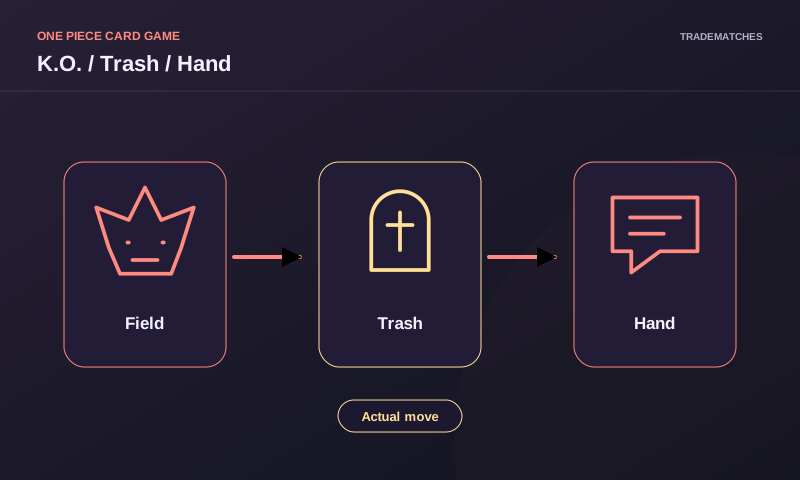
In One Piece Card Game, a character leaving the field does not necessarily mean it has been K.O.. It may have lost a battle, been sent to the trash by an effect that causes K.O., been moved to the trash by another procedure, returned to hand, or moved to another zone. The key difference determines whether abilities [On K.O.] activate or whether effects that prevent K.O. are relevant. The correct question is not "Did the card end up in the trash?" but rather "What instruction or rule moved the character?" Reading the precise verb before removing a character avoids triggering abilities that don't apply and also prevents denying abilities that should have activated.
What Counts as K.O.
The full rules define K.O. for a character sent to the trash by losing a battle or by an effect that causes K.O. When a text states "K.O. a character," the instruction moves that card from the Character zone to the owner's trash. In this case, a [On K.O.] ability that meets its conditions may activate, and a protection of the type "cannot be K.O." may be relevant. The origin of the movement is part of the resolution: simply observing the final zone is not sufficient. Two characters in the same trash may have been moved for different reasons and thus trigger different effects.
Example of a battle: you attack a rival character at rest, surpass or equal its power after legal responses, and that character loses. The rules state it is K.O. and is sent to the trash. If it had an applicable [On K.O.] effect, the owner must resolve it according to its conditions and activation order. To verify this, leave the card visible long enough to read it before physically mixing it with other cards in the trash. If the attack did not surpass the power comparison, do not invent a K.O. simply because the attack was declared: the battle loss is the actual event that produces the result.
"Send to Trash" Does Not Always Count as K.O.
The rules explicitly state that a character sent to the trash by a method other than losing a battle or being K.O. by an effect does not count as K.O.. Therefore, [On K.O.] does not activate simply because the card ends up in the trash. The game uses "trash" both for the discard zone and for movement instructions; the word does not substitute for K.O. A card that says "trash" must be resolved as written, without adding a battle-related effect that did not occur. This distinction also applies to cards that protect against K.O.: preventing a K.O. does not necessarily prevent another way of leaving the field.
A useful official example is the question about Tashigi ST19-003. Its [Activate: Main] effect sends a character to the trash, and the FAQ responds that the character's [On K.O.] effect does not activate. The card left the field, but not through the K.O. procedure. Do not turn this example into a rule that "no effect can cause K.O.": many effects literally use that instruction. What matters is comparing the verbs on each card. In a game, show your opponent the relevant line and distinguish "this text sends to trash" from "this text causes K.O.".
Returning to Hand Does Not Equal K.O.
If an effect returns a character from the field to the owner's hand, it has not been sent to the trash nor has it been K.O. by battle. The character's [On K.O.] ability does not trigger from the simple return. The card may have other effects related to leaving the field or being played again later; check the specific text. The return can be tactically strong because it temporarily removes a threat, forces the opponent to pay the cost again if they want to recover it, and can alter future attack availability. None of this makes the movement a K.O.
Also observe the difference between "return to hand" and "play again." A returned card is no longer in the Character zone; if played later, it enters as a played card and its rules and entry effects apply. Do not retain a previous state as if it had never left. If the return effect affected a character with DON!! attached, apply the regulation procedure for DON!! when the card changes zones: the DON!! attached return to the rest zone. Place those resources back on the table when resolving the return, not at the start of the next turn.
The Case of Making Space to Play Another Character
The Character zone allows up to five cards. According to the full rules, if you already have five and want to play a new one, you must reveal the card you're playing, send one of your existing characters to the trash, and then play the new card. This sending is part of a rule-based procedure, not a K.O. The rules clarify that no effects apply to this specific movement. Therefore, choosing a character with [On K.O.] to make space does not grant you its [On K.O.] benefit. Planning it as a sacrifice with a reward would create an illegal sequence.
The decision of which character to remove can still have tactical value. Perhaps you want to replace a resting character the opponent could attack, or a piece that has already delivered its [On Play] effect. However, the value comes from freeing a space and playing the new card, not from "voluntarily killing" the previous one. If the removed character had DON!! attached, order them according to the regulation procedure for a card leaving its zone. If there are special abilities that modify card placement, resolve their exact text, but do not call the normal five-space procedure a K.O.
How to Read [On K.O.]
[On K.O.] indicates an automatic ability that activates when the character meets the K.O. condition. Read the entire line: it may require a cost, a target, a condition on your Leader, or an optional decision. A K.O. occurring does not guarantee that all its instructions produce a useful result. If the character did not go K.O., you never reach that question. The rules distinguish automatic effects like [On K.O.] from activated abilities like [Activate: Main]. You cannot save a [On K.O.] to use it at a later time that is more convenient; its window depends on the event that triggers it.
When several cards appear to react to a K.O., proceed with care: complete the corresponding movement, identify which abilities have reached their moment, and consult the current rules for resolution order. Do not assume that the owner of the eliminated character always decides all abilities first, nor that a character sent to the trash by a cost automatically activates [On K.O.]. The text may refer to "one of your characters" or "an opponent's character" and limit its scope. It is preferable to keep the involved cards separate until you know which abilities are being resolved.
Protection Against K.O. and Other Exits
An instruction stating that a character "cannot be K.O." affects the K.O. event it describes. Do not read this protection as "it can never leave the field." A return to hand, a trash movement by another allowed method, or a replacement when filling the zone may follow different rules. The full rules section on K.O. states that effects like "cannot be K.O." are relevant when the character would be K.O. by battle or effect. Analyze the cause of the movement before applying the protection. If the opposing effect does not use K.O., the protection may not stop it.
Hypothetical example: your character is protected against K.O. by an effect, and the opponent announces a card that orders it returned to your hand. The protection against K.O. does not cover that return. Instead, if the opponent's card orders K.O. of a character and your protection meets its conditions, you must consider that it may prevent it. The actual outcome will depend on the cards, their target restrictions, and possible exceptions. Do not make a verbal substitution of "remove" for "cause K.O.": the game uses distinct instructions precisely to produce distinct interactions.
DON!! Attached When the Card Changes Zone
The rules state that when a card with DON!! tokens moves to another zone, the attached DON!! tokens are placed into the rest zone. This applies when examining a K.O., a return to hand, or any other exit from the zone that meets the condition. They are not added to your hand, do not go to the trash, and do not stay attached to a card that is no longer on the field. This repositioning of DON!! is a consequence of the movement, distinct from determining whether the movement was a K.O. You can resolve the DON!! correctly and still incorrectly activate [On K.O.], or vice versa; check both aspects.
If you are calculating whether a skill requiring a certain number of DON!! can activate, the exact moment when the condition is checked matters. Avoid a generic answer without reading the card: some abilities look at a prior state, while others require the condition to still hold. For a specific combination, consult the corresponding FAQ. As a table practice, physically separate the DON!! from the character leaving and place them in the correct zone before continuing with the next action. This way, it won't appear as if the power of a card that no longer exists in that zone is increasing.
Three Situations to Distinguish the Correct Verb
First: a resting character loses a battle. The combat rule causes it to be K.O.; check [On K.O.] and relevant protections. Second: a card states that you send a character to the trash without calling it K.O., as in the Tashigi FAQ. The character leaves the field, but its [On K.O.] does not activate due to that movement. Third: a skill returns a character to hand. It leaves the Character zone and may need to be played again later, but it did not go K.O. due to that return. These three scenarios may look similar during a game with many cards, but their text and subsequent effects are different.
There is a fourth common situation: playing a sixth character and sending one of your own to the trash to make space. The rules classify this sending as a rule-based procedure that does not apply effects, meaning it also does not count as a way to gain a free [On K.O.]. If you're unsure during a game, reconstruct the verbal sequence: "Which card or rule moved it?" "To what zone?" "Did it say K.O.?" "Did it lose the battle?" Asking after the character has already been mixed into the trash may hide the origin of the movement; stop the action before if it's still unclear.
What to Check When Choosing a Card
When evaluating a character with [On K.O.] for a deck, think about the actual ways it could go K.O. It could lose a battle or be the target of effects that explicitly cause K.O.; it could also be returned to hand or sent to the trash in another way that does not trigger its ability. If your plan depends on voluntarily activating [On K.O.], look for a legal instruction that actually causes K.O. and review its costs, not assume that any sacrifice works. A card whose benefit seems huge may turn out less consistent in an environment where returns to hand are common.
The same reading applies to a card that removes rival threats. A "K.O. to" effect may give the opponent a chance at [On K.O.] and encounter specific protection; a "return to hand" effect may avoid that ability but allow the opponent to re-play the card. Neither is better in all contexts. Compare cost, timing of use, allowed target, and what happens in the next turn. If you're acquiring the card through exchange, check the edition's text and official questions, as a single verb can be decisive for your strategy.
Frequently Asked Questions
Does [On K.O.] activate whenever a character ends up in the trash?
No. Only if it actually went K.O. as a result of a battle loss or an effect that causes K.O. Other movements to the trash do not automatically meet that condition.
Does returning a character to hand activate [On K.O.]?
No, due to that return. The card changes zone, but it does not lose a battle nor receives a K.O. instruction. Check separately for any other effects it might have.
Can I activate [On K.O.] when removing a character to play a sixth?
No, through the standard procedure of making space. The rules treat this as a rule-based movement to trash, which does not apply any effects of that movement.