Double Attack vs Banish in One Piece
On this page
Double Attack and Banish modify what happens when an attack deals damage to the opponent's Leader in One Piece Card Game. Double Attack turns that damage into two points, which are processed one after the other; Banish sends the Life card to the trash instead of putting it into the hand and prevents the use of its [Trigger]. No ability increases the attacker's power on its own or guarantees that the attack will deal damage. To use them properly, first resolve the battle, then check if damage is dealt to the Leader, and only then modify the Life procedure.
What happens with a normal attack on the Leader
When you declare a legal attack on the Leader, the opponent still has opportunities during the designated windows: a Character with [Blocker] can substitute the target, and Counter cards can modify the power. If the attack remains directed at the Leader and the attacker's power meets or exceeds the defender's power, the normal attack typically deals one point of damage. If there are Life cards, the defender takes the top card and adds it to their hand, unless they choose to reveal and activate a permitted [Trigger] on that card. An activated Trigger resolves according to its text and the card ends up in the trash unless otherwise specified. This basic sequence serves as the reference point for understanding what changes with each key phrase.
If a Blocker takes the attack or the defender avoids the attacker winning the power comparison, no damage is dealt to the Leader's Life. In that case, Double Attack does not remove two cards and Banish does not send any card to the trash. Neither ability activates because an enemy Character has been knocked out: both abilities refer specifically to damage dealt to the Leader's Life through an attack. Always distinguish between "attacking the Leader," "the Leader remaining the target during battle resolution," and "dealing damage to their Life"; these are not interchangeable expressions.
Double Attack: two damages, one attack
[Double Attack] causes an attack that deals damage to the opponent's Leader to deal two points of damage instead of one. You do not declare a second attack, the attacker does not get a rest, and the opponent does not reopen a full Blocker and Counter window between the two damage points. The power comparison corresponds to the battle that has already been resolved. Once two damage points are established, the Life procedure is repeated for each point. The attacker cannot choose to deal only one point to avoid the opponent receiving a card or activating a possible Trigger; official game questions explicitly clarify that no such choice exists.
For example, the defender has three Life cards and the attacker wins a battle against their Leader with Double Attack. The first damage is processed: the top Life card is taken and it is decided whether to use its Trigger, if available. Then the second damage is processed against the remaining Life state. The defender can end up with two new cards in hand, none, or one, depending on their Trigger decisions and the instructions of those cards. Simply stating "lose two Life cards" serves as a rough estimate of pressure, but does not describe everything that happens during resolution. If there is only one Life card, Double Attack does not automatically win the game: the official Q&A confirms that taking that card does not cause a loss from the second damage of the same attack. A later attack that deals damage while the Leader already has zero Life is a different event. Do not treat two damage from one battle as two consecutive attacks.
Why damage points are processed in order
Each damage point examines the top Life card at that moment. If the first card has a [Trigger] and the defender chooses to activate it, the effect resolves before moving to the second damage point. That effect may alter the field or hand, so it is not advisable to lift both cards simultaneously or to pre-select which Trigger seems most beneficial. The order of Life cards remains important. In a physical game, you announce "first damage," allow the opponent to complete their decision and resolution, and then announce "second damage." This makes it clear which card was on top at each step and when the field state changed.
Official documentation presents a case that often causes confusion: the Trigger of the first card causes the attacker to leave the field or lose Double Attack. The second damage still proceeds, because the amount of damage was already fixed when the battle was resolved. This does not mean Triggers never matter: they are applied and can change other aspects of the situation. It means that removing Double Attack at that specific moment does not retroactively reduce the two already-determined damage points to one. If a specific card states that it cancels or modifies damage in another way, follow its text and official resolution, do not extrapolate this example to any defensive effect.
Banish: the Life card goes to the trash
[Banish] changes the destination of the Life card when an attack deals damage to the opponent's Leader. The corresponding card is sent to the trash of the defender instead of being added to their hand. Additionally, its [Trigger] cannot be activated during this process. The ability does not add a second point of damage: a normal attack with Banish still deals one point of damage, but the defender loses immediate access to that card and its potential Life effect. Official questions indicate that the defender cannot choose to receive it in hand or decide that it will not be sent to the trash once Banish is applied.
Suppose the opponent has two Life cards. Your attacker with Banish surpasses their Leader. The top Life card moves to the trash and one Life card remains, unless another text changes the result. The defender does not necessarily know in advance which card will be lost: Life cards are typically face down. If that card had a [Trigger], it cannot be used due to this damage. This ability is valuable when the opponent relies on gaining resources from hand by receiving hits or on possible responses from Life. Still, it does not prevent the opponent from defending before the damage with Blocker or Counter.
Mental table: quantity versus destination
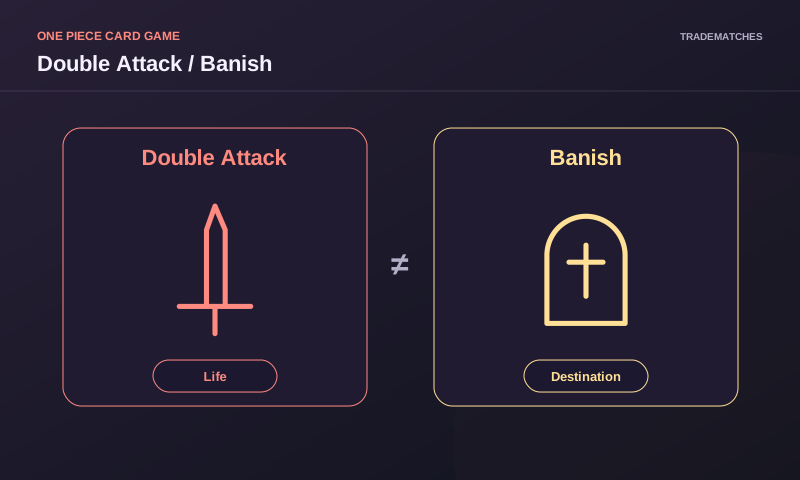
To quickly resolve a doubt, think of two axes. Double Attack answers "how much damage?": two points instead of one when the attack deals damage to the opponent's Leader. Banish answers "where does the Life card go?": to the trash without a Trigger, instead of to hand or its usual Trigger procedure. One ability affects the quantity; the other affects the treatment of the involved card. This distinction avoids imprecise phrases like "Banish hits harder" or "Double Attack discards two cards," which can lead to misresolving a game.
If an attacker combines both abilities through card text or a legal effect, both questions are examined. There may be two points of damage and each card affected by Banish follows the destination established by applicable rules and effects. Do not assume that any card with an ability gains the other, nor that the result can be abbreviated without considering simultaneous effects. For a specific combination, show the involved cards, resolve each damage point in order, and consult official FAQ if the wording alters the normal procedure. The combined case does not change the individual meaning of Double Attack or Banish.
What happens if the attack targets a Character
You can choose a normal attack's target to be either the opponent's Leader or a rested enemy Character. If the target is a Character, the primary result of winning the battle is that that Character is knocked out. Double Attack does not cause two K.O.s because the battle was won once; Banish does not send a Life card to the trash because the Leader did not receive damage to Life. The text of both abilities refers specifically to damage dealt to the opponent's Leader. This also matters if a Blocker intercepts an attack originally aimed at the Leader: the effective target becomes the Character blocking, and you should not automatically apply the consequences of Life damage.
A card may also have [When Attacking] or other instructions that affect the attacked Character. Resolve these instructions separately and do not attribute their result to Double Attack or Banish. In a complex board, speak aloud what ability you are applying: "this effect reduces power," "this battle knocks out the Character," or "this attack deals damage to Life." A precise phrase allows the opponent to verify their response and avoids using a key term to explain a result caused by another card.
Defensive decisions before the ability matters
The defender does not have to wait to see which Life cards they would lose to decide their entire defense. During the Blocker step, they can redirect the attack if they have a legal Blocker; during the Counter window, they can increase power using permitted cards. If preventing normal damage saves a Life card, preventing Double Attack may save two; if the attacker has Banish, defense can protect a card that would otherwise reach the hand. The value of using a Counter also depends on how many cards remain in your hand, upcoming attacks, and whether the Character with Blocker has another function. There is no universal answer of "always block Double Attack."
For the attacker, the presence of Blockers and the opponent's card reserves may make a powerful keyword ineffective this turn. You can force other defenses, combine DON!! to boost an attacker's power, or choose a different attack order, as long as it follows the rules. Double Attack and Banish reward attacks that connect; therefore, you must separate power calculation from the reward of impact. Buying or trading a card for its keyword without checking its cost, power, color, and actual position in your curve may leave you with a threat that never deals damage.
Low Life and defeat condition
In One Piece, reaching zero Life cards does not automatically mean defeat at that moment. Defeat occurs when your Leader receives damage while having zero Life, except for specific effect modifications. This is especially relevant when counting attacks with Double Attack. If you have two Life cards and receive two damages, you typically end up with no Life cards, but you must continue playing until a defeat condition is met. If there was only one Life card, the two-damage procedure may first remove that card from Life and then face damage with zero. Verify each step before announcing the end.
Banish also does not change the victory condition: sending a Life card to the trash does not automatically mean the attacker won. With one Life card, a Banish hit may leave the defender at zero, but it requires evaluating whether additional damage was received when they already had no Life cards. Do not conclude prematurely just because of the apparent strength of the keyword. In learning games, placing a visible marker for remaining Life cards helps track Double Attack points, while directly moving the affected card from Banish to the trash avoids accidental mixing with the hand.
Errors to correct on the board
The first is treating Double Attack as two attacks. This invents new defensive windows and may allow or deny effects at times when they don't exist. Declare a battle, determine if damage is dealt, and process two Life points. The second is giving the defender a Life card reached by Banish so they can decide whether to activate its Trigger. Banish sends that card to the trash without that choice. The third is applying either ability simply because the attacker won against a Character. Winning a battle against a Character and damaging the Leader are different results.
Another error is taking two Life cards at once with Double Attack. If the first card contains a permitted Trigger, it must resolve before moving to the second. Also, do not change the damage amount because the attacker disappears after the first Trigger: official FAQ maintains the second damage is already fixed. When there is an exceptional effect altering Life, pause the sequence, read the full text, and consult the current rules document. It is better to spend a few seconds identifying which damage point is being resolved than to reconstruct the game several turns later.
Frequently Asked Questions
Does Double Attack allow choosing to deal only one damage?
No. If the attack meets its conditions and deals damage to the Leader's Life, the ability turns it into two damage points; the attacker does not choose to reduce it to one.
Can a Trigger on a Life card sent to the trash by Banish be activated?
No. Banish replaces the card going to hand with the card going to trash, and the [Trigger] on that card is not activated by this damage.
Do Double Attack or Banish work when attacking a Character?
Their effects on Life do not apply if the battle ends against a Character and no damage is dealt to the Leader. Other abilities on the card may have their own effects; check them separately.