Once Per Turn in One Piece: when can you use it again?
On this page
[Once Per Turn] in One Piece Card Game limits a specific ability of a card to one activation and resolution per turn. If you have two cards with that ability, the limit counts separately for each card, unless another text specifies otherwise. It does not mean "once per game" and does not allow using the ability at any time: in addition to this limit, the conditions, activation window, and costs must also be met.
What exactly does the expression limit?
The full rules define [Once Per Turn] as a keyword that allows activation and resolution of an effect only once during that turn. After resolving it, you cannot activate the same ability of that card again during the same turn, even if its condition is met again. You also cannot pay the activation cost again to try to repeat it. The restriction applies to that use of the card, not to all actions you can take with the Leader, Characters, or DON!! during the turn.
For example, imagine a hypothetical ability that triggers when you play a Character and includes [Once Per Turn]. If the event occurs, the conditions are met, and the ability is resolved, playing another Character later in the same turn does not allow you to reuse that ability from the same card. You can continue playing cards if you have resources and the sequence permits; what has already been used is the limited use of that ability. This distinction prevents treating the keyword as a general prohibition against playing more Characters.
"Per turn" does not mean "per game"
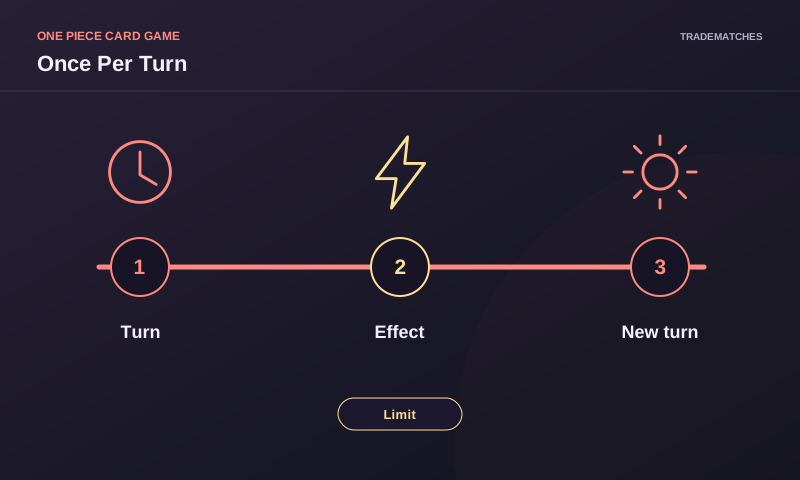
Once a turn ends and a new one begins, the [Once Per Turn] count resets for the new turn. If the card remains in a zone where its ability functions and its condition is met again, it has a new opportunity. You do not need to return it to your hand and play it again just to "recharge" it. The ability does not exhaust itself for the entire game simply because it was used in a previous turn.
In card games, it's easy to say "round" when actually referring to two turns—the one you play and the opponent's. [Once Per Turn] refers to the turn in which the effect can be activated and resolved. If an ability also has a condition that can occur during the opponent's turn, read that condition and the moment of activation; do not assume that using it in your turn automatically blocks the opponent's next turn. You also cannot assume you can use it there: the specific window is defined by the rest of the text.
Two copies do not automatically share one use
The rules state that when there are multiple cards with the same effect [Once Per Turn], the effect can be activated and resolved once per card. If you control two different Characters with such an ability, each has its own count. Using the effect of one does not consume the use of the other simply because both have the same name or wording. Each copy is a separate game object and must meet its own requirements.
Example: Two Characters in your zone have a hypothetical ability that activates when an event occurs. The event happens and both cards meet their conditions. The [Once Per Turn] keyword limits each card to one resolution during the turn, but does not combine the two cards into one. The activation and order rules of effects must still be applied; the point of this guide is the individual count. If a specific card establishes an additional limit affecting a name or the entire player, that special text must be read separately.
The keyword does not create a new window
[Once Per Turn] answers to "how many times?" not "when?" To know when you can use an ability, read the rest of the card: it may say [Activate: Main], refer to an attack, activate when playing a Character, or wait for another event. If the condition does not occur during the turn, the keyword does not allow you to activate it at all. Similarly, if an ability only works during your Main Phase, it does not gain permission to be used as a response during the opponent's turn.
Suppose a Stage has an ability that says [Activate: Main] and [Once Per Turn], with an additional cost. First, check that you are in the permitted moment for [Activate: Main]. Then verify that you have not already used that Stage's ability during the turn and that you can pay the cost. Only then do you activate it. Performing this check in this order avoids a common mistake: seeing "once per turn" and assuming any moment of the turn is valid. The existing guide on [Activate: Main] provides more detail on the activation window.
Condition, cost, and effect are separate pieces
The wording of an ability may include a condition for activation and a cost you must pay before applying the effect. [Once Per Turn] does not eliminate any of these components. If the condition requires a specific game state, simply having the ability not yet used is not sufficient. If the cost requires resting DON!!, returning DON!! to the deck, or performing another action, verify that you can pay exactly what is specified. Then resolve the effect according to the current text.
The full rules include a less intuitive detail: if an ability with [Once Per Turn] activates and, during cost payment, it becomes impossible to complete the cost, it may remain unable to be activated again during that turn, even if the subsequent effect does not resolve. This situation requires reconstructing the exact sequence; do not use it as an excuse to repeat a failed activation without reading the rule. In an organized game, if a partial payment or unusual interaction occurred, explain the sequence to a judge before attempting to "rewind" the play.
What happens if the card leaves and returns to the field?
The rules treat a card that moves to another zone and returns to the field as a different card for these effects. If its ability [Once Per Turn] was already resolved, and it leaves the field and later returns legally, it can be activated again if its moment and conditions are met. It is not a general license to move cards at will: you need an action or effect that genuinely causes those zone changes.
Imagine a Character whose ability with a [Once Per Turn] limit was used during your turn. An allowed effect returns it to your hand and then you play it again. The copy that just entered is considered a new object for the use limit, so it could use the ability again if its text and sequence allow it. If the Character simply rested and was reactivated, it did not leave the zone and remains the same card for the count. The difference between changing orientation and changing zone is decisive.
A new copy stolen later
A second copy of a card you already have may also appear in play. If the rules and zone limits allow playing it, its [Once Per Turn] is counted independently. This does not mean it can automatically activate upon entering: it may require a moment that has already passed or a condition that has not yet occurred. The independent count does not replace other requirements. A full reading prevents concluding "it's a new copy, so I get the effect now" without verifying the trigger.
When building a deck, this separation helps evaluate multiple copies of a Character or Support Stage. Two copies on the field may offer more opportunities if the ability is per-card, but they also occupy space and consume game resources. For Stages, remember that only one can occupy your Stage zone; playing another replaces the previous one. Therefore, the [Once Per Turn] rule per card and the Stage limit can interact, but they do not turn two Stages into permanent simultaneous presence.
Effects that trigger multiple times
Some cards have conditions that could be met multiple times in a single turn: playing different cards, attacking more than once with different elements, or producing a repeated event. The keyword exists precisely to prevent the effect from resolving each time from the same card. After the first valid use, mentally or physically mark that it has already occurred. Do not place the ability back into the sequence simply because the same event occurred again.
If a condition is met but you choose not to activate an optional ability, the question about the count may depend on the exact wording and whether the ability actually activated. Do not convert a general assumption into a response for all cards. It's certain to record which effect was announced and resolved, and to check whether the text gives a choice or imposes activation. The rules distinguish activation, cost, and resolution; for a specific interaction, those stages matter more than a summarized memory phrase.
How to keep a clear count
At a table with multiple Characters, use a signal that does not confuse with active or rested status. You can place a small marker next to the card that has already used its ability, if the format and event allow auxiliary markers, or simply announce "this ability has already been used this turn." Remove or reset the signal at the start of the corresponding turn. Do not rotate the card to represent use if the ability does not require resting it: that would alter another relevant game information.
When two identical cards have the same ability, mark which of the two activates each time. If both are in the Character zone and one is sent to trash, it's important to know which one had used its ability. Physical order on the table can help, but explicit announcement is better. Before a long sequence, verify that the cost and moment are met; this reduces future corrections and the risk that your opponent thinks you used the same copy twice.
Three scenarios exercise
First: a Character with [Once Per Turn] resolves its ability, and the condition reoccurs during the same turn. Do not repeat the ability of that card. Second: you have two Characters with the same text; each card meets the condition and neither has used its own ability. The limit allows one resolution per card, subject to sequence rules. Third: the first Character leaves the field and returns legally; the rules treat it as a new card, and the previous count does not carry over to the new object.
In all three scenarios, add a follow-up question: was this the permitted moment for the ability? If the text says [Activate: Main], it is not enough that a use remains; it must be within a window where activation is allowed. If a cost is required, it must be paid. This exercise separates the three concepts most often mixed up: frequency, opportunity, and resources. A correct answer to "once per turn" does not automatically resolve a play whose moment or cost is illegal.
Frequently Asked Questions
Can two identical cards use the same ability once each?
Yes, the [Once Per Turn] limit is counted per card according to general rules, as long as each one meets its condition and there is no specific limit otherwise.
Does it reset when a new turn begins?
The count applies to the turn. A card remaining in play can have another opportunity in a future turn if its ability can be activated at that moment.
Can I repeat it if the card leaves and returns to the field?
The rules treat the card that returns as a new object for this limit. Still, you must meet the activation window and any cost or condition specified in the text.