How to read a graded card label: PSA and CGC explained
On this page
Read a graded card label like a record card: which card it is, what grade it got, and whether anything is attached to that grade. On PSA slabs, letters after the number (MK, MC, OC, ST, PD, OF) flag one specific flaw; an N1–N9 code means the card came back without a grade; and "Authentic" confirms the card is genuine but gives it no number. On CGC slabs, Pristine 10 and Gem Mint 10 are two different tens, and an error name describes a recognised factory mistake without replacing the grade. Everything below was checked against PSA's and CGC's own websites on 21 October 2026.
What is on a PSA or CGC label
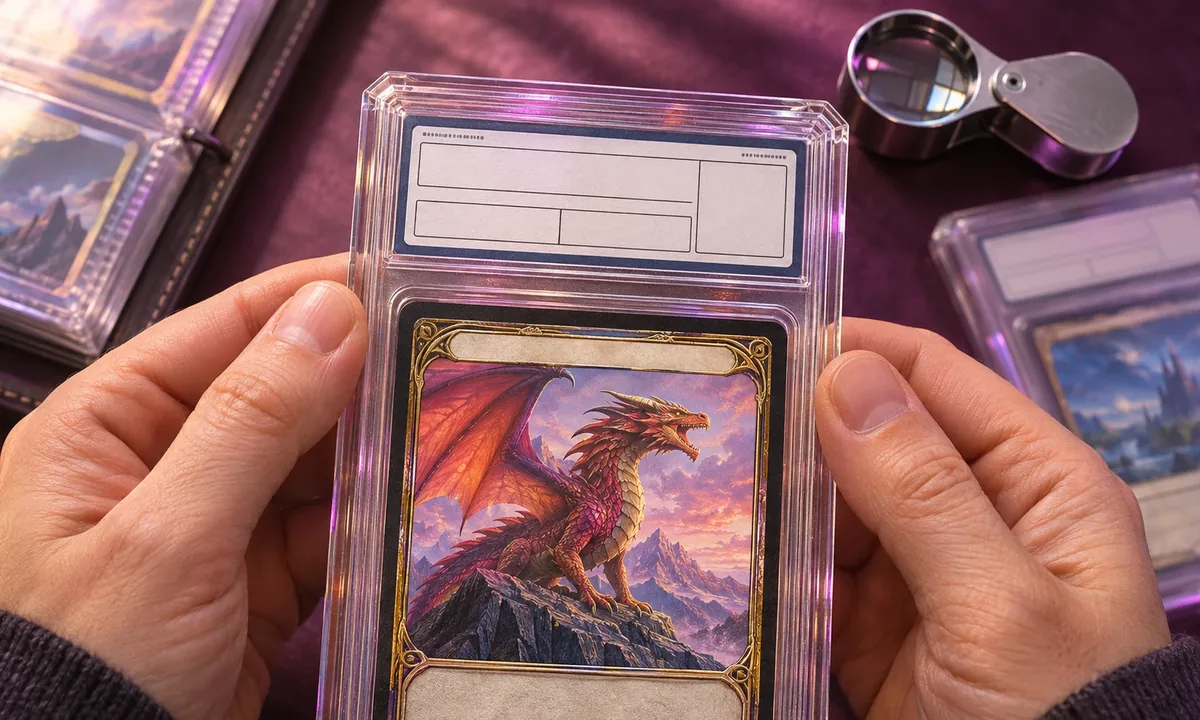
The front of the label identifies the card and gives the grade; the back is mostly there so you can check it. PSA's security page says its LightHouse label, in use since 2017, carries a QR code on the reverse that opens the cert lookup. CGC says its label has a unique certification number and barcode, and that the back holds a QR code, any autograph grades and, if requested, a pedigree.
Each PSA number comes with a fixed abbreviation. Knowing them stops you from mixing up, say, an "NM-MT 8" and an "NM 7":
| Grade | Label abbreviation | Full name |
|---|---|---|
| 10 | GEM-MT | Gem Mint |
| 9 | MINT | Mint |
| 8 | NM-MT | Near Mint-Mint |
| 7 | NM | Near Mint |
| 6 | EX-MT | Excellent-Mint |
| 5 | EX | Excellent |
| 4 | VG-EX | Very Good-Excellent |
| 3 | VG | Very Good |
| 2 | GOOD | Good |
| 1.5 | FR | Fair |
| 1 | PR | Poor |
Before comparing two slabs, read four things: the card description (game, year, set, number, language or variant), the number with its abbreviation, any letters or words added to the grade, and the cert number. For checking that number on PSA's site, and what a match does and does not prove, see how to verify a PSA graded card by its cert number.
PSA qualifiers: what MK, MC, OC, ST, PD and OF mean
MK on a PSA label stands for "Marks": the card has writing, ink, pencil or the indentation left by writing on it, and PSA flags that with the two letters next to the grade. It is one of PSA's six qualifiers. PSA's FAQ describes a qualifier as the term used when a card meets every requirement for a grade except for one significant flaw, so the number and the letters belong together. PSA's own glossary example is a card that has everything an NM-MT 8 needs apart from 90/10 left-to-right centering: it gets "NM-MT 8 OC".
| Code | PSA name | What it flags | PSA category |
|---|---|---|---|
| MK | Marks | Writing, ink, pencil, or the impression left by writing | Required |
| MC | Miscut | A cut that is atypical for the issue: part of the card missing, or more than one card visible | Required |
| OC | Off Center | Centering below the minimum for the grade | Optional |
| ST | Staining | Staining | Optional |
| PD | Print Defect | A printing defect | Optional |
| OF | Out of Focus | Blurred or out-of-register image | Optional |
"Optional" is not a box you tick. For OC, ST, PD and OF, PSA's grading standards say a card will either carry the qualifier or receive a number that already accounts for the flaw. An off-center card can come back as "8 OC" or simply as a lower number with no letters.
The June 2021 change
Until 2021, submitters had to decide card by card whether to request "No Qualifiers". In its customer update of 7 June 2021, PSA said that, as of the previous week, that choice was gone: MK and MC would still be applied when warranted, while the other four would be left to the grader and would most typically lower the number instead of appearing as letters. As of 21 October 2026, PSA's FAQ still splits them into two required and four optional qualifiers. None has been retired.
Worked example: "PSA 8 OC" or "PSA 7"?
Two copies of the same card are on offer. By PSA's definition, the first meets the bar for an 8 in every respect except centering. The second is a 7 overall, with no single flaw singled out. If a lopsided border bothers you most, you may prefer the 7; if corners and surface matter more to you, the 8 OC may be the nicer card. There is no universal answer, and none of the PSA pages we read gives a table converting an 8 OC into some other grade. Ask for front and back photos and judge the actual flaw.
Common mistakes with qualifiers
- Reading MK as a certified autograph. MK only says there are marks. A genuine signature is certified through a separate route, covered in the signed cards section below.
- Treating MC and N8 as the same thing. MC sits next to a grade; N8 is a no-grade result for an abnormal factory cut. PSA publishes no measurement separating the two, so go by what the label says.
- Pricing off the unqualified grade. A "9 ST" and a "9" are different results; look for sales with the same number and the same letters.
- Expecting a half point. A qualified card cannot get a half grade, as explained in the half grades section.
PSA N1–N9 codes: what N9 means and the other no-grade results
N9 on a PSA result means "Don't Grade": PSA does not grade that kind of card or cannot fit it in a holder, for example because it is oversized or comes from an obscure issue. The card is returned unslabbed and PSA does not charge the grading fee. The other N codes give different reasons why a card received no grade. None of them is a low grade, and there is no such thing as a "PSA 0".
| Code | PSA name | What PSA found | Can it be slabbed? | Grading fee charged? |
|---|---|---|---|---|
| N1 | Evidence of Trimming | An edge that appears to have been cut down | As Authentic Altered, if "AA" was requested | Yes |
| N2 | Evidence of Restoration | Card stock built up, such as rebuilt corners | As Authentic Altered, if "AA" was requested | Yes |
| N3 | Evidence of Recoloration | Colour artificially improved | As Authentic Altered, if "AA" was requested | Yes |
| N4 | Questionable Authenticity | Appears counterfeit, or the autograph is deemed not genuine | Never | Yes |
| N5 | Altered Stock | Pressed creases, removed scratches, enhanced gloss or applied substances | As Authentic Altered, if "AA" was requested | Yes |
| N6 | Minimum Size Requirement | Significantly undersized against factory specs | As Authentic, if "Auth" was requested | No, unless slabbed |
| N7 | Evidence of Cleaning | Whitened borders, cleaning solutions or sprays | As Authentic Altered, if "AA" was requested | Yes |
| N8 | Miscut | Factory cut abnormal for the issue | As Authentic, if "Auth" was requested | No, unless slabbed |
| N9 | Don't Grade | PSA does not grade the issue or cannot encapsulate it | No | No |
Slabbing an N result needs two things: the grader's agreement, and "AA" or "Auth" entered as the minimum grade on the submission form. PSA notes that the minimum grade option is only offered on some service levels. Without it, the card simply comes back raw.
After an N9: how to ask PSA to look again
An N9 is not necessarily final. PSA says the decision can be reversed on resubmission if you supply information about the issue from two or more verified or hobby-approved resources, and it asks you to file a Research Request through its Customer Request Center before sending the card back. With a local promo or a poorly documented event card, gather that evidence first; resubmitting with nothing new gives PSA little reason to decide differently.
N4 says nothing about other copies
N4 applies to the item PSA actually examined: it looks counterfeit, or its signature was judged not genuine. It does not make every copy of that card fake, and it is not grounds for accusing another seller without further evidence. What it does settle is that this item will never be slabbed, and the fee is charged.
The alteration codes: N1, N2, N3, N5 and N7
These five codes describe something done to the card after it left the factory: trimming, rebuilding, recolouring, pressing or cleaning. PSA charges the grading fee for all of them because spotting the alteration takes its graders' time. Do not try to "fix" the card before resubmitting: any further work is another alteration.
PSA Authentic vs a numerical grade
A PSA "Authentic" label means PSA judged the card genuine but gave it no grade: it is not a PSA 10 or a PSA 1, and no number can be inferred from it. According to PSA's standards, the reason may be an alteration, a major defect, or a submitter who asked for the card to be slabbed without a grade. On the same page, PSA lists Authentic under the code N0.
There is also "Authentic Altered" (AA): genuine, but showing trimming, recolouring, restoration or cleaning. PSA uses it case by case, space permitting, and only when "AA" was requested as the minimum grade. The part buyers should know sits in PSA's guarantee: because character limits sometimes stop PSA printing the word "Altered", any card labelled "Authentic" must be treated as potentially interchangeable with "Authentic Altered", and the guarantee values them equally. In other words, an Authentic label does not promise an unaltered card.
| What you see | What PSA certifies | What it leaves open |
|---|---|---|
| A grade from 1 to 10 | Authenticity and condition under its standards | Market price |
| A grade with a qualifier | That grade, apart from one named flaw | What unqualified grade it "matches" |
| Authentic | The card is genuine | Its condition, and whether it is altered |
| Authentic Altered | Genuine and altered | How much the alteration matters |
| No slab, N code | Why it got no grade | Anything about other copies |
A typical listing reads "PSA authentic, basically mint". The label backs up the first half; the second half is the seller's opinion. Ask for sharp photos of the card through the holder and compare with completed sales of other Authentic slabs, not with PSA 10 or PSA 9 sales.
PSA half grades: an 8.5 is not halfway between 8 and 9
PSA awards half grades from 2 up to 9 (2.5, 3.5 and so on up to 8.5) to cards that stand out within their grade, with centering weighed heavily; there is no PSA 9.5. The 1.5 is something else: a grade in its own right, Fair (FR), sitting between Poor 1 and Good 2.
PSA announced half grades on 16 January 2008, for cards submitted from 1 February that year. It skipped 9.5 because it already had two Mint grades, 9 and 10, and described a half point as a premium example within the grade rather than a midpoint, adding that a whole-number card is not "low-end" for its grade. The announcement also gave a rule of thumb: in most cases, centering has to beat the grade's tolerance by at least five to ten percentage points.
That same announcement ruled out half grades for qualified cards: a card must first reach an unqualified grade, so an "NM-MT 8 OC" cannot become an 8.5 however strong the rest of it is. As of 21 October 2026 we found no later rule on psacard.com changing this. If you are choosing between an 8 and an 8.5 of the same card, look hardest at front centering in straight-on photos.
PSA signed cards: dual grading of card and autograph
With PSA's Card and Autograph Dual Service, the label can show two grades from 1 to 10: one for the card's condition and one for the quality of the signature. PSA's autograph authenticators certify the signature before any grade is given. An autograph 10 describes the signature, not the card: a card graded 7 with an autograph graded 10 has two results, not an average of 8.5.
PSA's FAQ sets out which cards must go through that service: signed cards from before 1998, and any card whose autograph was not certified directly by the manufacturer. Manufacturer-certified autographs from 1998 onward can go through a regular service, but then only the card is evaluated. On that rule, a TCG card signed by its illustrator at an event, with no manufacturer certification, belongs in the Dual Service, where you can ask for the card, the autograph or both to be graded.
For an autograph 10, PSA's standards call for bold writing with no skipping or retracing, a signature that is strong, clear and typical of how that person signs, and good placement. On modern cards, PSA takes factory surfaces such as gloss and embossing into account. An inscription does not count against the grade in itself, since the signature carries more weight; an autograph that has been enhanced or touched up, however, cannot be graded at all.
One point to know before paying for a dual-graded card: PSA's guarantee does not cover the authenticity or grade of any autograph, whether manufacturer-certified or added later. A signature judged not genuine is also one of the N4 cases. On 21 October 2026, the Standard Dual tier cost US$79.99 per card, with a US$1,000 maximum insured value and an estimated 100–110 business days; the Value tiers were listed as unavailable. For the full cost of sending cards from Spain, see the guide to PSA grading from Spain.
CGC Pristine 10 vs Gem Mint 10: two different tens
At CGC, Pristine 10 is the top grade and gets its own special label; Gem Mint 10 is a 10 overall where one grading criterion falls short of Pristine. CGC's scale describes a Pristine 10 as virtually flawless to the naked eye, with 50/50 centering and flawless colour and registration; the same page presents the label as reserved for cards that are flawless under 10x magnification. A Gem Mint 10 has corners that look perfect to the naked eye and Mint+ under 10x, a surface free of print spots, and centering no worse than about 55/45 on the front and 75/25 on the back.
| Current CGC label | CGC's description, in short |
|---|---|
| Pristine 10 | Flawless to the naked eye, 50/50 centering; special label |
| Gem Mint 10 | A 10 overall, with one criterion below Pristine |
| Mint+ 9.5 | A Mint card with premium eye appeal, for example exceptional centering or surface |
| Mint 9 | Four sharp corners with minor wear; for TCG cards, only a few minor manufacturing or handling defects |
| NM/Mint+ 8.5 and NM/Mint 8 | Minor wear; for TCG cards, small handling defects (8.5) or small-to-moderate ones (8) |
Easy to miss: from 9 downwards, CGC's centering percentages are stated for sports and non-sports cards. For TCG cards, the descriptions talk about manufacturing and handling defects rather than a centering ratio.
Older labels: the 9.5 that now counts as a 10
CGC publishes a key for grades it no longer uses. The old "CGC Trading Cards Gem Mint 9.5" and "CSG Gem Mint 9.5" now correspond to CGC Cards Gem Mint 10, while "Perfect 10" from either brand is retired but keeps its Perfect 10 status. CGC's Population Report and Registry already use the updated scale, so a cert lookup can show a 10 for a slab whose printed label says 9.5. Check the brand name on the label before suspecting a fake. The conversion does not apply to today's Mint+ 9.5, which is still a 9.5.
Coming from BGS? CGC's FAQ says it no longer offers subgrades. Comparing with PSA, a PSA 10 allows the same maximum centering as CGC's Gem Mint 10 (55/45 front, 75/25 back), but PSA has nothing above 10 and no 9.5. Neither company publishes a conversion table between their labels, so compare sales from the same grader at the same grade.
CGC error cards: what the label certifies
When CGC recognises a factory error, it names it on the label next to the grade: the error name (Miscut or Crimped & Cut, for instance) says what happened in production, and the number still measures the card's condition. CGC's FAQ says it grades cards with printing errors at no extra fee. Its error guide, posted on 7 February 2022 and updated on 18 August 2025, describes each type with Pokémon, Magic and Yu-Gi-Oh! examples.
The guide itself shows the error name and the grade working independently. A paper jam that crumples a card at the factory, before it is cut from the sheet, counts as an error and, according to CGC, does not affect the final grade. The reverse also happens: on a Fossil Zapdos used as an example, an incorrect holo cutout found on every English 1st Edition copy is left off the label, because it belongs to the print run rather than to that one card.
CGC's three levels of miscut
| Label wording | CGC's threshold |
|---|---|
| Off-Center (error) | Clearly uneven margins, usually with no registration marks showing |
| Minor Miscut | At least half of one alignment dot visible in a corner, or part of the design missing without another card showing |
| Miscut | Part of at least one other card visible |
| Major Miscut | Parts of at least two other cards visible |
PSA, by contrast, handles an abnormal factory cut either as an MC qualifier on a grade or as an N8 with no grade. The same dramatic miscut can therefore end up described very differently depending on who graded it.
What CGC will not certify as an error
- Not-factory-cut (NFC) cards. Usually not graded; the exception is NFC test prints.
- Wizards of the Coast-era square cuts. Only Neo Genesis holos are accepted without paperwork; others need provenance tracing back to a WotC employee, because uncut sheets are in circulation. The guide warns that some resellers cut cards from those sheets and pass them off as errors.
- Alterations that imitate a rarer version, such as blacking out white borders or changing the set symbol, plus rebacked cards and clipped Beta cards.
- "Holo bleeds". The guide states plainly that CGC does not recognise them.
A CGC label can also carry notes that are not errors: "Hand Cut" on hand-cut cards, "Inadvertent Early Release" on cards accidentally released early and delivered to CGC at least 30 days before the official release date, or a pedigree naming an owner (US$5 per card on 21 October 2026). If you have a raw card with something odd about it and cannot tell whether it is an error or damage, start with how to tell a Pokémon card misprint from damage.
CGC Authentic, Authentic Altered and autograph grades
CGC uses AU (Authentic) for genuine, unaltered cards that cannot be given a grade, AA (Authentic Altered) for genuine cards that have been altered, and ART for cards with custom artwork. AU covers, for example, undersized cards and hand-cut cards that fall below the published measurements. The contrast with PSA is worth noting: CGC's AU definition includes "unaltered", whereas a PSA Authentic label may hide an alteration.
CGC grades autographs from 5 to 10 with no half grades; a signature that would fall below 5 becomes AU. Autograph grades go on the back of the label. CGC certifies cards with manufacturer-certified autographs and offers JSA authentication as an option for other signatures.
FAQ
What does MK mean on a PSA card?
PSA found writing on it: ink, pencil or the groove left by a pen. The qualifier is applied whenever that happens and never certifies a signature.
Does PSA charge me if my card comes back with an N code?
It depends on the code. N1, N2, N3, N4, N5 and N7 are charged; N6, N8 and N9 are not, unless the card ends up slabbed as Authentic because you set that as your minimum grade.
Why is there no PSA 9.5?
PSA already had two Mint grades, 9 and 10, and in 2008 chose not to add a third. CGC does use a 9.5, called Mint+.
Is an old CGC 9.5 the same as a CGC 10?
Only when the label says CGC Trading Cards or CSG Gem Mint 9.5; CGC now treats those as Gem Mint 10. The current Mint+ 9.5 is unchanged.
Before you buy or trade a slab
Ask for a photo where the whole label is legible, copy its full text into your records (grade, letters, designation and cert number), and only compare against sales with exactly the same combination. If you are hunting a particular graded card to swap in person, TradeMatches lets you add it to your "want" list, see nearby matches and talk to other collectors in your province's chat.
Sources and checks
- PSA: grading standards (grades, qualifiers and N codes)
- PSA: full text behind the standards page, including optional qualifiers and Authentic
- PSA: FAQ on qualifiers, no grades and the Dual Service
- PSA: glossary definition of a qualifier
- PSA: June 2021 customer update on qualifiers
- PSA: half grades announcement (2008)
- PSA: Authenticity and Grade Guarantee
- PSA: Card and Autograph Dual Service, with pricing
- PSA: autograph grading standards
- PSA: autograph grading guide and modern cards
- PSA: LightHouse label and security features
- CGC Cards: grading scale, designations, autographs and legacy grades
- CGC Cards: holder and label
- CGC Cards: FAQ on accepted cards, errors and NFC
- CGC Cards: FAQ on grades and subgrades
- CGC Cards: FAQ on pedigrees and early releases
- CGC: error guide (linked from cgccards.com)