The stack and priority in Magic: how to respond
On this page
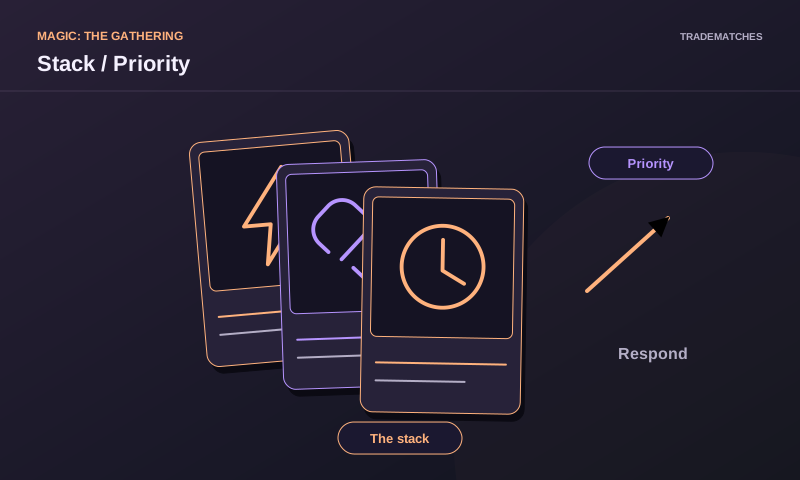
In Magic, the stack orders spells and abilities that are waiting to resolve; priority determines who can act before something resolves. When a player casts a spell, they typically retain priority and can make another legal action. If both players pass consecutively, the top object on the stack resolves. The most recently placed object is usually resolved first. Mastering this sequence explains when you can respond and why an effect occurs before another.
The stack is an ordered wait, not a turn queue
Imagine you cast spell A, and before it resolves, your opponent casts an instant B in response. A is on the stack beneath B. If no one adds anything else and both players pass, B resolves first. Then the players get another opportunity to act before A resolves. The spells do not resolve simultaneously just because they were both announced. The stack precisely allows you to insert responses between a spell and its resolution.
The order is inverse to entry: the most recently placed object occupies the top. If you respond to B with another instant C, the normal resolution sequence will be C, then B, then A—provided no effect counters or alters it. It's helpful to physically stack the cards or repeat aloud, "A, on top of B, on top of C." Memory fails when multiple abilities trigger and each player adds responses; visualizing the stack shows what still awaits.
Priority determines who can add something
The player with priority can cast spells at times allowed by their rules, activate abilities, or perform certain special actions. An instant can be cast when you have priority. A non-instant spell usually requires your main phase and an empty stack, unless another rule or effect changes that permission. Therefore, "I have a card in my hand" is not sufficient to respond to an attack or spell from your opponent.
At the start of most steps and phases, the active player receives priority after processing automatic actions and placing relevant triggered abilities onto the stack. They also receive priority after a non-mana spell or ability resolves. There are exceptions, such as the "reorient" step, where no player normally receives priority. For casual play, it's sufficient to simply not interrupt an effect mid-resolution and ask "Can I act now?" during windows when a player has priority.
Passing priority is not the same as passing turn
If you have priority and choose to do nothing, you pass it to the next player. If the stack contains a spell, your opponent can respond or also pass. When all players pass consecutively without adding actions in between, the top object on the stack resolves. If the stack is empty and all pass, the corresponding step or phase ends. Thus, saying "I pass" in front of a spell does not mean you're giving up the ability to intervene throughout the entire turn; it means you pass on that specific opportunity.
Example: You cast A and pass. Your opponent passes, so A resolves. Then you receive priority again according to the game sequence and could make another legal action. If A created a new situation, both players can respond in later windows. In contrast, if your opponent responds to A with B, the chain of passes is broken; before resolving B, priority must be offered again according to the rules. This mechanic prevents a player from accumulating three spells and declaring they all resolved without offering a response.
Who casts a spell can respond to themselves
The rules state that if a player had priority and casts a spell or activates an ability, that player receives priority again. Thus, they can place another legal action on top of their own spell before the opponent receives priority, if they truly wish to do so. In casual play, the sequence is often abbreviated by assuming the player passes to give the opponent a chance, but that custom does not erase the rule. If it matters, explicitly announce "I maintain priority."
Suppose you cast a spell that is more effective if another instant is resolved first. You could cast the first, maintain priority, and cast the second on top. If both players pass, the second resolves first and can change what happens to the first. The play does not allow casting a spell in response outside its normal moment: maintaining priority gives a window, but each spell retains its own timing restrictions. Always distinguish "I have priority" from "this type of spell can be cast now."
What does it mean to respond to a spell?
Responding means placing a new spell or activated ability onto the stack while another object is already waiting. That new action resolves first if no one adds another response. A response can protect a permanent, increase a creature's power, change an effect's target, or counter a spell, depending on the specific text. Do not assume all responses "cancel" the previous action—many simply modify the game state before the first object attempts to resolve.
Generic example: A targets a creature and intends to deal damage. Before A resolves, the creature's controller casts B, an instant that grants protection as specified in its text. B resolves first. Then A attempts to resolve in the new state of the board. The outcome depends on the protection, legal targets, and exact wording. Priority explains when B could have been cast; the stack explains why B resolved first; the cards determine the final result.
You cannot interrupt a resolution mid-way
Once all players have passed and the top object begins to resolve, no player receives priority during that resolution. If the spell says "draw a card and then discard one," you cannot cast an instant between those two normal instructions simply because you saw the card drawn. Complete the spell's text and steps as written. Then, actions based on the resulting state and any pending triggered abilities are processed before priority is offered again.
This rule avoids disputes like "I respond to the second phrase." The opportunity to respond was before the spell began to resolve, or there will be another opportunity later if the game continues and priority is granted. Some spell instructions may request decisions or allow mana abilities during resolution, but that does not open a general window to cast any instant. In the case of an unusual sequence, consult the spell text and the corresponding rule rather than inventing a mid-effect interruption.
Triggered, static, and mana abilities
Not everything in Magic uses the stack in the same way. Triggered abilities can activate during different events and are placed on the stack when the sequence reaches the appropriate moment before priority is granted. A static ability continuously modifies the game and is not "cast" as a response. Mana abilities have special treatment and typically do not use the stack like a normal instant. Identifying the type of ability prevents offering responses at times when no object is waiting.
If a permanent says "whenever a land enters," the event may trigger an ability. That ability is managed according to trigger rules and can be responded to when it's on the stack and priority exists. If a card simply states that your creatures have a continuous bonus, there is no "activation" to wait for in order to respond; the effect operates as long as its conditions are met. When an interaction combines several types, separate the event, triggers, and the actions players choose to add.
Targets and costs are decided before waiting for a response
When casting a spell, you follow steps that include choosing targets when appropriate and paying costs. Do not wait to see your opponent's response to decide which creature was the original target of your spell. The response is played knowing those announced choices. If a subsequent effect changes the target or the creature's state, it resolves according to its text, but not because the caster can freely rewrite their spell after the opponent responded.
The same applies to many cost requirements of activated abilities. If an ability requires tapping a permanent as part of the cost, the cost is paid when the ability is activated, before the opponent responds. Countering the ability afterward does not automatically "refund" the cost already paid. This distinction is useful when evaluating whether to respond: sometimes the opponent has already invested resources, and your response may prevent the effect, but it does not undo the prior action. For a specific card, read where the cost is located and which part is the effect.
A complete example with three objects
The active player casts spell A and announces its targets. They retain priority but decide to pass. The opponent casts instant B in response; B is placed on top of A. The opponent retains priority after casting and passes. The active player casts instant C in response to B; C is placed on top. Both players pass consecutively: C resolves. Priority is offered again and both pass: B resolves, if still possible. Priority is offered again; after the passes, A resolves if it can still do so.
If C counters B, B will not resolve. If B changes something relevant to A, A attempts to resolve in the new state. The order does not depend on who owns each card, but on when each object was placed and on the passes of priority. Repeating aloud, "First C, then B, then A," before moving cards helps both players share the same sequence. If an ability triggers during a resolution, it must be placed at the regulated moment, not interrupting the object mid-way.
Common mistakes and a way to check them
Common mistakes include believing that casting a spell immediately resolves it, casting an instant as a response without special permission, thinking that a player "passed their turn" when they only passed priority, responding to an instruction during a resolution, or confusing a static effect with an object on the stack. Players also forget that the caster receives priority after casting and can maintain it. None of these mistakes are resolved by simply memorizing "the last one placed resolves first"—you also need to know who can act.
When in doubt, place or name the objects from bottom to top. Ask who has priority, whether the proposed action is legal at that moment, and whether all players passed consecutively. Resolve only the top object. Then offer priority again before continuing with the stack. If there's nothing in the stack and all pass, advance to the next step or phase. This method preserves the logic of the rules even when multiple effects are present, without requiring full memory of a full game sequence.
Frequently Asked Questions
Can I respond after a spell has begun to resolve?
No, during its normal resolution. You respond while it's on the stack and you have priority, or wait for the next legal window.
Who acts first after casting a spell?
The player who had priority and cast the spell receives priority again. They can legally act or pass it to the next player.
What happens when everyone passes?
If there are objects on the stack, the top one resolves. If the stack is empty, the corresponding step or phase ends according to the rules.