The five Character limit in One Piece
On this page
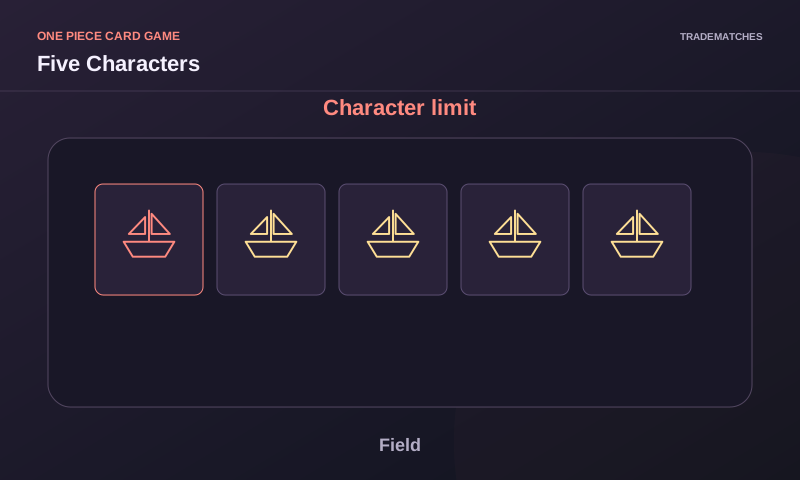
In One Piece Card Game, you can have up to five Characters in your Character zone. If you already have five and want to play another, the rules don’t require you to wait for one to be defeated: reveal the new card, send one of your existing five to trash, and then play the new Character in the empty space. That Character leaves via the limit rule, not because it took a K.O.
The limit applies to the Character zone
The rules distinguish the Leader zone, the Character zone, the Stage zone, the cost area, and the Life zone. The maximum of five refers only to Characters in each player’s Character zone. Your Leader does not consume one of those spaces. A Stage also does not occupy a Character slot, since it has its own zone with a different limit. DON!! in the cost area are resources, not additional Characters.
Both players can have their own five Characters at the same time; there is no shared pool of five cards. This matters when the table is full and it seems there is no room for more cards. To count correctly, only mark the cards classified as Characters in your own zone. Do not include hand cards you plan to play, cards in trash, or DON!! placed under a Character. This simple count avoids rejecting a legal play or accidentally keeping a sixth Character.
What the rules do when playing a sixth Character
If your zone already contains five Characters and you want to play a new one, first reveal the card you are playing. Then choose one of your existing Characters and send it to trash. Finally, play the new Character in the zone. This is the order specified by the full rules. You do not place the sixth Character in a temporary space to decide later which one to remove; the limit is resolved before the new Character is played.
Example: you have five Characters A, B, C, D, and E in your zone and a card F in your hand. You decide to play F and can satisfy the cost and applicable conditions. Reveal F, choose C among the existing Characters, send C to trash, and play F. At the end, you again have five: A, B, D, E, and F. If you don’t want to lose any of the five, keep F in your hand; the rules allow substitution, but do not require you to play the card.
It is not a Character K.O.
The Character sent to trash due to the five-character limit does not take a K.O. as a result of an attack. It leaves via a zone capacity rule. The full rules describe this exit as a rule processing that does not trigger effects. Therefore, you should not activate an [On K.O.] ability simply because the card ended up in trash. The existing TradeMatches post on K.O., trash, and returning to hand explains why the verb and reason for removal are important.
The difference can change a game. Suppose one of your five Characters has an ability that benefits you when it takes a K.O. in battle. Sending it to trash to make room for a sixth does not reproduce that condition. You also cannot announce that it was “defeated” to earn a Prize or an effect that depends on a K.O.; One Piece does not use Pokémon-style Prize cards. Every game and every rule word has its own meaning. Here, the precise procedure is to reveal, send a card to trash due to the limit, and then play the new one.
What happens to DON!! given to a Character that is sent to trash?
When a card with DON!! given to it moves to another zone, the DON!! that were under it return to the cost area and go rested. Therefore, if you choose to replace a Character that had two DON!! given to it, send that Character to trash and place the two DON!! in your cost area rested. They do not go to trash with the Character nor do they float as if still boosting it. The new Character does not automatically inherit those DON!!.
This detail influences your choice of which Character to remove. If one had DON!! that increased its power during your turn, removing it may leave you with less strength for a planned attack sequence. You might prefer to send to trash another without DON!! to preserve the current distribution. On the other hand, the new Character might provide more value than the old one, even if you lose that bonus. The important thing is to immediately reflect the return of the DON!! to the cost area, in the correct state, before continuing to play.
The new Character follows normal entry rules
Making space does not grant the new Character special permission to attack. Generally, a Character played that turn cannot attack during that same turn unless an ability like Rush or another instruction allows it. The new Character is placed active unless otherwise indicated. Its [On Play] text, if it exists, resolves according to its own conditions and game procedures; do not assume that replacing a Character alters everything printed on the new card.
Example of planning: you have five Characters, you remove one that wasn’t going to attack, and play another without Rush. Although the new one enters active, you cannot attack it simply because the previous one had been on the table for several turns. The time on the table does not transfer. If the new Character has Rush and its requirements are met, consult the specific Rush guide to determine what it can attack. Keeping the zone capacity and the eligibility to attack separate avoids an improper double advantage.
When does it make sense to use substitution?
A full table does not always mean an optimal one. Perhaps one of your five Characters has already done its job, has little power for current battles, or doesn’t contribute against your opponent’s strategy. Playing a new card can update your position without waiting for your opponent to eliminate an old one. It might also give you access to a new [On Play] effect or a different defense. But the new Character costs resources, and the replaced Character is definitively sent to trash unless effects later recover it.
Before deciding, compare the value you lose with the value you gain. Check if the old Character had DON!! given, a continuous ability, a Blocker function, or an attack threat for the next turn. Also verify how many active DON!! you will have after paying the cost of the new card. It’s not enough to think “this card has more printed power.” A substitution might open a better line or leave a defensive gap. The rule allows you to choose which of the five to remove: use that choice deliberately.
The selection does not depend on whether it is active or rested
The limit procedure speaks of choosing one of the existing Characters. It does not say the Character must be active or have attacked. Thus, a rested Character after attacking can be a candidate, but so can an active one that is no longer relevant. As always, a specific card may introduce additional conditions for a particular play; this explanation covers the general limit of the zone. Do not turn a common strategic preference into a restriction that the rules do not state.
A common decision is to remove a rested Character because it won’t attack again this turn. It may be reasonable, but check whether you needed its ability during your opponent’s turn or whether its presence conditioned another effect. An active Character might have greater defensive value, but it might also be the least useful in the group. The active or rested state is information for deciding, not a legal requirement for limit substitution.
Difference with losing a Character through battle or effect
If an attack results in a K.O. of one of your Characters, your zone drops from five to four, and you can play another following normal rules without needing to remove an additional one due to capacity. If an effect sends a Character to trash or returns it to hand, your zone may also have space available. The consequences of that removal depend on how it occurred and the card text. The special rule for playing a sixth applies only when you already have five and want to add a new one.
Therefore, when reading a sequence, pause on the verb. “K.O.” in battle, “trash” due to an effect, “return to hand,” and “send to trash due to limit” are not the same action, even though all free up space. Some abilities are triggered by a specific reason of removal. A phrase like “when this Character is K.O.” does not apply because you voluntarily replaced it. The blog post on K.O. and trash offers more examples of this distinction; here, the priority is not to forget the five-character limit when playing from hand.
How to keep the table clear
Place Characters in a row so they can be counted. Keep your Leader and Stage in separate positions, and place DON!! given under the card that boosts it. Before playing another Character, count out loud: “I have five.” If you want to substitute, reveal the new card, indicate which one leaves, move its DON!! given to the cost area rested, and then place the new one. This physical sequence matches the regulation order and allows your opponent to verify what happened.
If you accidentally end up with six Characters in the zone, do not continue playing for several turns waiting for one to disappear. Stop the game, identify when the illegal entry occurred, and consult how to correct it fairly. In an organized game, ask a judge for help, because the post-game state may include attacks and cards seen that prevent a simple, straightforward fix. Checking the limit at the moment of playing each Character is much easier than undoing a long chain of decisions.
Frequently Asked Questions
Can I play a sixth Character if I already have five?
Yes. Reveal the new one, send one of your existing five Characters to trash, and then play the new card following applicable rules.
Does the removed Character activate [On K.O.]?
No, because of that removal. It is sent to trash via the limit rule, not because it took a K.O. in battle.
Are the DON!! given to the removed Character lost?
No. When the card moves to another zone, the DON!! given return to the cost area rested according to the general rule.