Burn in Riftbound: burning cards and Burn Out
On this page
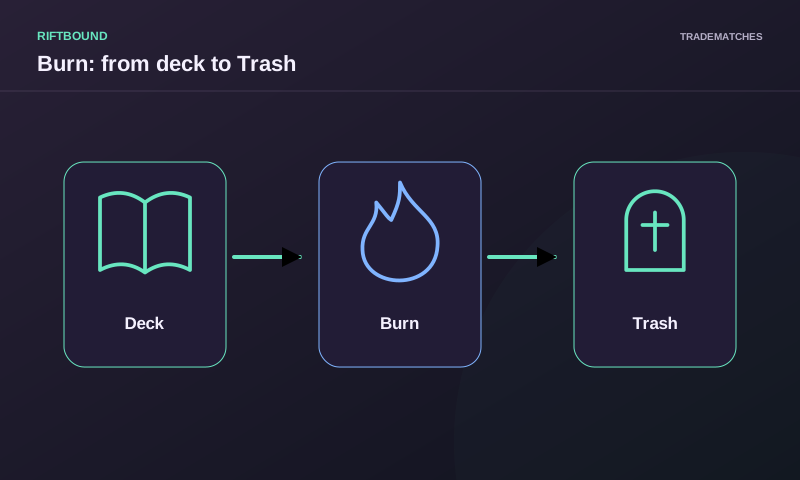
Burn moves cards from the top of your Main Deck to your Trash. Burn Out is a different procedure used when an attempted movement exceeds the cards remaining. An empty deck is not automatic defeat. This guide uses the Core Rules updated on 9 October 2026, checked on 13 October.
Source · Burn in Riftbound: burning cards and Burn Out.
Track the burned cards' destination
Identify the required number and move the relevant top cards to Trash. They do not go to hand or Banish. Nor does an effect's illustration let you freely select cards from anywhere in the deck.
Keep the zones distinct. Mixing Trash with cards temporarily set aside for inspection makes it harder to establish what was burned and what still belongs to the deck. Reliable counts matter most when few cards remain.
Separate a cost from a resolving instruction
The rules allow Burn through effects or costs. An effect burns as many as possible and uses Burn Out when it must continue beyond the available cards. Do not automatically transfer that explanation to every cost payment.
Before announcing a card or ability, identify payment separately from its resolution. If payment legality is uncertain, consult the cost rules and specific wording. “I can recycle afterward” does not independently establish that the activation is legal.
For practice, use two columns: announced cost and resolved effect. Put each Burn instruction in the correct column. This prevents repairing an unpaid cost with a rule you were reading about resolving effects.
Identify what actually causes Burn Out
The key is attempting to move more cards than are available. A movement that leaves exactly zero is not automatically Burn Out. A later instruction asking to move a card from that empty deck needs its own check.
Looking or revealing is also different from moving. An instruction to look at more cards than are available looks at what it can without causing Burn Out through that shortage. A large number beside the word “deck” is not enough to justify recycling.
| Practice situation | Question to ask |
|---|---|
| Two cards remain; an effect says Burn 2 | Does the required movement exceed availability? |
| Two remain; an effect says Burn 3 | How does Burn Out complete the instruction? |
| Empty deck; you must draw one | How is the missing card for this draw processed? |
| Look at five; only two remain | What may be inspected without treating it as a movement? |
These cases isolate quantity. Include other conditions and effects when reviewing an actual game.
Recycling and the point are one procedure
Burn Out performs as much as possible, recycles and randomises Trash into the Main Deck, chooses an opponent to gain one point, and completes the remaining movement. Shuffling without the point is incomplete.
With two cards and an effect requiring Burn 3, burn the two available, follow the procedure and complete the outstanding card. It is neither “burn only two” nor “ignore the instruction because the deck is small.”
The point can matter to victory. Keep the score visible before and after processing. With several opponents, follow the required choice rather than applying a two-player habit.
An empty Trash cannot create replacement cards
If nothing can be recycled, the deck may remain empty. The rules provide for repeated Burn Out and its scoring consequences. Do not declare an unresolvable loop or invent cards to complete the draw.
For that edge case, consult rule 432.3 in full. It includes victory conditions and special handling of points after the first Burn Out. It is not adequately described as “always lose a point” or “continue normally.” Preserve the game state to apply those rules.
Practise the difference between exact and excess movement
Prepare a three-card deck and identifiable Trash. Test an instruction moving exactly three and another requiring four. Record the initial count, completed movement, outstanding amount and score. Repeat with a look instruction to demonstrate the different event.
This also supports deck planning: consuming cards may change information and scoring rather than merely shrink a pile. Evaluate the actual sequence without assuming deck-out has the same meaning in Riftbound and One Piece.
Frequently asked questions
Does Burn mean Banish?
No. The ordinary destination for burning is Trash.
Is an empty deck automatic defeat?
Not through a generic empty-deck rule. Check the attempted movement, Burn Out and relevant victory conditions.
Does looking at more cards than remain cause Burn Out?
Not merely because of that shortage. The rules distinguish inspection from the movement requiring the procedure.