How to propose a card trade both collectors want
On this page
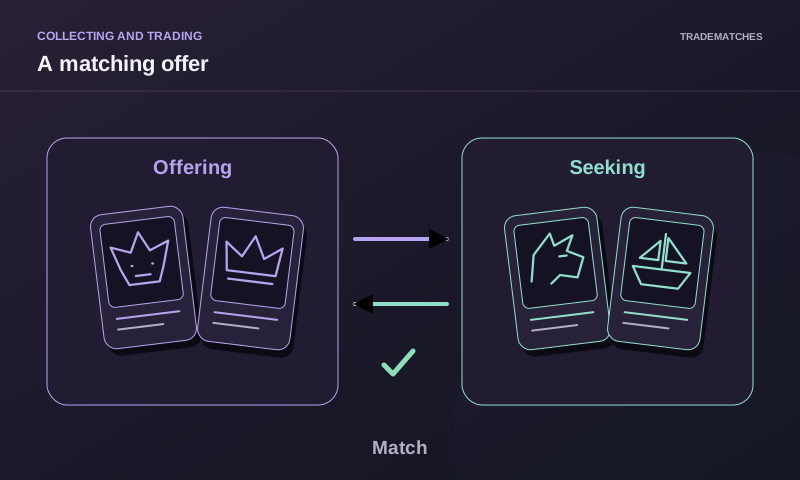
A trade both collectors want starts with a specific overlap, not a huge list or a value demand. Name the card you want, the copy you can offer, and what you need to confirm. Then leave room for the other person to say what matters to them and suggest an alternative.
Begin with a checkable overlap
Choose one or two cards that appear on both lists. Confirm that your copy remains available and check version, language, finish, and condition. Look at the other person’s entry too: the same name can mean another edition or variant. An offer based on identified copies avoids most early misunderstandings.
Do not use a permanent-collection card as bait. If you are still unsure whether you would move it, keep it offline until you decide. An offer is useful only when you can honour it, even if both people later decide it does not fit.
Write a message that can be answered
A simple structure works: interest, offer, check, and question. “I am interested in your Y from expansion Z. I have X available; it is version A and condition B. Is yours still available, and would you be interested in considering X for Y?” The other person can confirm, correct a detail, or say they prefer something else.
Avoid “what is it worth?” as a first message when you do not yet know which version the card is. Do not assume a match requires negotiation either. A respectful greeting and small proposal build more trust than trying to resolve a whole binder at once.
Explain priorities without pressure
It is fine to say a card is a priority or that you would trade another only for something specific. The difference lies in presenting it as information rather than an ultimatum. “I am saving X to complete this set; if Y does not work for you, we can look at these alternatives” informs and opens a real door.
Ask about the other person’s priority too. The card you saw may be available, but they may seek several copies, prefer another language, or have an advanced conversation already. Learning this early saves turns and may reveal another card that fits better.
Build the deal in layers
| Layer | What you confirm |
|---|---|
| Central cards | The copies that started the conversation. |
| Details | Version, language, finish, condition, and quantities. |
| Adjustments | Extra cards only if both people want to balance the group. |
| Meeting | Public place and time after the deal is clear. |
This prevents adding five extras before you know whether the main card works. If the central piece fails, the rest may make no sense. If it fits, both people can expand calmly and write an “I receive” and “I give” list.
Handle condition or version differences
If confirmation reveals a difference, do not hide it or solve it in a rush. Share a photo or describe the exact point. You can change the card, add another piece, adjust the group, or leave it for another time. None is a failure. The point was learning whether the trade was possible before meeting.
For sensitive offers, read the guide to information to include when offering a TCG card. The less interpretation remains, the easier it is for both people to answer honestly.
Close with a recap, not an assumption
When both accept the group, write it again in one or two sentences: “We confirm my X, version A, for your Y, version B, plus Z; we will inspect cards before handing them over.” Then agree on a public place. Bring only confirmed cards and let the other person examine them.
Update the list after trading or reserving a card. A proposal does not end with the message; it ends when the lists tell the truth again. For the full process, see turning a match into a trade.
Signs of a healthy proposal
- Both people can identify the cards without guessing.
- Questions about details come before time and place.
- A refusal or alternative is allowed without pressure.
- The final agreement fits in a clear recap.
Such a proposal cannot guarantee every deal closes, but it makes every conversation useful and respects both collectors’ time.
A short offer example
“Hi, I saw you are looking for card A from my list. I have the version from set B, in Spanish, with one light mark that I can photograph. I am interested in your card C from set D. Is it still available? If its condition fits, would you consider A for C? I also have two commons from D if you want to complete the trade.” The message does not assume identical copies or that the deal is closed.
If you receive a positive reply, do not add changes from memory. Repeat the details, ask about any difference, and only then reserve the copy. If the answer is no, thank them for being clear. Polite refusals also teach you what you seek and what you can offer next time.
Avoid these shortcuts
- Do not say a card is available if you first need to find it.
- Do not hide a mark hoping the meeting will resolve it.
- Do not propose a large lot to compensate for a card you do not want to give.
- Do not interpret no reply as acceptance.
An appealing proposal is more than a sum of prices. It considers the cards the other person wants, the real condition of both copies and how easily the agreement can become a meetup without surprises.
One main proposal and one alternative
You offer A and B for C, but the other person only wants A. Ask which specific card would complete the proposal rather than adding random extras. If unavailable, offer an explicit alternative such as A for D when D is also wanted. Each proposal needs version and condition checks.
Summarize the accepted lot and remove alternatives from the agreement. Follow “I accept the second option” with exact contents so both people bring the same expected cards. Interest in one card is not agreement to a whole lot.