Three-way card trades: how to set one up so nobody is left empty-handed
On this page
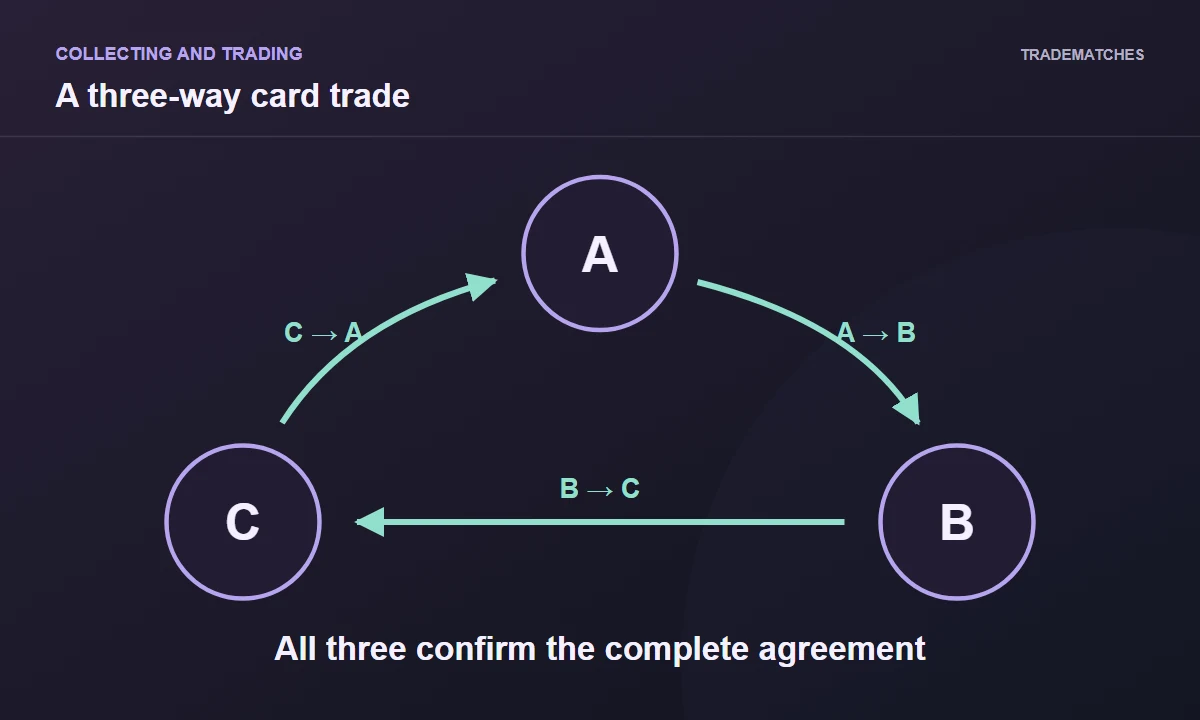
A three-way trade works when you do not match in pairs: Anna has what Ben wants, Ben has what Clara wants and Clara has what Anna wants. Each person gives one card and receives another, but the three handovers depend on each other, so they have to be closed together, ideally in person and at the same moment. If one of the three falls through, the other two have no obligation to go ahead.
It happens all the time in trading groups: someone wants your card, but you want nothing they offer. Instead of dropping the trade, sometimes all it takes is a third person to close the circle. This guide explains how to find them, how to check that the deal is fair for all three, and how to make the handovers so nobody gives their card without getting theirs.
When a three-way trade makes sense
Try the usual two-person trade first, which is simpler: we cover it in how to propose a trade both collectors want. A three-way trade is worth it when all of this is true:
- There is a card you really want and its owner wants nothing of yours.
- You have something a third person wants, and that person has what the owner of your card is looking for.
- All three cards are available right now: none is promised to someone else or for sale elsewhere.
- The three of you can meet in the same place, or at least know each other well enough to trust each other by post.
If closing the circle needs a fourth person, the complexity shoots up: four handovers that depend on each other and four people who have to line up. In that case it is usually better to split it into smaller trades or wait for another chance.
How to find the third person
The circle rarely appears by itself; you have to look for it. For that you need to know what the owner of the card you want is after. Ask directly: “What are you looking for right now?” With their list in hand, look for someone who has one of those cards and also wants something of yours.
The usual places are where it tends to show up: your city’s WhatsApp, Telegram or Discord group, the trading table at a shop league (we cover it in the trading table at events) or someone’s list you have seen in a trading app. In TradeMatches every user has a list of cards they want and another of cards they trade; if the owner of your card shares their list, you can check whether another collector who wants something of yours has one of their wanted cards. The app does not build circles by itself: you propose them by talking.
Map the three handovers before proposing anything
Write it with arrows going one way. “Anna, Ben and Clara trade” says nothing; what counts is who gives what to whom.
| Handover | Who gives | Who receives | Exact card |
|---|---|---|---|
| 1 | Anna | Ben | Name, set, number, language, finish and condition |
| 2 | Ben | Clara | Name, set, number, language, finish and condition |
| 3 | Clara | Anna | Name, set, number, language, finish and condition |
Each card has to leave one person and reach a different one; if in your map someone gives to and receives from the same person, it is not a circle but a two-way trade with an onlooker. And each card is identified in full, as in any trade: the same Pokémon can have many versions, and the difference between two languages or two finishes can be exactly what someone will not accept. If you are unsure about condition, compare it with our Mint, Near Mint and LP condition guide and ask for photos like the ones we describe in how to take photos for card trading.
Fair for each person, not just for the total
In a three-way trade the three cards do not need to be worth the same. What matters is that each person is happy with what they give and what they get. The total can balance and one of the three can still come out behind.
Check each leg separately with the trade calculator: what Anna gives against what Anna gets, and the same for Ben and Clara. An example with made-up values: if Anna gives a €30 card and gets a €25 one, Ben gives a €25 card and gets a €30 one, and Clara gives a €25 card and gets another €25 one, Ben comes out ahead and Anna behind. If Anna accepts because she needs that card for her binder, fine; if not, Ben can make up the difference with €5 or a small card. In our guide on telling whether a card trade is fair we explain which reference price to use.
If money is involved, write down who pays whom and how much. Do not assume “we’ll sort it out later”: with three people, that “later” is where misunderstandings start.
The message to propose it
The most practical option is a group chat with the three of you, so everyone reads the same thing. This message, adapted to your cards, is usually enough:
Hi both. I’d like to propose a three-way trade, since we don’t match in pairs:
1. I (Anna) give Ben [card, set, number, language, condition].
2. Ben gives Clara [card…].
3. Clara gives me [card…].
I’ll send photos of mine now. Shall we meet on Saturday at [shop] at 6 pm and do it all at once? If anyone can’t make it or changes their mind, we call it off for everyone, no problem.
The message makes three things clear: the three handovers, the place and time to do them together, and that if one person drops out it is cancelled for all. When each person answers “agreed” to that exact version, the deal is closed. If someone changes anything, for example a different version of a card or a payment, all three confirm again.
The handover: all three together, at the same moment
The safest way is to meet in a public, well-lit place, such as the shop where the league is played. There:
- Each person takes out the card they are giving, in its sleeve or toploader, and puts it on the table.
- Each person checks the card they will receive: that it is the agreed version and the condition matches the photos.
- If everything is right, you swap at once: each card goes to its new owner at the same moment.
- If a card is not as described, stop everything before anything moves. The three of you renegotiate or cancel.
What you must avoid is two people swapping and leaving while the third is still looking at their card. In a circle, nobody is done until all three are.
By post: only if you trust each other, with clear rules
Doing it by post is riskier, because there are three separate parcels and someone has to send without having received. If there is no other option, agree beforehand:
- that all three of you send on the same day, tracked, and share the receipt in the group;
- how each card is packed and who pays each postage (we explain it in how to ship trading cards safely, and the shipping calculator gives the cost);
- what happens if a parcel is lost or a card arrives in worse condition than described.
Tracking proves that something was sent, not that the agreed card was inside. That is why, by post, a three-way trade is only advisable between people with a track record: someone with several confirmed trades and good ratings, or someone you already know from the league. If that is not the case, set it up as two separate trades or meet in person. More ideas to avoid nasty surprises are in how to trade cards safely.
If someone pulls out
Before any card moves, pulling out is easy: the circle is cancelled and nothing happens. The problem is when someone pulls out halfway, for example by post, when one of the three cards has already arrived. For that case, agree from the start that whatever has been received goes back to whoever sent it, with postage paid by the person who pulls out.
If Clara pulls out, Anna and Ben have no obligation to keep trading with each other: the deal was for three. They can see whether a different trade interests them, but as a new agreement.
And how is it recorded in the app?
In TradeMatches, the “Did you make the trade?” prompt and the “Mark” button work between the two people in a chat, and they count towards both people’s reputation. In a three-way trade nobody gives to and receives from the same person, so there is no two-person trade to mark. The right thing is to coordinate it by chat and not mark trades that did not happen as such: each user’s reputation is only useful if it reflects real deals.
Frequently asked questions
Do the three cards have to be worth the same?
No. It is enough for each person to be happy with what they give and what they get. Check it leg by leg with the calculator and, if someone comes out behind and does not accept it, make up the difference with money or another card.
Who sends first if we do it by post?
The fairest option is for all three of you to send on the same day and share the receipt. If you do not know each other, better not to do it by post: split the trade or meet in person.
Can it be done with four or more people?
It can, but every extra person is one more handover that can fail and leave someone without their card. With four or more, it is usually more sensible to split it into two- or three-person trades.
What do I do if, when we meet, a card is not as in the photos?
Stop before swapping anything. If the difference is small, you can adjust with a payment; if not, it is cancelled for all three.
Sources and checks
Editorial procedure based on common practice in trading groups and on our guides on proposals, value, shipping and safe trading. The TradeMatches “Mark” button is described as it works in the app in November 2026 (see how to propose a trade). The amounts in the example are made up to illustrate the calculation; they are not market prices.